
• Home
  • Latest
  • Fortune 500
  • Finance
  • Tech
  • Leadership
  • Lifestyle
  • Rankings
  • Multimedia

Trendingnow

1

The U.S. spent $30 billion to ditch textbooks for laptops and tablets: The result is the first generation less cognitively capable than their parents

2

Current price of oil as of July 13, 2026

3

Trump embraces Australian retirement system backed by Larry Fink

1

The U.S. spent $30 billion to ditch textbooks for laptops and tablets: The result is the first generation less cognitively capable than their parents

2

Current price of oil as of July 13, 2026

3

Trump embraces Australian retirement system backed by Larry Fink
Leadershipfertility
Asia

East Asian societies have the world’s lowest birth rates—and are learning that ‘throwing a bit of money’ at the problem isn’t solving anything

By
Lionel Lim
Lionel Lim
Asia Reporter
Down Arrow Button Icon
By
Lionel Lim
Lionel Lim
Asia Reporter
Down Arrow Button Icon
March 12, 2024, 5:00 PM ET
Children visit a Chinese New Year decoration at the Flower Dome of Gardens by the Bay in Singapore.
Children visit a Chinese New Year decoration at the Flower Dome of Gardens by the Bay in Singapore.Then Chih Wey—Xinhua/Getty Images
Add Fortune on Google for similar content.

Governments across Asia—in Singapore and Beijing, Tokyo and Seoul—are facing a crisis: plummeting birth rates. 

For several decades now, people in East Asian economies have had fewer and fewer children. Last year, South Korea beat its own record for having the world’s lowest birth rate, reporting 0.72 births per woman for 2023, down from 0.78 in 2022. Singapore reported 0.97 births per woman, the first time the rate has fallen below one. Japan has one of the world’s oldest populations, with a median age of 49.5. Hong Kong, Taiwan, and mainland China are all reporting falling birth rates as well. 

All of these economies have fertility rates far below 2.1, the “replacement rate” which allows for a stable population. They haven’t reported a rate above 2.1 for years, if not decades. 

A low birth rate leads to a shrinking population, and a smaller workforce to produce the goods and services that lead to economic growth. Slower economic activity results in drops in fiscal revenue, giving fewer resources to a government that now needs to provide welfare for a growing elderly population. 

Academics often point to the cost of childcare, poor work-life balance, a lack of support for new parents (particularly mothers), and the stresses of modern society as reasons for falling birth rates. “In all the cosmopolitan cities, the fertility rate tends to be much lower because a lot of choices. The higher the development, [the] more urbanized, the more education that women get, the smaller the family size,” Paul Cheung, director of the Asia Competitiveness Institute at the Lee Kuan Yew School of Public Policy, says. 
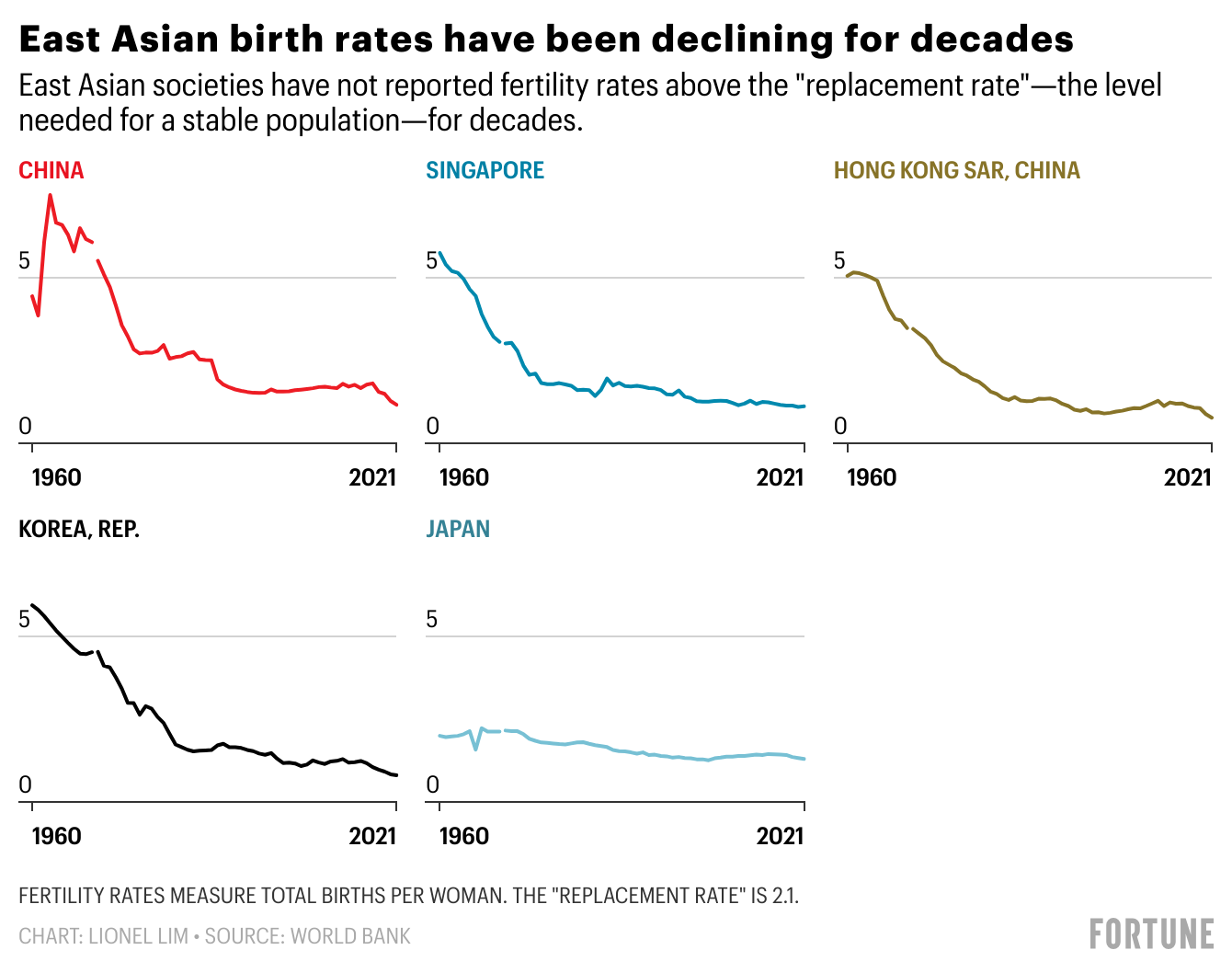
Faced with this looming crisis, Asian governments have turned to a straightforward solution: Give prospective parents money if they have kids. The connection is simple to understand. If a major barrier to having children is the cost of childcare, then alleviating that cost with extra cash should change someone’s economic calculus. 

Except it hasn’t worked. Even Singapore, which Cheung suggests had a “way more generous [policy] than all the Asian countries,” has not succeeded in arresting the decline in fertility. 

“Low birth rates are a reflection of big institutional, cultural, structural problems,” said Stuart Gietel-Basten, a professor of social science and public policy at the Hong Kong University of Science and Technology. “Throwing a bit of money at it is not going to fix it.”

What are governments currently doing to stop falling birth rates?

Cheung, before his stint as an academic, was the director of Singapore’s population planning unit between 1987 and 1994. He helped start Singapore’s pronatalist policy, offering a relatively more generous set of incentives to encourage more births. The government even organized events to help single Singaporeans to meet. 

Singapore’s government officially inaugurated its baby bonus scheme in 2001. The most current payout is 11,000 Singapore dollars ($8,263) for each first and second child and 13,000 Singapore dollars ($9,766) each for the third and subsequent child. 

Other governments are also trying to dole out incentives. Japan increased its lump-sum childbirth benefit to 500,000 yen ($3,400) in April last year. Starting this October, the government will also offer 15,000 yen ($102) a month to households after the birth of a first and second child until the age of 2, and then continue providing 10,000 yen ($68) till high school. The government will offer more money to families with more than two children. 

South Korea has increased its incentives, too. The government gives 2 million Korean won ($1,519) to parents when a baby is born, which increases to 3 million won ($2,279) for the second child. Parents will also get an allowance of up to 18 million won ($13,674) in total for the first two years of the child’s life.

Hong Kong, on the other hand, is offering a one-off cash allowance of HKD 20,000 ($2,557). 

Singapore’s birth rate is declining at a slower pace than that of other Asian economies, only falling below 1.0 last year. (By comparison, Hong Kong’s fertility rate first fell below 1.0 in 2001, and hovered around that level before falling back below 1.0 again in 2020). Singapore’s population is still stable, but that may be the result of the country’s more liberal immigration policies, compared with Japan and South Korea.

All these measures seem to do is “delay the population decline a little into the future,” Cheung says. 

‘I feel sorry for the government’

The scary thought for demographers may now be that there’s no easy fix for falling fertility. Even Nordic countries, whose more generous pro-child policies were credited with keeping birth rates relatively high, have seen fertility collapse after the COVID pandemic. 

“The strange thing with fertility is nobody really knows what’s going on,” Anna Rotkirch, a research director at Family Federation of Finland’s Population Research Institute, told the Financial Times earlier this year. The demographer, who advised former prime minister Sanna Marin on population policy, now thinks fertility decline is “not primarily driven by economics or family policies. It’s something cultural, psychological, biological, cognitive.”

Research from Singapore implies that a drop in fertility could be the result of something more fundamental in how people live in modern society. Tan Poh Lin, a research fellow at the National University of Singapore, found rates of sexual intercourse among married heterosexual couples in Singapore—a “high-stress” society—were lower than the ideal frequency to conceive, generally considered to be five or six times every 30 days. There were “strong negative effects of both stress and fatigue, especially during weekdays,” she writes. Other surveys in Japan and South Korea report similar findings. 

But if monetary incentives or better social welfare programs and work-life balance, as in northern European countries, are not getting birth rates to what they should be, then what can Asian economies do to raise them?

“I feel sorry for the government because it’s the only organization or institution doing anything,” Gietel-Basten said. “In reality, everyone has to take responsibility for this. Companies have to change their attitude and recognize children are a social good, and that parents should be supported and not penalized,” he says. “But that costs money.”

Some companies in Asia have made high-profile offers to support employees having children. In February, a South Korean construction firm, the Booyoung Group, offered a bonus worth 100 million won ($76,000) to encourage female employees to have children. China’s Trip.com Group also offered some employees a 10,000 yuan ($1,391) annual bonus for households for every child under the age of five.  

But there’s no quick solution, says Gietel-Basten. Instead, he suggests that governments focus on other economic well-being issues—like youth unemployment, job security, and a sense that work is being valued—and hope that indirectly improves fertility rates.

In mainland China, “there’s not even jobs for the young people who are alive now,” he says. “Why do you want to have more children?” 

About the Author
By Lionel LimAsia Reporter
LinkedIn icon

Lionel Lim is a Singapore-based reporter covering the Asia-Pacific region.

See full bioRight Arrow Button Icon
Add Fortune on Google for similar content.

Latest in Leadership

Finance
Lorem ipsum dolor sit amet, consectetur adipiscing elit, sed do eiusmod tempor incididunt ut labore et dolore magna aliqua. Ut enim ad minim veniam
By Fortune Editors
October 20, 2025
Finance
Lorem ipsum dolor sit amet, consectetur adipiscing elit, sed do eiusmod tempor incididunt ut labore et dolore magna aliqua. Ut enim ad minim veniam
By Fortune Editors
October 20, 2025
Finance
Lorem ipsum dolor sit amet, consectetur adipiscing elit, sed do eiusmod tempor incididunt ut labore et dolore magna aliqua. Ut enim ad minim veniam
By Fortune Editors
October 20, 2025
Finance
Lorem ipsum dolor sit amet, consectetur adipiscing elit, sed do eiusmod tempor incididunt ut labore et dolore magna aliqua. Ut enim ad minim veniam
By Fortune Editors
October 20, 2025
Finance
Lorem ipsum dolor sit amet, consectetur adipiscing elit, sed do eiusmod tempor incididunt ut labore et dolore magna aliqua. Ut enim ad minim veniam
By Fortune Editors
October 20, 2025
Finance
Lorem ipsum dolor sit amet, consectetur adipiscing elit, sed do eiusmod tempor incididunt ut labore et dolore magna aliqua. Ut enim ad minim veniam
By Fortune Editors
October 20, 2025

Most Popular

Finance
Lorem ipsum dolor sit amet, consectetur adipiscing elit, sed do eiusmod tempor incididunt ut labore et dolore magna aliqua. Ut enim ad minim veniam
By Fortune Editors
October 20, 2025
Finance
Lorem ipsum dolor sit amet, consectetur adipiscing elit, sed do eiusmod tempor incididunt ut labore et dolore magna aliqua. Ut enim ad minim veniam
By Fortune Editors
October 20, 2025
Finance
Lorem ipsum dolor sit amet, consectetur adipiscing elit, sed do eiusmod tempor incididunt ut labore et dolore magna aliqua. Ut enim ad minim veniam
By Fortune Editors
October 20, 2025
Finance
Lorem ipsum dolor sit amet, consectetur adipiscing elit, sed do eiusmod tempor incididunt ut labore et dolore magna aliqua. Ut enim ad minim veniam
By Fortune Editors
October 20, 2025
Finance
Lorem ipsum dolor sit amet, consectetur adipiscing elit, sed do eiusmod tempor incididunt ut labore et dolore magna aliqua. Ut enim ad minim veniam
By Fortune Editors
October 20, 2025
Finance
Lorem ipsum dolor sit amet, consectetur adipiscing elit, sed do eiusmod tempor incididunt ut labore et dolore magna aliqua. Ut enim ad minim veniam
By Fortune Editors
October 20, 2025
Fortune Secondary Logo
Rankings
  • 100 Best Companies
  • Fortune 500
  • Global 500
  • Fortune 500 Europe
  • Most Powerful Women
  • World's Most Admired Companies
  • See All Rankings
  • Lists Calendar
Sections
  • Finance
  • Fortune Crypto
  • Features
  • Leadership
  • Health
  • Commentary
  • Success
  • Retail
  • Mpw
  • Tech
  • Lifestyle
  • CEO Initiative
  • Asia
  • Politics
  • Conferences
  • Europe
  • Newsletters
  • Personal Finance
  • Environment
  • Magazine
  • Education
Customer Support
  • Frequently Asked Questions
  • Customer Service Portal
  • Privacy Policy
  • Terms Of Use
  • Single Issues For Purchase
  • International Print
Commercial Services
  • Advertising
  • Fortune Brand Studio
  • Fortune Analytics
  • Fortune Conferences
  • Business Development
  • Group Subscriptions
About Us
  • About Us
  • Press Center
  • Work At Fortune
  • Terms And Conditions
  • Site Map
  • About Us
  • Press Center
  • Work At Fortune
  • Terms And Conditions
  • Site Map
  • Facebook icon
  • Twitter icon
  • LinkedIn icon
  • Instagram icon
  • Pinterest icon

Latest in Leadership

Elon Musk and Sam Altman are accusing each other of scamming investors as SpaceX and OpenAI jockey to lead AI revolution
AIBillionaires
Elon Musk and Sam Altman are accusing each other of scamming investors as SpaceX and OpenAI jockey to lead AI revolution
By Marco Quiroz-GutierrezJuly 13, 2026
7 hours ago
na
North AmericaEducation
‘We devalued the trades’: A Native American graduation miracle that isn’t what it seems
By Savannah Peters and The Associated PressJuly 13, 2026
10 hours ago
t
North AmericaElections
Trump floats Lindsey Graham’s sister as interim Senate replacement; Scott Bessent reportedly fields calls
By Meg Kinnard and The Associated PressJuly 13, 2026
10 hours ago
Jason Kidd, COO of Chipotle
SuccessThe Promotion Playbook
Chipotle’s COO takes employees to dinner every week to spot his next leaders—here are the 4 traits he’s seeking
By Emma BurleighJuly 13, 2026
11 hours ago
b
CommentaryWorld Cup
Columbia Business School professors: What the Balogun red card can teach us about AI and judgment
By Oded Netzer, Christopher Frank and Paul MagnoneJuly 13, 2026
11 hours ago
Trump stunned by sudden death of rival turned ally Lindsey Graham: ‘He was like a member of the family’
PoliticsAmerican Politics
Trump stunned by sudden death of rival turned ally Lindsey Graham: ‘He was like a member of the family’
By The Associated PressJuly 13, 2026
13 hours ago

Most Popular

The U.S. spent $30 billion to ditch textbooks for laptops and tablets: The result is the first generation less cognitively capable than their parents
Innovation
The U.S. spent $30 billion to ditch textbooks for laptops and tablets: The result is the first generation less cognitively capable than their parents
By Sasha RogelbergJuly 12, 2026
2 days ago
Current price of oil as of July 13, 2026
Personal Finance
Current price of oil as of July 13, 2026
By Joseph HostetlerJuly 13, 2026
17 hours ago
Trump embraces Australian retirement system backed by Larry Fink
Personal Finance
Trump embraces Australian retirement system backed by Larry Fink
By Brianna Sosa and BloombergJuly 12, 2026
1 day ago
Peter Thiel and other tech billionaires are publicly shielding their children from the products that made them rich
Big Tech
Peter Thiel and other tech billionaires are publicly shielding their children from the products that made them rich
By Marco Quiroz-GutierrezJuly 12, 2026
2 days ago
Current price of silver as of Monday, July 13, 2026
Personal Finance
Current price of silver as of Monday, July 13, 2026
By Joseph HostetlerJuly 13, 2026
17 hours ago
Ex-PepsiCo CEO Indra Nooyi worked from midnight until 5 a.m. as a receptionist to pay for her Yale degree—and she says ‘respect went up’ because of it
Success
Ex-PepsiCo CEO Indra Nooyi worked from midnight until 5 a.m. as a receptionist to pay for her Yale degree—and she says ‘respect went up’ because of it
By Preston ForeJuly 6, 2026
7 days ago

© 2026 Fortune Media IP Limited. All Rights Reserved. Use of this site constitutes acceptance of our Terms of Use and Privacy Policy | CA Notice at Collection and Privacy Notice | Do Not Sell/Share My Personal Information
FORTUNE is a trademark of Fortune Media IP Limited, registered in the U.S. and other countries. FORTUNE may receive compensation for some links to products and services on this website. Offers may be subject to change without notice.