The Biden administration is on a mission to stop China from catching up to the cutting-edge chips designed by the U.S. and its allies. But even Washington is realizing that the giants making the world’s most advanced semiconductors can’t abandon China entirely.
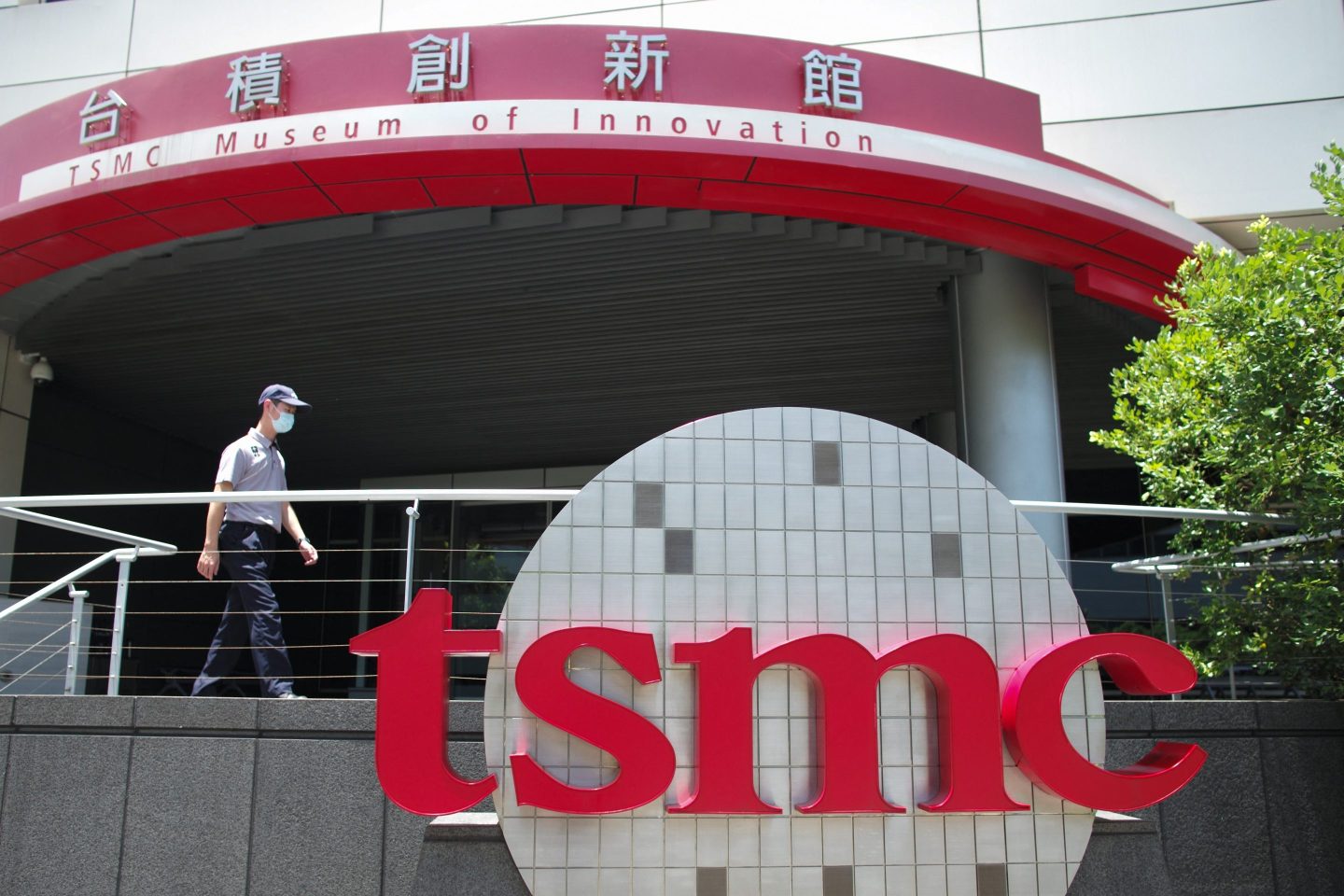
On Friday, leading chip manufacturer Taiwan Semiconductor Manufacturing Co. (TSMC) received a U.S. waiver to continue supplying chip equipment to the firm’s Chinese factories.
Taiwan’s Economic Affairs Minister, Wang Mei-hua, first announced the waiver in a briefing with reporters on Friday, though did not give further details including its duration.
TSMC said in a statement to Fortune that it was now authorized to “continue operating in Nanjing,” and that it expects to receive permanent authorization for its operations in China soon.
The waiver is “good news” for TSMC, as it allows the company to continue with expansion plans for its 28-nanometer chips in Nanjing, China, says Lucy Chen, vice president of Isaiah Research, a Taiwan-based tech-research firm. (TSMC started making 28 nm chips in 2011.)
TSMC was the third chipmaker to get a waiver last week. Washington granted an indefinite waiver last Monday to Samsung and SK Hynix to keep supplying equipment to their Chinese chip plants. “The most significant trade issues of our semiconductor companies have been resolved,” Choi Sang-mok, South Korea’s senior presidential secretary for economic affairs, said during a media briefing.
In a statement, SK Hynix said that it welcomed the U.S. decision, and that it would “contribute to the stabilization of the global semiconductor supply chain.” Samsung did not immediately respond to a request for comment.
TSMC has fabs in Nanjing and Shanghai, yet neither make the company’s most advanced chips. Samsung has two facilities in China, while SK Hynix operates multiple plants in the country.
The fact that TSMC and others are not producing their cutting-edge chips in China could explain Washington’s decision to extend the waiver. “The aim of [Biden’s chip controls] was to limit tech transfer to China, not to cause issues for foreign firms with operations in China,” Chris Miller, author of Chip War: The Fight for the World’s Most Critical Technology, says.
And Washington may want to keep some foreign firms in China’s chip supply chain. If TSMC, Samsung, and others were blocked by U.S. sanctions, “demand would shift to local Chinese memory factories or semiconductor foundries,” Chen says. That would give the U.S. “less control and visibility” over China’s chip industry, she notes.
The chip industry contributes greatly to both South Korea’s and Taiwan’s economies. Chips made up almost 20% of South Korea’s exports last year, according to Invest Korea, a South Korean trade promotion group. Semiconductor exports represented almost a quarter of Taiwan’s GDP in 2022, ING estimated in April.
Are chip companies unhappy with Biden’s chip controls?
Firms like TSMC and Samsung keep most of their high-tech production in their home countries, instead relying on their China operations for more mature chips.
Chinese firms, on the other hand, are not yet able to make these cutting-edge chips—and current U.S. policy is to stop them from catching up. Last October, the Biden administration enacted sweeping export control measures to restrict China’s ability to procure or produce these advanced chips, and the equipment used to make them. Washington also persuaded Japan and the Netherlands—two U.S. allies and home to important producers of chipmaking equipment—to similarly restrict exports to China.
Companies that accept U.S. government subsidies from last year’s CHIPS and Science Act are also constrained from expanding their manufacturing presence in “countries of concern,” including China, for at least a decade.
Foreign companies and governments have bristled at some of the CHIPS Act provisions, which also include requirements to use union labor, provide affordable childcare, and share excessive profits with the U.S. government. In March, TSMC chairman Mark Liu complained that conditions on U.S. government funds for its planned Arizona factory were “unacceptable.” South Korean officials have also expressed confusion at the expansive nature of U.S. chip subsidies.
Semiconductor companies are warning that expanded chip controls will encourage China to invest in its own domestic alternatives. Peter Wennink, CEO of ASML, warned in January that U.S. rules would encourage Chinese firms to make their own version of ASML’s lithography equipment used to create the most advanced chips.
Chinese firms may already have made progress in circumventing U.S. rules. Chinese device maker Huawei Technologies recently released a new smartphone with a processor just a few years behind the cutting-edge, despite sanctions barring the company from purchasing said chips. (Though some experts question whether Huawei and its suppliers can continue to make the chip cheaply and at scale.)
The Biden administration is preparing to update its chip export rules, with changes potentially being announced as early as this week, reports Reuters. The updates target a loophole used by Nvidia and other chipmakers to continue selling advanced AI processors to China.
Last year, Nvidia developed a less sophisticated version of its premium A100 GPU for the Chinese market that complied with U.S. rules. Intel has also developed a U.S.-compliant, China-focused processor, according to the South China Morning Post.
In August, Nvidia said that up to a quarter of its data center revenue came from China, and the chipmaker warned of a “permanent loss” of opportunities for the U.S. chip industry if expanded rules came into effect.