This fall, Senate Majority Leader Chuck Schumer is slated to lead a bipartisan group of U.S. senators to China. The planned trip, like other recent visits to China by high-ranking U.S. officials, is aimed at improving the relationship between the U.S. and China.
Such efforts to ameliorate U.S.-China diplomatic relations come amid growing tensions between the two economic giants. They also run parallel to U.S. efforts to strengthen ties with Indo-Pacific countries to limit Beijing’s influence.
Take, for example, President Joe Biden’s September 2023 trips to India for the G20 summit and to Vietnam, where U.S. competition with China was a focus of Biden’s discussions. While he was in Asia, Biden made several agreements in science, technology and supply chain security designed to bolster U.S. relations with India and Vietnam.
“I don’t want to contain China,” the president told reporters in Hanoi on Sept. 10, 2023, shortly after meeting with Vietnam’s communist party leader.
U.S. Reps. Mike Gallagher and Raja Krishnamoorthi echoed similar sentiments during an event held by the Council on Foreign Relations think tank in New York City the following day.
But even if the U.S.’s stated goal isn’t to limit China’s global influence, its recent agreements with India, Vietnam and other countries may do exactly that.
What US-led G20 deals mean for China
The U.S. is actively looking for ways to blunt one of China’s best tools of influence: international loans.
During the G20 summit Sept. 9-10 in New Delhi, the U.S. pledged to help reform the World Bank and International Monetary Fund to make them more flexible in lending to developing countries to finance renewable energy, climate mitigation and critical infrastructure projects. Biden committed the first $25 billion to make those reforms possible and secured additional financial pledges from other countries totaling $200 billion in new funding for developing countries over the next decade.
The U.S. also signed onto a deal with the European Union, Saudi Arabia and India that will help connect the Middle East, Europe and Asia through rails and ports. Characterizing it as a “real big deal,” Biden said the rail and ports agreement would help stabilize and integrate the Middle East.
These plans are aimed at providing an alternative to China’s Belt and Road Initiative. Commonly referred to as BRI, the initiative is China’s international infrastructure loan program. Over the past decade, Chinese government agencies, banks and businesses have loaned more than $1 trillion abroad, and 60% of the recipient countries are now in debt to these Chinese entities. The U.S. and other countries have long criticized BRI as “debt trap diplomacy”. One study suggests that the trillions of dollars in infrastructure loans to countries by the government and quasi-government bodies in China typically lead to debt problems that the borrowing countries can’t manage.
As China grapples with a slowing domestic economy, it may become more difficult for Chinese entities to keep shelling out funding for big-ticket overseas projects. The new U.S.-led agreements that come out of the G20 could fill the coming gap.
These G20 plans complement existing Western economic initiatives to compete with the BRI, including U.S. trade pacts for the Indo-Pacific region and the Americas, the EU’s Global Gateway and the G7’s Partnership for Global Infrastructure and Investment.
What the US’s agreement with India means for China
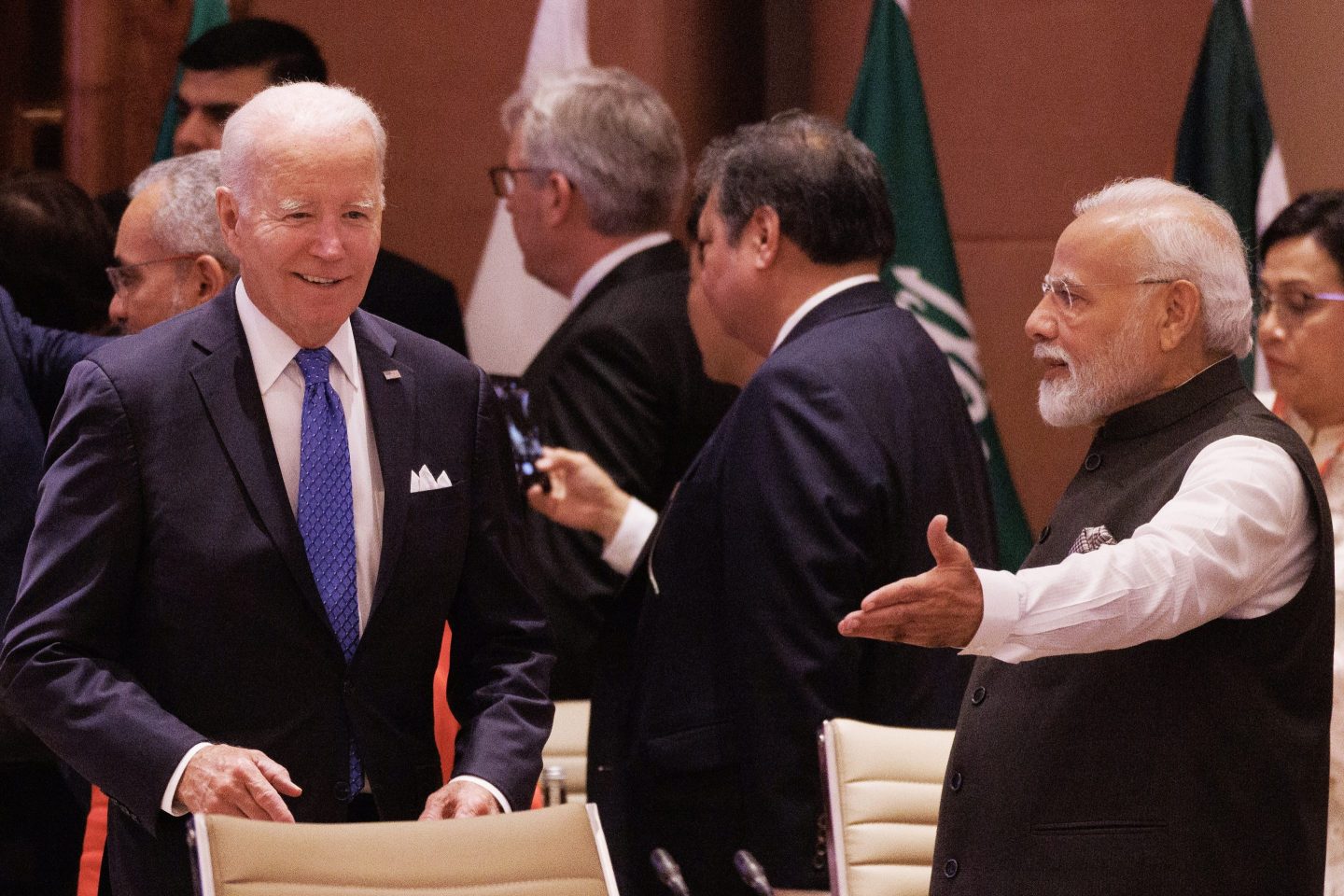
In their meeting on the sidelines of the G20, Biden and Indian Prime Minister Narendra Modi agreed to deepen collaboration on developing critical and emerging technology, such as quantum computing and space exploration, as well as 5G and 6G telecommunications. This will help India compete with China in the technological arena in the Indo-Pacific.
The telecommunications portion of a joint statement by Biden and Modi specifically mentions the U.S.’s Rip and Replace program. It is about helping smaller telecommunications companies rip out technology from Chinese companies like Huawei or ZTE and replace them with network equipment from the West that will protect users’ data.
The U.S. has banned Huawei and ZTE equipment from its telecommunication networks, deeming those companies national security risks. The U.S. and India’s pledge to support Rip and Replace is a direct counter to China’s telecommunication technology expansion.
What the US’s agreement with Vietnam means for China
In Vietnam, Biden elevated the bilateral relationship to a comprehensive strategic partnership, expanding the relationship in everything from economics to education to technology in a country that has long counted China as its top trading partner.
The enhanced partnership includes the U.S. providing $2 million to fund teaching labs and training courses for semiconductor assembly, testing and packaging.
One company in Arizona and two in California have already pledged to set up semiconductor factories and design centers in Vietnam, and the U.S. artificial intelligence company Nvidia will help Vietnam integrate AI into automotive and health care systems.
All these investments will make Vietnam even more attractive to U.S. and Western companies that don’t want China to be the sole source of their supply chain. As Vietnam becomes a key player in the semiconductor market, it will shrink China’s share of the market as well as its regional technological advantage.
The U.S. also agreed to provide nearly $9 million to help Vietnam patrol the waters around its borders and beef up port facility security, as well as boost efforts to fight illegal, unregulated and unreported fishing, or IUUF. While not explicitly mentioned, China is the target of this initiative; China and Vietnam continue to be at loggerheads over disputed claims over the Spratly Islands in the South China Sea, and Chinese industrial fishing vessels are the largest culprits of IUUF around the globe.
By inking these agreements at the G20 in India and in Vietnam, the U.S. broadened its circle of allies and partners in the Indo-Pacific that can help counterbalance China.
Along with similar diplomatic accomplishments by Vice President Kamala Harris at the recent ASEAN summit in Indonesia; security partnerships like AUKUS, between the U.S., Australia and the UK, and the Quad, between the U.S., India, Australia and Japan; increased military sales and training to Taiwan; and the recent Camp David meeting Biden held with Japan and South Korea, the U.S. is building partnerships all across Asia.
These actions are aimed at restraining China’s political, economic and military might, even if U.S. leaders don’t explicitly say that is their intention. Regardless of rhetoric, actions speak louder than words.
Leland Lazarus is Associate Director of National Security, Florida International University.
This article is republished from The Conversation under a Creative Commons license. Read the original article.