• Home
  • Latest
  • Fortune 500
  • Finance
  • Tech
  • Leadership
  • Lifestyle
  • Rankings
  • Multimedia
CommentaryTech

Steve Jobs thought devices would become ‘a bicycle for the mind’—but their effect on our brains is similar to that of smoking and junk food

By
Royce Branning
Royce Branning
Down Arrow Button Icon
By
Royce Branning
Royce Branning
Down Arrow Button Icon
November 28, 2024, 5:17 AM ET
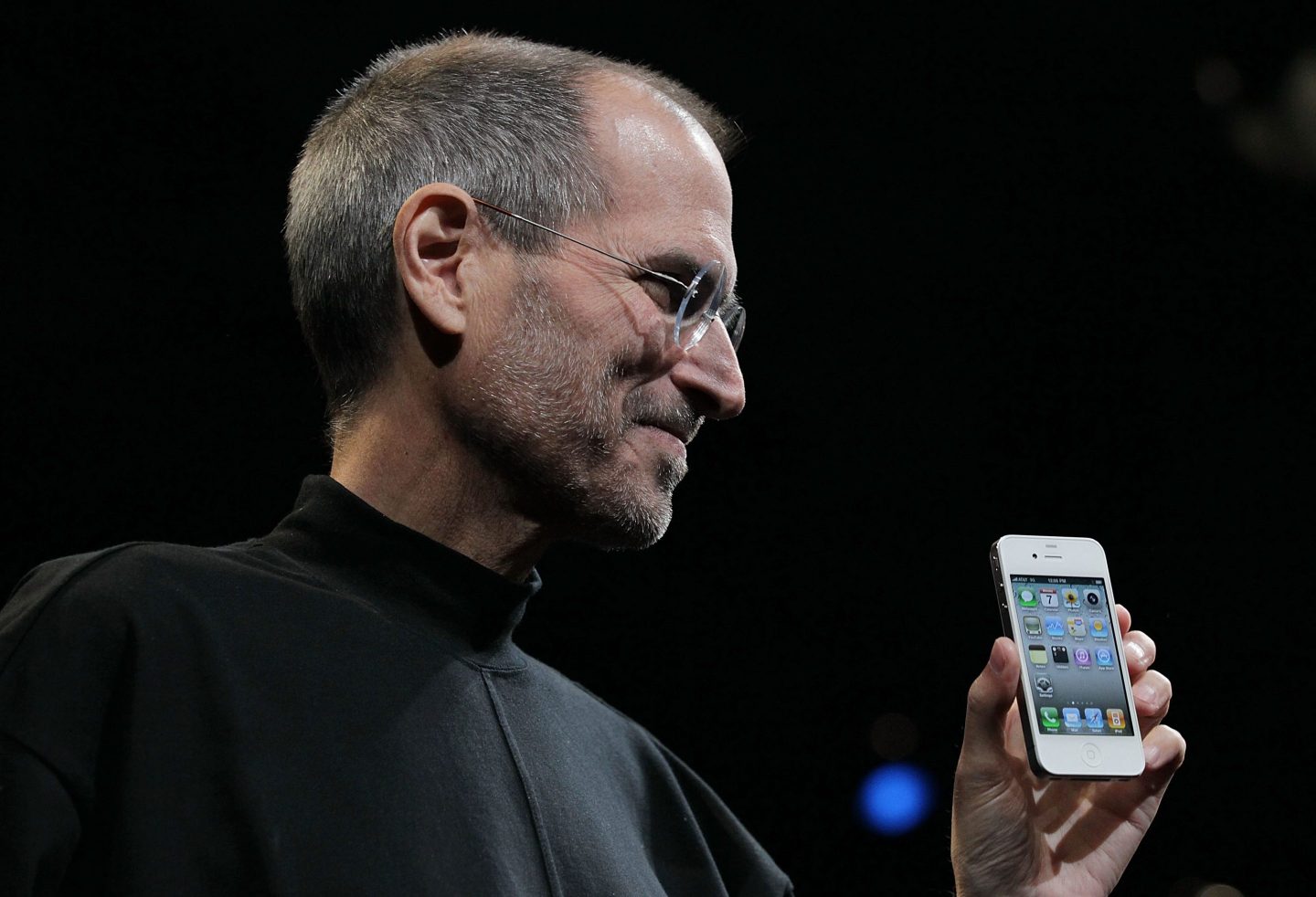
Steve Jobs holding an iPhone.
pple CEO Steve Jobs holds the new iPhone 4 after he delivered the opening keynote address at the 2010 Apple World Wide Developers conference June 7, 2010 in San Francisco, California. Photo by Justin Sullivan/Getty Images

It’s been 33 years since Steve Jobs talked about the personal computer becoming a bicycle for the mind. In those years, the advent of the smartphone and the mass adoption of social media have turned those bicycles into runaway trains. Americans spend more than four hours a day on their smartphones–and more than half say they are addicted to their device. In May 2023, the surgeon general issued a warning about the concerning effects of social media on youth mental health.

Recommended Video

Most of us probably do not require such statistics to identify the phenomenon: Our own habits reveal that the state of digital well-being today is a grim one. There is a fundamental misalignment between human attention and intention when engaging with screens.

However, there is cause for optimism. Behavioral misalignment is not a new problem. As urbanist and philosopher Paul Virilio once said, “When we invented the ship, we invented the shipwreck.” And we have an unfair advantage–the very digital nature of the problem.

The universal challenge of behavioral misalignment

Behavioral misalignment–where our actions diverge from our best interests–is a recurring challenge across various domains. From the obesity epidemic spurred on by the mass introduction of processed foods to habitual overspending that came on the heels of access to easy credit, history is replete with examples of such misalignments. However, the trend in U.S. cigarette smoking provides a promising example of progress in society-wide issues of behavioral misalignment. In recent decades, the number of U.S. smokers has declined from around 40% to around 12%.

The downward pressure on this graph was driven by a number of efforts in concert:

  • Public awareness and education: The Surgeon General’s 1964 report on smoking’s health risks sparked widespread awareness, leading to extensive public health campaigns.
  • Policy interventions: Comprehensive legislation, including smoking bans in public places and stringent advertising restrictions, significantly curtailed smoking habits.
  • Cultural shifts: Over time, smoking became socially less acceptable, aided by changing media portrayals and public opinion.
  • Technological advances: The introduction of nicotine replacement therapies and digital tools for cessation support played a key role in helping smokers overcome addiction.

These same forces are coming into play in the fight for digital well-being. Increased awareness is giving rise to greater research attention that is deepening our collective understanding of the issue. The time has come for a parallel solution: technology that is just as good at protecting our attention as social media platforms are at exploiting it.

Our biggest advantage in fighting digital addiction

Imagine if you could write code that would make a donut increasingly heavier as you got closer to your calorie limit for the day. This is what we can do with devices. It is entirely possible to encode the practices of responsible device engagement in the same environment as the “addiction” itself.

We can deploy environment change at scale with no marginal cost to anyone who wants to change their behavior. That is an unfair advantage that smoking cessation, or health food campaigns have never had.

This is all the more important as the next generation of digital interfaces–Large Language Models, virtual reality, and Brain-Computer Interfaces–promise to bring the digital world closer to us than ever before with their promise to reduce the latency of communication between humans and devices. Our impulse to access the internet is now a reach to the pocket away, in the future, it will be one thought away.

As the space between stimulus and response shrinks the opportunity for platforms to exploit human attention will continue, unless we increase our own capacity to articulate and implement our attention preferences in these environments.

To do this effectively we focus on four key tenets:

  1. High-tech solutions for a high-tech problem: The best technology of our day must be leveraged as a force to protect attention rather than exploit it.
  2. Enabling moderation rather than abstinence: An outright war to remove technology from our lives is futile and unhelpful. We can develop integrated methods of moderating engagement that keep the tool while removing the distraction.
  3. Benefit-based content consumption: Up-skilling is a fundamentally different digital engagement practice than doom scrolling. We track the difference and let it inform ongoing protocols.
  4. Replacement behaviors (The “Better Yes”): In the same moment that you are enticed to scroll, we remind you of the more important things in life; like hiking in the mountains, deep conversations, and pursuing your life’s work.

As Austrian psychiatrist and Holocaust survivor Victor Frankl put it, “Between stimulus and response, there is a space. In that space lies our freedom and our power to choose our response. In our response lies our growth and our happiness.” It is time for technologists to help humanity reclaim that space.

Royce Branning is the co-founder and CEO of Clearspace.

More must-read commentary published by Fortune:

  • Trump’s plans to kill EV subsidies signal a new era of climate tech Darwinism.
  • Here’s the formula companies like Netflix, Uber, and Spotify will use to capture $2T in growth over the next decade.
  • I would have stumbled without these 4 qualities: How women can defy gravity in their careers.

The opinions expressed in Fortune.com commentary pieces are solely the views of their authors and do not necessarily reflect the opinions and beliefs of Fortune.

A version of this story originally published on Fortune.com on January 9, 2024.

Join us at the Fortune Workplace Innovation Summit May 19–20, 2026, in Atlanta. The next era of workplace innovation is here—and the old playbook is being rewritten. At this exclusive, high-energy event, the world’s most innovative leaders will convene to explore how AI, humanity, and strategy converge to redefine, again, the future of work. Register now.
About the Author
By Royce Branning
See full bioRight Arrow Button Icon

Latest in Commentary

Finance
Lorem ipsum dolor sit amet, consectetur adipiscing elit, sed do eiusmod tempor incididunt ut labore et dolore magna aliqua. Ut enim ad minim veniam
By Fortune Editors
October 20, 2025
Finance
Lorem ipsum dolor sit amet, consectetur adipiscing elit, sed do eiusmod tempor incididunt ut labore et dolore magna aliqua. Ut enim ad minim veniam
By Fortune Editors
October 20, 2025
Finance
Lorem ipsum dolor sit amet, consectetur adipiscing elit, sed do eiusmod tempor incididunt ut labore et dolore magna aliqua. Ut enim ad minim veniam
By Fortune Editors
October 20, 2025
Finance
Lorem ipsum dolor sit amet, consectetur adipiscing elit, sed do eiusmod tempor incididunt ut labore et dolore magna aliqua. Ut enim ad minim veniam
By Fortune Editors
October 20, 2025
Finance
Lorem ipsum dolor sit amet, consectetur adipiscing elit, sed do eiusmod tempor incididunt ut labore et dolore magna aliqua. Ut enim ad minim veniam
By Fortune Editors
October 20, 2025
Finance
Lorem ipsum dolor sit amet, consectetur adipiscing elit, sed do eiusmod tempor incididunt ut labore et dolore magna aliqua. Ut enim ad minim veniam
By Fortune Editors
October 20, 2025

Most Popular

Finance
Lorem ipsum dolor sit amet, consectetur adipiscing elit, sed do eiusmod tempor incididunt ut labore et dolore magna aliqua. Ut enim ad minim veniam
By Fortune Editors
October 20, 2025
Finance
Lorem ipsum dolor sit amet, consectetur adipiscing elit, sed do eiusmod tempor incididunt ut labore et dolore magna aliqua. Ut enim ad minim veniam
By Fortune Editors
October 20, 2025
Finance
Lorem ipsum dolor sit amet, consectetur adipiscing elit, sed do eiusmod tempor incididunt ut labore et dolore magna aliqua. Ut enim ad minim veniam
By Fortune Editors
October 20, 2025
Finance
Lorem ipsum dolor sit amet, consectetur adipiscing elit, sed do eiusmod tempor incididunt ut labore et dolore magna aliqua. Ut enim ad minim veniam
By Fortune Editors
October 20, 2025
Finance
Lorem ipsum dolor sit amet, consectetur adipiscing elit, sed do eiusmod tempor incididunt ut labore et dolore magna aliqua. Ut enim ad minim veniam
By Fortune Editors
October 20, 2025
Finance
Lorem ipsum dolor sit amet, consectetur adipiscing elit, sed do eiusmod tempor incididunt ut labore et dolore magna aliqua. Ut enim ad minim veniam
By Fortune Editors
October 20, 2025
Rankings
  • 100 Best Companies
  • Fortune 500
  • Global 500
  • Fortune 500 Europe
  • Most Powerful Women
  • Future 50
  • World’s Most Admired Companies
  • See All Rankings
Sections
  • Finance
  • Leadership
  • Success
  • Tech
  • Asia
  • Europe
  • Environment
  • Fortune Crypto
  • Health
  • Retail
  • Lifestyle
  • Politics
  • Newsletters
  • Magazine
  • Features
  • Commentary
  • Mpw
  • CEO Initiative
  • Conferences
  • Personal Finance
  • Education
Customer Support
  • Frequently Asked Questions
  • Customer Service Portal
  • Privacy Policy
  • Terms Of Use
  • Single Issues For Purchase
  • International Print
Commercial Services
  • Advertising
  • Fortune Brand Studio
  • Fortune Analytics
  • Fortune Conferences
  • Business Development
About Us
  • About Us
  • Editorial Calendar
  • Press Center
  • Work At Fortune
  • Diversity And Inclusion
  • Terms And Conditions
  • Site Map
  • Facebook icon
  • Twitter icon
  • LinkedIn icon
  • Instagram icon
  • Pinterest icon

Most Popular

placeholder alt text
Big Tech
The Chan Zuckerberg Initiative cut 70 jobs as the Meta CEO’s philanthropy goes all in on mission to 'cure or prevent all disease'
By Sydney LakeFebruary 1, 2026
22 hours ago
placeholder alt text
Economy
'I just don't have a good feeling about this': Top economist Claudia Sahm says the economy quietly shifted and everyone's now looking at the wrong alarm
By Eleanor PringleJanuary 31, 2026
2 days ago
placeholder alt text
Future of Work
Ford CEO has 5,000 open mechanic jobs with up to 6-figure salaries from the shortage of manually skilled workers: 'We are in trouble in our country'
By Marco Quiroz-GutierrezJanuary 31, 2026
2 days ago
placeholder alt text
Success
U.S. Olympic gold medalist went from $200,000-a-year sponsorship at 20 years old to $12-an-hour internship by 30
By Orianna Rosa RoyleFebruary 1, 2026
16 hours ago
placeholder alt text
Success
Ryan Serhant starts work at 4:30 a.m.—he says most people don’t achieve their dreams because ‘what they really want is just to be lazy’
By Preston ForeJanuary 31, 2026
2 days ago
placeholder alt text
Energy
Top energy expert says probability the U.S. will attack Iran soon is 75% as risk of major disruption to oil supply is priced in — 'this one is real'
By Jason MaFebruary 1, 2026
11 hours ago

© 2026 Fortune Media IP Limited. All Rights Reserved. Use of this site constitutes acceptance of our Terms of Use and Privacy Policy | CA Notice at Collection and Privacy Notice | Do Not Sell/Share My Personal Information
FORTUNE is a trademark of Fortune Media IP Limited, registered in the U.S. and other countries. FORTUNE may receive compensation for some links to products and services on this website. Offers may be subject to change without notice.


Latest in Commentary

dewar
CommentaryLeadership
The AI adoption story is haunted by fear as today’s efficiency programs look like tomorrow’s job cuts. Leaders need to win workers’ trust
By Carolyn DewarFebruary 1, 2026
19 hours ago
CommentaryLeadership
How Trump helped Harvard: 5 ‘Crimson’ leadership lessons on standing up to bullies 
By Jeffrey Sonnenfeld, Steven Tian and Stephen HenriquesFebruary 1, 2026
22 hours ago
Economygeopolitics
BRICS could become a new pillar of global governance—if its rapid growth doesn’t erode its newfound clout
By Brian WongJanuary 31, 2026
1 day ago
taxi
Commentaryregulation
America’s AI regulatory patchwork is crushing startups and helping China
By James Richardson and Eric TanenblattJanuary 30, 2026
3 days ago
EuropeLetter from London
Struggling to remain relevant during the AI watercooler chat? Talk about your latest ‘new collar’ hire
By Kamal AhmedJanuary 29, 2026
4 days ago
trump
Commentaryregulation
Trump is driving capital out of capitalism
By Andrew BeharJanuary 29, 2026
4 days ago