

Rocket launches. Vegan values. Dogecoin. What do they have in common? There is now a dedicated exchange-traded fund for each of them. They are among the record 1,180 or so ETFs that have launched in the U.S. this year alone—a number that already exceeds the total for 2025.
This proliferation is a far cry from 1993, when the first U.S. ETF, known as SPY, launched as a simple way to own the entire S&P 500 in a product that was cheaper to buy and more tax-efficient than a mutual fund. Today, there are more than 5,200 U.S. ETFs holding $16.3 trillion in assets, according to the Investment Company Institute.
Itzhak Ben-David, a finance professor at Ohio State University who studies ETFs, compares the market to a grocery store’s yogurt aisle. “Why do you need so many yogurts?” he asks. There’s little money in plain yogurt, since every brand sells it, so companies compete on toppings that appeal to narrower groups of shoppers and cost more, he adds.
Broad index funds are the plain yogurt: They’re cheap and nearly identical from issuer to issuer. To stand out, issuers roll out funds built on whatever investors happen to be excited about at the time, and charge higher fees. The question is whether investors are getting anything extra for their money.
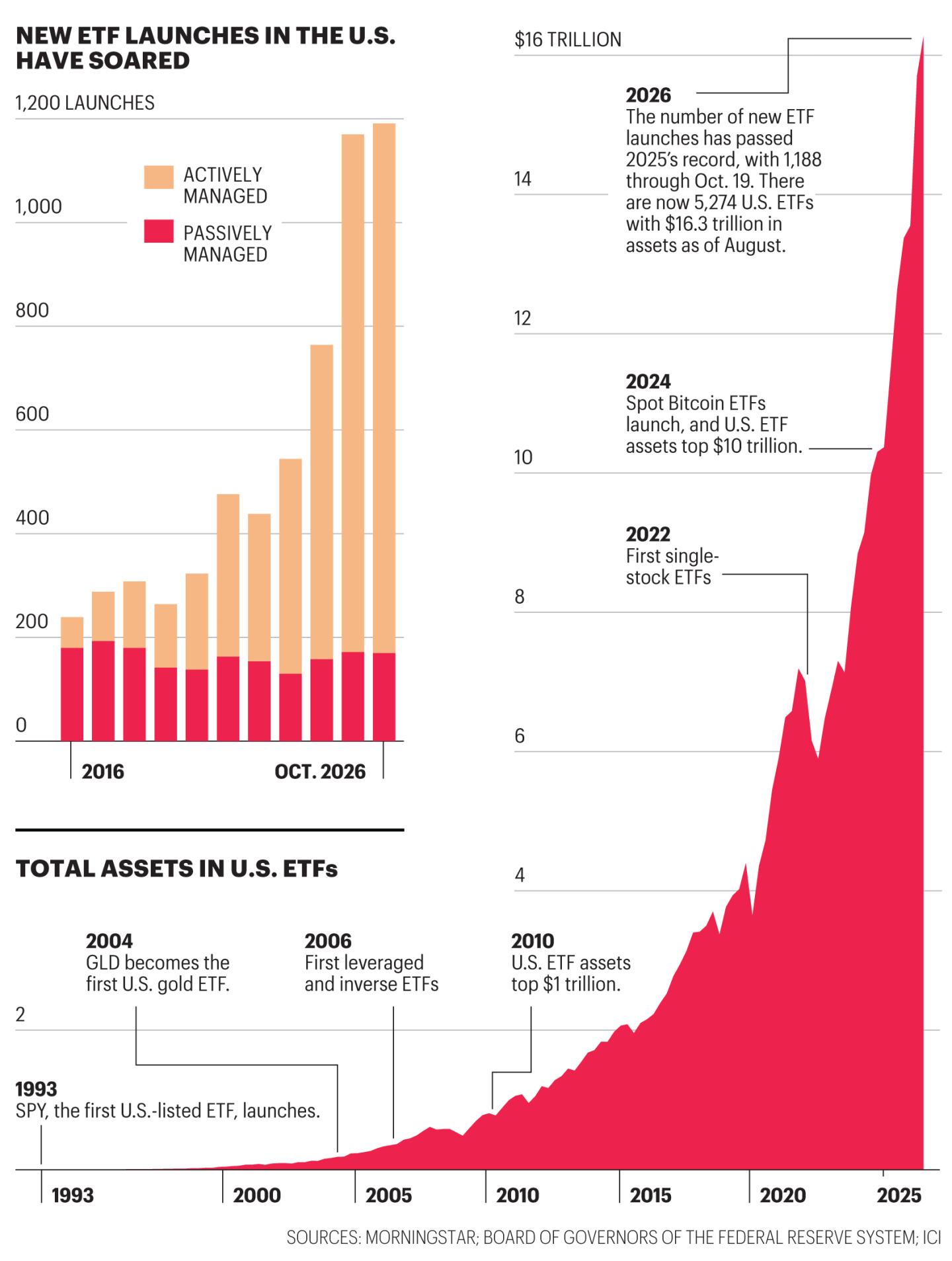
The broader explosion in ETF offerings stems in part from a 2019 SEC rule that streamlined the approval process for most new funds. Meanwhile, AI has reduced many of the remaining hurdles to launching a new fund, says Jeff Weniger, chief investment strategist at Corgi Invest, a new player in the ETF space that popped up last December, and now offers more than 220 ETF products. Those include ETFs focused on popular consumer products, including coffee and energy drinks, and ones dedicated to buzzy industries like space and semiconductors. “There’s a little bit of a land grab going on,” observes Aniket Ullal of CFRA Research, adding that the first fund to succeed in a category often ends up dominating it.
To be sure, the bulk of ETF investors’ money is still going to the plainest funds with the lowest price. That includes Vanguard’s S&P 500 ETF (VOO), which collects a paltry 0.03% management fee, and this June became the first ETF to reach $1 trillion in assets.
The temptation among some investors to pursue more exotic offerings is understandable, since a handful have posted eye-popping returns. Those include the Breakwave Tanker Shipping ETF (BWET), which bets on the future cost of transporting crude oil by sea, and was on track for a 3,411% year-to-date return as of mid-November. Other high-performers include ZCSH, which tracks the cryptocurrency Zcash, and the AI-focused AIS; as of mid-November, those ETFs had posted respective year-to-date gains of roughly 239% and 33%. By comparison, VOO was up about 9%.
But while buying the right specialized ETF at the right time can deliver a big jolt to your portfolio, Ben-David warns specialized funds often disappoint in the long run. His research has found that, through 2019, such funds trailed the market by more than 30% over five years. Issuers tend to launch funds around themes that have already run up, so investors buy near the peak: “It’s like buying insurance after the flood.”
Beyond active funds, two other kinds of products are driving the ETF boom, Ullal says. About 30% of this year’s launches are leveraged or inverse funds, many of which make amplified bets on a single stock. Another fast-growing group uses options to shape returns, such as buffer funds, which cap an investor’s gains in exchange for some protection against losses.
Many of these funds won’t last. This year alone, 259 ETFs have already closed after trading on average for only 1.3 years, according to CFRA. Just a few years ago, the average duration of a shuttered ETF was 2.5 to three years. “There’s very much a Silicon Valley fail-quick kind of mentality that’s come into the industry,” Ullal notes.
This article appears in the December 2026/January 2027 issue of Fortune with the headline “There are ETFs for almost everything. That doesn’t mean they belong in your portfolio.“