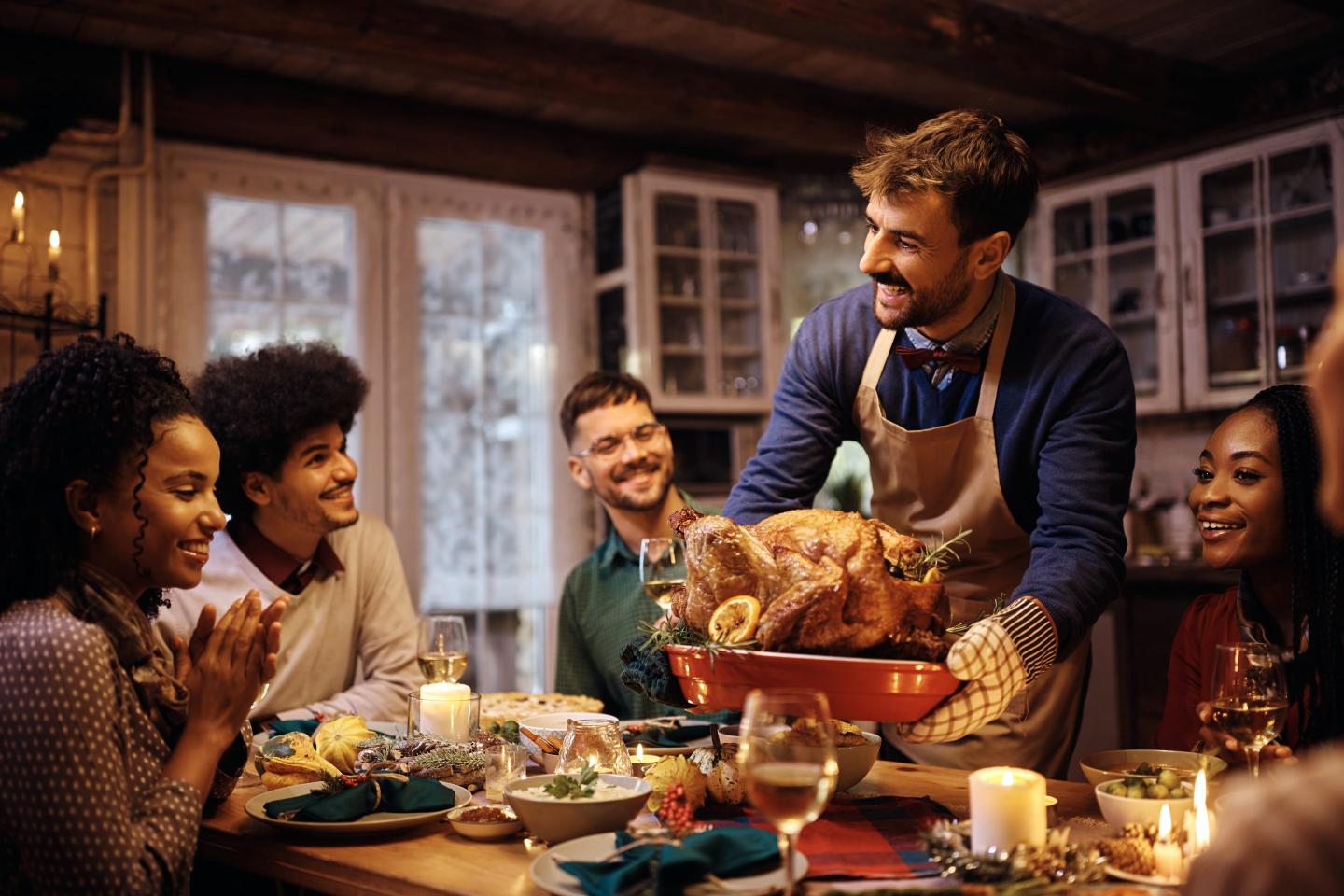
One of my favorite holiday memories is of a Friendsgiving my husband and I hosted in our tiny two-bedroom house in Atlanta. We didn’t have a dining room. We barely had space to fit a foldout table in the living room. I think one of us sat in an office chair because we didn’t have enough seating. But having our friends gather in our home, no matter how small, made me feel proud.
I planned the menu for weeks, grocery shopped far in advance, and spent days prepping. As a young adult hosting my first holiday, I felt a lot of pressure to get it right. But I also reveled in the freedom to make it what I envisioned. I deviated from traditional family dishes, made impressive magazine cover desserts, and bought linens and dishware to create a tablescape.
While I knew I couldn’t recreate the grandness of my grandma’s family gatherings, I wanted this one to reflect my taste.
My inclination to host a gathering that honors the holiday while making the presentation my own may feel familiar. While many people grow up with certain familial obligations around holidays, entrance into adulthood may grant you some liberties from them, or at least some agency on whether to participate in the production of the event.
If you’re looking to assert that agency, Friendsgiving is the perfect holiday.
As a food studies scholar researching how food traditions are shared and preserved, I am interested in the idea of a holiday that centers friends over kin. I think this is why Friendsgiving, a term that emerged only in the early 2000s even though people had been participating in the concept long before, endures as a sanctified gathering.
Not your grandma’s dinner party
Modern American dinner parties still have roots in the Victorian era, when a formal gathering was steeped in etiquette and tradition to demonstrate class and propriety and to create social connections to improve one’s status. And while some form of social connection is still likely the main reason for gatherings today, dinner parties can take on many forms, often with the intention of sharing the labor involved.
In her book “Eating Together: Food, Friendship, and Inequality,” sociologist Alice P. Julier interviewed people of various classes, ages, incomes, sexualities, ethnicities and genders about mainly non-kin gatherings around food. Different forms of gathering require different amounts of labor – sometimes paid labor – and the labor between couples and friends is often negotiated. But she found that women often still took on the bulk of the work in the planning, communication or execution of an event.
Within these circumstances, the women often navigated this labor in ways that worked for them or fit their ideas around work, femininity and hospitality. As a young woman, I wanted to emulate the holidays I had experienced, hosted by my mother and grandmother, and was happy to take on the labor involved. However, the beauty of a Friendsgiving is that this labor can be shared and divided in accordance with capacity.
Friends who don’t enjoy cooking can provide drinks or snacks, while those – like me – who spend their days scouring food magazines can try out a new recipe. The key is being honest about the time and money you are able to spend and fit the gathering to the needs of the group.
No one’s 20s and 30s look the same. You might be saving for a mortgage or just struggling to pay rent. You could be swiping dating apps or trying to understand childcare. No matter your current challenges, our Quarter Life series has articles to share in the group chat, or just to remind you that you’re not alone.
Read more from Quarter Life:
What’s your apocalypse skill? Finding a future‑proof hobby can bring fulfilment today
Five ways to enjoy fashion as a hobby without indulging in overconsumption
The ick: The psychology of why a romantic partner can suddenly repulse you
A holiday that expands boundaries
Today, Thanksgiving is typically viewed as a family holiday.
For some, this may be the gathering that provides the warm, fuzzy holiday feeling many search for. But for others, family holidays are stressful.
A 2023 survey of 2,061 adults found that 9 in 10 people reported experiencing stress around money, lost loved ones, familial conflict or other expectations during the holidays.
As Friendsgiving isn’t an established holiday, participation is difficult to capture. But of 1,000 people surveyed in 2024, 20% said they planned to celebrate Friendsgiving.
A Friendsgiving is the opposite of established kin-keeping traditions. It gives the opportunity to gather with found family, and while the reason for gathering is established, the form is malleable.
Many people choose a potluck-style as a way of sharing the burden for what can be a labor-intensive meal. Others choose to do away entirely with what is considered the “traditional” meal and showcase foods from their own culture or a cuisine they enjoy.
As a parody of a holiday, Friendsgiving gives participants permission to make the holiday their own and be as playful as they wish. So, if I burn my miso butter corn casserole, no one will be disappointed, because they’ve never tasted it before anyway.
How to host a successful Friendsgiving
While playing with form and bucking traditional structure can be rewarding, there are some things you may want to keep in mind to have a successful Friendsgiving.
In her book “The Art of Gathering: How We Meet and Why it Matters,” author Priya Parker advises anyone planning a gathering to be specific about purpose. This will help decide the form of the event and whom to invite.
Is this a casual gathering with friends? Is fellowship or food more important? Are you hoping to try a recipe your family would never approve? Be specific about your own expectations before you start planning.
The Emily Post Institute, which promotes etiquette and offers resources for a variety of social situations, recommends being flexible with the menu. This is especially important for a potluck-style gathering. As a host, you may want to assign dishes to guests to ensure a balanced meal without eight desserts. If you have the gumption, however, you can throw caution to the wind and see what happens.
It is also important to keep dietary restrictions in mind to make sure everyone feels included and has something to eat.
Make a plan for heating or reheating. The oven is prime real estate during Thanksgiving. You may want to tell guests to bring their dish already cooked to avoid playing oven Tetris.
Finally, tell guests to bring Tupperware. There will be leftovers, and I have found that nothing is better than creating a second plate to take home and heat up the next day.
Alice P. Julier, a professor of food studies at Chatham University, assisted with the writing of this article.
Kirsten Chervenak, Research Associate for the Center for Regional Agriculture, Food, and Transformation, Chatham University
This article is republished from The Conversation under a Creative Commons license. Read the original article.
