
Busy people living busy lives want simple solutions to their everyday problems. This isn’t laziness; it’s a fundamental part of how our brains work. Psychology explains that our desire for simplicity is a deeply ingrained survival strategy. The human brain is an energy-intensive organ and is constantly working to conserve energy. One way it does this is by steering us away from tasks that require a high cognitive load – that is, too much mental effort.
When we’re faced with complexity – too many options, unclear instructions or unfamiliar journeys – our working memory becomes overwhelmed, decision-making slows and stress hormones like cortisol can rise. This doesn’t feel good. We get the urge to abandon the task and find an easier path. In contrast, simplicity feels like a reward. When something is easy to understand or use, our brains release a small dose of dopamine, giving us that sense of mastery, a feeling that we’ve cracked the puzzle. It feels good. We’re wired to seek that feeling, and we’ll come back for more.
This attraction to simplicity frequently operates on a subconscious level. Often, we’re not aware of it. But the yearning for simplicity is there, all the time, in the background, influencing every decision we make and every product we buy. In geometry class, we’re taught that the shortest distance between two points is a straight line – but, of course, a toddler taking their first steps recognizes this intuitively. And when faced with a choice, our brains automatically favour the most direct route. It follows that the products we choose are a reflection of this principle – we gravitate towards those that offer the shortest, simplest journey to fulfilling our needs.
This innate preference for simplicity directly ties into the ‘Jobs to Be Done’ theory, a framework proposed by Harvard Business School professor Clayton Christensen. The theory suggests that customers don’t simply purchase products; they ‘hire’ them to perform a specific job. If the product does the job well – with efficiency and with minimal friction – the customer will continue to ‘employ’ it. If it doesn’t, they’ll ‘fire’ it and look for an alternative.
A classic example is the hammer: No one actually wants to own a hammer; they want a way to put a nail in their wall. Their ‘good’ hammer enables its owner to bang a nail into the wall securely, quickly and with a minimum of fuss. In today’s busy world, our overworked brains ‘hire’ the products and services that help us complete everyday tasks with the least amount of effort. They will let us follow the news, keep in touch, listen to music, take photos and track our workouts to an acceptable standard in the most straightforward way.
Ultimately, we just want to get our stuff done without working too hard. Where possible, we want to save money, of course, but just as importantly, we want to save time, thought and effort. We live in an age dominated by products and services that understand this deep-seated need and can deliver a simple life. Here are some examples:
- ChatGPT conquered the world with its gloriously simple invitation to ‘Ask anything’.
- Lego is the world’s simplest toy (and a simple choice of gift for a child).
- Amazon will deliver virtually any product you can dream of, to your door, in under twenty-four hours – with one simple click.
- Zara brings the very latest fashions to a shop close to your home.
- Instagram and Facebook make it simple to keep in touch with loved ones and the kid who once borrowed your ruler in Year 9.
- TikTok takes established social media and makes it even simpler: open the app, watch a video, swipe for the next one.
- Uber makes getting from A to B as simple as tapping a button.
- Tinder offers a simple way to meet people and find ‘love’. The swipe-based interface boils the process down to a quick, engaging game.
- YouTube offers a simple gateway to the world’s library of video content (and makes it simple for influencers to build an audience).
While lots of companies have achieved success by delivering one breakthrough in simplicity, Apple has built an empire by continually repeating the trick. Every successful Apple product is built on the same promise to make life simpler:
- iPhone packs all of the functionality you need daily – a phone, camera, music player, web browser and a universe of apps – into a single, easily transportable device.
- Apple Intelligence simplifies and speeds up many of our day-to-day tasks.
- AirPods pair seamlessly and remove the tangle and frustration of traditional wired earbuds.
- AirTags make it easy to locate lost items or runaway dogs.
- Time Machine simplifies the tedious chore of backing up your Mac.
- Apple Pay removes the need to carry a physical wallet (and the worry of losing cards).
- Face ID simplifies unlocking your iPhone and entering passwords.
- Apple Watch offers the most essential iPhone features in a form that you don’t have to take in and out of your pocket and is simpler to take on a run.
- iPad offers a simpler interface to almost all the functionality of a laptop.
- Shazam immediately identifies music that’s playing around you.
- FaceTime makes it simple to have rich, personal interactions at a distance.
- App Store makes it simple to add functionality to your devices.
Every successful Apple product is a promise to make your life simpler – which then delivers on that promise in a simple way. It’s not just what the product does, it’s the way it does it. From the moment that you unbox a new Apple product, your experience has been painstakingly choreographed to ensure that ‘it just works’. iPhones and iPads are so intuitive to use that they are shipped with no instruction manuals and can (for better or worse) be operated by pre-schoolers.
Apple products, by and large, continue to deliver simplicity throughout their working life. They lead industry rankings for build quality and reliability, which means customers spend fewer frustrated hours trying to get them fixed. If something does go wrong, technical support is easily accessible (everyone knows the location of the nearest Apple Store). Regular software updates ensure your devices run smoothly.
Apple doesn’t sell ‘labour-saving gadgets’ that end up unused and unloved; it sells genuine, life-simplifying solutions.
In Silicon Valley, innovations are often categorized as either ‘vitamins’ or ‘painkillers’. Vitamins are new features that broaden the users’ experience. Painkillers, on the other hand, solve real, recurring problems. Vitamins might be a new photo filter in a social media app or a voice assistant’s ability to tell jokes. Painkillers might be longer battery life or privacy safeguards. While vitamins give you something new, painkillers make your existing life simpler. Most new products offer a mix of both. We’re attracted to the vitamins and they often steal the headlines. But when looking for the next big thing, Silicon Valley’s venture capitalists almost always bet on the painkillers. Vitamins are ‘nice to have’ but are nonessential and easy to ignore. Painkillers solve real problems. A good number of people in the developed world supplement their diets with vitamins. Virtually everyone takes painkillers.
Dig beneath the surface and you’ll find Apple’s success is built on delivering painkillers. And it’s the painkillers that keep us coming back for more. You might believe you love your new iPhone because of its ‘heat-forged aluminium unibody’ or its super-fast ‘neural accelerators’. You may think you love your AirPods because they boast ‘dynamic head tracking’ and ‘computational audio’. These things may have sparked your original attraction. But your real love for your iPhone and AirPods – and maybe it’s not exactly the kind of love parents try to teach their children about, but it’s not far off – comes from the everyday ways you can depend on them to make your life simpler.
Apple does indeed make luxury products. But the real luxury Apple sells doesn’t come from the titanium casings or the gorgeous rounded corners. The luxury comes from how little effort you need to exert when using them every day. It’s in the way that your iPhone’s screen unlocks with a glance, your AirPods effortlessly connect the moment you put them in your ears and your photos automatically sync across all your devices without you lifting a finger.
Apple is often described as a company that sells technology, but really, it’s selling simplicity.
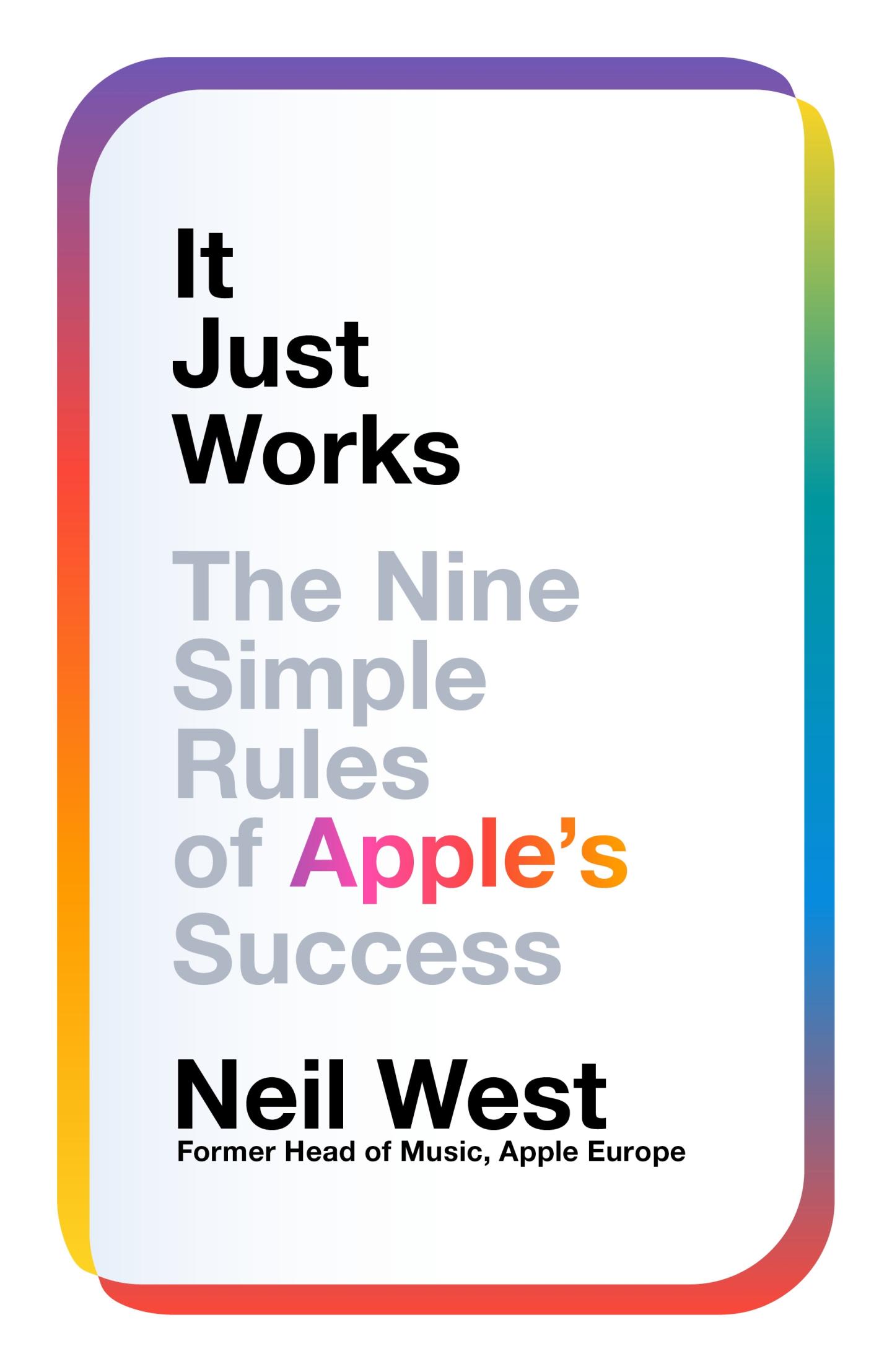
Excerpted from IT JUST WORKS: The Nine Simple Rules of Apple’s Success by Neil West, published by Macmillan Business, an imprint of Pan Macmillan. Copyright © 2026 by Neil West.