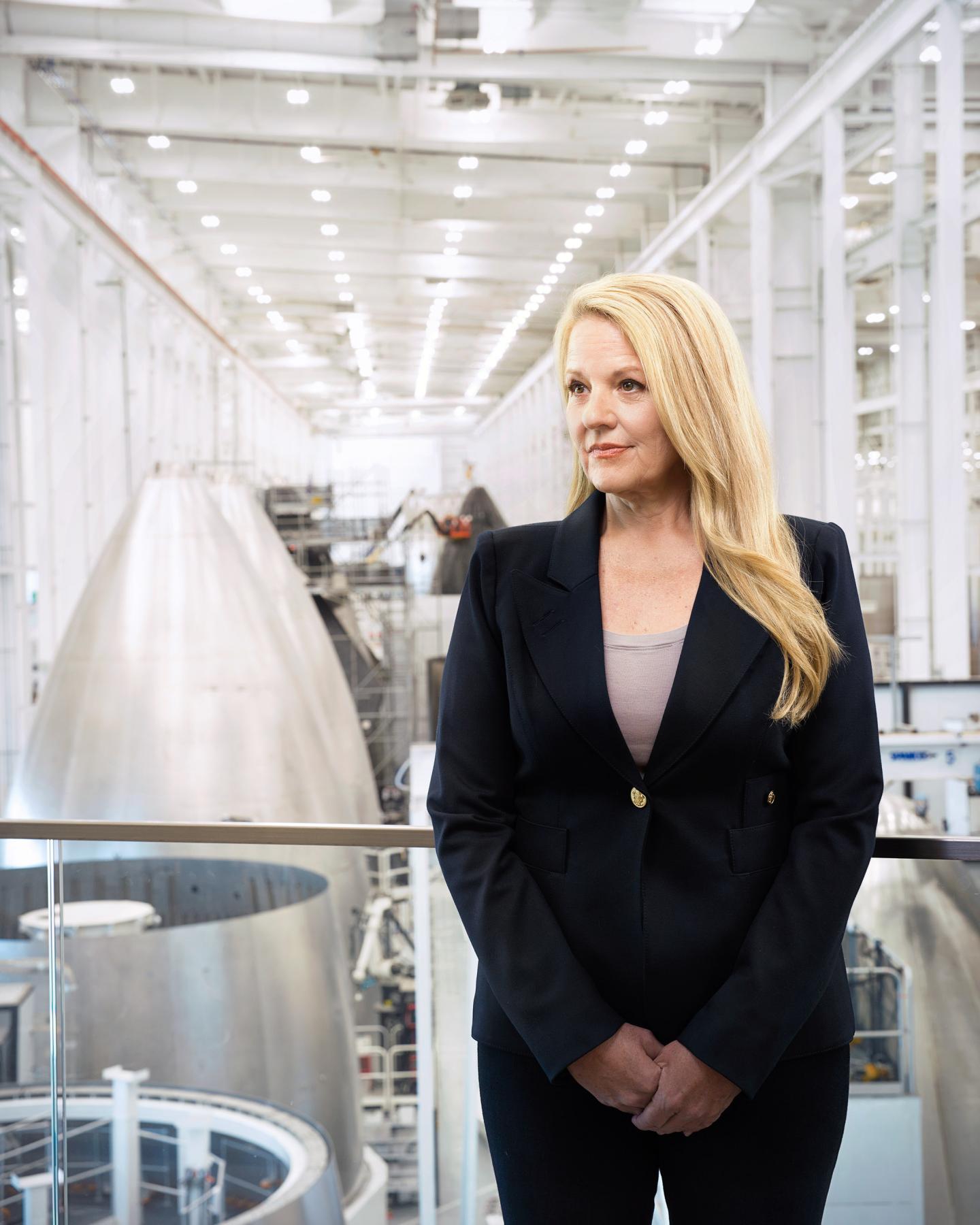

In 2002 Gwynne Shotwell had a lunch that would change her life—and the trajectory of the business world as we know it. Then 38, she had been working for a decade at a rocket startup, frustrated at the pace of innovation on the ground. “It wasn’t a vibrant industry, and we hadn’t gotten back to the moon [in 30 years],” she said on a podcast in 2022. “The systems were designed to eliminate risk, so they took forever and cost too much.” A former colleague had just departed for another rocket startup, and she met him to celebrate at a favorite Austrian restaurant in the coastal L.A. suburb of El Segundo. Afterward, her friend suggested Shotwell stop by his new company to meet the owner.
The owner, of course, was Elon Musk. Fresh off making a fortune at PayPal, Musk laid out his vision to the curious Shotwell: make rockets a lot more cheaply than NASA; sell launches to commercial satellite companies at super-bargain prices; slash prices even more by making the rockets reusable. Shotwell blurted out that he needed a “business developer,” effectively a sales leader who could win the pre-product contracts needed to fund the vision. Musk called her with an offer, and within days, Shotwell came aboard SpaceX. “I knew that working for Elon would be my last job in aerospace,” she has often said.
The investors and funds that have bought shares in SpaceX since its debut as, pre-Anthropic, the biggest IPO of all time are placing a huge bet on the visionary genius of Elon Musk. Though they may not realize it, those investors are also betting on the far lesser-known figure who’s spent two decades at Musk’s side turning his seemingly crazy dreams into big-money ventures. Now 63, Shotwell was employee No. 7 at SpaceX, and the IPO made her extremely wealthy: her 12.6 million shares were worth some $2 billion after the company went public. While Musk is SpaceX’s CEO, chairman, and chief technology officer (and controls around 40% of the shares), Shotwell’s the operator. As she put it in a recent interview, “He focuses on the future…on strategy and deep dives on the technical [side]. I focus on things that are helpful to customers today to earn money.” Shotwell doesn’t post on social media or seek publicity. She toils behind the scenes, mining Musk’s portfolio of futuristic ideas for the ones she can craft into cash-generating products.
Shotwell has achieved a spectacular record of tackling never-before-seen technological hurdles. She oversaw development of the Falcon 9, the world’s first orbital-class reusable commercial rocket, and helped make SpaceX the first private company to carry astronauts into orbit. Her cost breakthroughs enabled the Starlink galaxy of over 11,000 satellites, now SpaceX’s prime revenue and profit provider. Douglas Loverro, a former top official in the Air Force space program who’s worked extensively with Shotwell, told Fortune that for decades he’s believed that the only thing that makes money in space is communications and connectivity. “Elon and Gwynne saw it,” he observes. “Gwynne made it happen.”
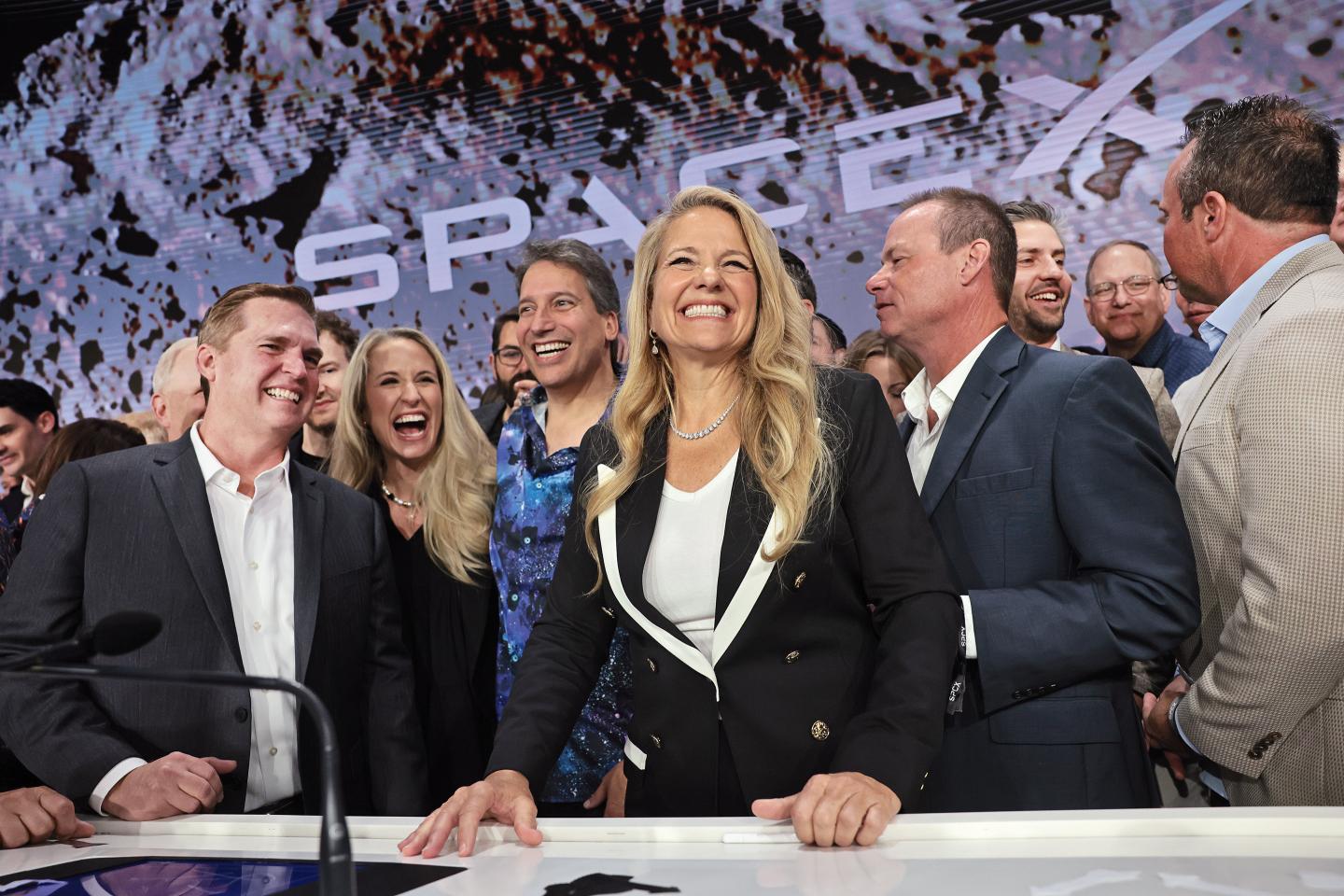
But Shotwell’s job just got exponentially more difficult. Musk has rebranded SpaceX as an AI company, taken it public, and forecast a $1 trillion revenue run rate by 2030, a feat he plans to achieve largely by putting data centers in orbit. To get there, SpaceX more than tripled its capex to $48.1 billion in the first nine months of 2026, and in August Shotwell unveiled a $100 billion Louisiana launch site to send them up. Skeptics, including some who won’t bet against Musk, doubt the economics can ever work. The numbers, observes Aswath Damodaran, a professor at NYU’s Stern School of Business, are “mind-blowingly large.” His biggest fear for SpaceX’s future is that “it overspends on orbital AI.”
The biggest thing working in Shotwell’s favor is that she has mastered a challenge that has defeated many others: managing Musk himself. As Walter Isaacson states in his definitive biography Elon Musk, the boss “doesn’t naturally partner with people. Collegiality is not part of his skill set. He inspires, frightens, bullies, and does not like to share power.” At Tesla, for example, Musk named one president who served just over two years, and never replaced him. Somehow, Shotwell’s rare combination of an engineering mindset, a knack for smoothly wooing customers, not to mention her money-making instincts, has fully captured Musk’s confidence.
People who’ve observed the pair in action credit Shotwell as the adult in the next cubicle. “I’ve worked with both Elon and Gwynne, and I’ve got to tell you, working with Gwynne is a lot more pleasant,” says one former client. As Isaacson told Fortune, “Gwynne’s indispensable to SpaceX, a perfect mind partner for Elon. She knows how to accomplish his goals while occasionally altering his trajectories and being engineering-honest with him, which is the way he likes to operate. She combines an engineering mind with a fingertip feel for how to deal with people.”
It’s a kind of odd-couple collaboration that works. Tom Mueller, SpaceX’s first employee and developer of the Merlin engine that powers the Falcon rockets, said in an email to Fortune that Shotwell brought a “unique skillset to the table that complements all the talent Elon was assembling.” In other interviews Mueller, who retired from SpaceX in 2020, put it even more simply: “I built the rockets, but Gwynne built the company.”
For 24 years Musk has supplied the vision, and Shotwell’s genius has been finding the money. Now she has to monetize the most expensive idea he’s ever had. The question is, Can she? Can anyone?
In her own way, Shotwell’s just as much a Big Personality as Elon Musk. Regularly attired in dark blazers, skinny jeans and super-high heels, sporting a flowing blond coif and typically, a crescent of pearls, she’s a born raconteur who describes herself as “a people engineer.” Today she and her husband, Robert Shotwell, a NASA engineer, are repurposing their ranch on the San Gabriel River in Texas as a vineyard. From the spread, Gwynne drives to work in a bright red Tesla Model S, a Starlink mini-dish strapped to the ski rack so she doesn’t drop the call when Elon phones.
For this story, SpaceX declined to make Shotwell available for interviews. She’s talked extensively to the mainstream or business media only a few times, though over the past 20 years she has spoken in depth to industry groups and at universities, including her alma mater Northwestern. Where not otherwise attributed, Fortune’s account of her background and career draws on those public statements and on Isaacson’s Elon Musk.
Gwynne Rowley grew up in the Chicago suburb of Libertyville, the middle daughter of an artist mom and a father who taught neurosurgery at Northwestern medical school. She relished fixing bicycles, but her career-sparking revelation came when her mother dragged the 15-year-old to a conference for the Society of Women Engineers. “I didn’t want to be there, I was a grumpy teenager,” Shotwell recalls. “I was interested in cheerleading and clothes. I thought of engineers as nerds and outcasts.”
But one mechanical engineer’s super-style black suit and elegant footwear knocked Gwynne out. “I went up and congratulated her on her suit,” says Shotwell. Suddenly, she decided engineers could be “cool.” But Shotwell doesn’t discount her glamorous high school avocation as training for the business world. “Cheerleaders make great salespeople,” she observes.
In 1986, Shotwell was one of three women in her class of 36 who graduated from Northwestern’s McCormick School of Engineering. Two years later, she joined Aerospace Corp., a nonprofit that advises government and commercial space programs, where she wrote papers modeling how heated and cooled satellite components work in tandem—a challenge that’s paramount for orbital data centers. But her real passion was designing and building spacecraft. So after 10 years, she joined Microcosm Inc., which won military and NASA contracts to architect rockets aimed at radically reducing the cost of sending satellites into space.
Then came the fateful lunch and meeting with Elon.
Shotwell’s mission: Selling contracts to military and corporate clients to fund development of the lowest-cost rocket ever produced. “If you don’t have a rocket to sell, what’s really important is selling the team,” recalls Shotwell. “Selling the technical savvy of your CEO and making sure you can address any technical issue right away.” Shotwell worked out of a cubicle next to Musk’s, and would even vacuum the conference room prior to client meetings. As Mueller told Fortune, “We were writing our own playbook across all aspects of the business, and she jumped in and became a contributor from day one.”
Indeed, Shotwell won clients for the maiden SpaceX launches from an atoll in the South Pacific, aboard its new Falcon 1 rocket, including NASA and the DOD. On the first three flights, the rockets either failed or exploded. Musk believed SpaceX had sufficient cash for two more attempts; Shotwell told Musk that he was being a Pollyanna, and that if the next one flopped, SpaceX would flame out, too. On the fourth liftoff day in September of 2008, Shotwell was in a hotel in Glasgow apologizing to customers who’d lost payloads on the earlier launches when, well past midnight, she watched the livestream of the Falcon 1 reaching orbit and carrying a dummy payload nicknamed RatSat that substituted for a satellite the Malaysian government pulled due to nervousness over the three failed flights. She relishes telling how she ran down the hotel corridor in her “jammies” yelling joyously, and commandeered the bar for a night of champagne and revelry.
“I built the rockets, but Gwynne built the company. We were writing our own playbook.“
Tom Mueller, Employee No. 1 on Spacex
That first successful launch landed SpaceX a $1.6 billion contract from NASA to deliver cargo to the International Space Station. The deal also inspired Musk to offer her the position of president at the close of 2008. She relates that at first, she “thought it was weird to be boss” and “my first reaction was ‘no.’” But after “a nanosecond of stupidity,” she said yes to Musk. Since then, SpaceX has made 36 cargo and 14 crewed launches to the ISS for NASA, long its biggest customer. In 2010, SpaceX introduced the Falcon 1’s successor, the 21-story-tall Falcon 9 that’s still its workhorse.
Shotwell’s a whiz at deploying templates to drive down costs. Instead of paying what she claims would have been $1 billion to develop an all-new engine for the Falcon 9, SpaceX packed nine of the Falcon 1’s Merlins into the booster; Starship, which will head its future fleets, carries a total of 39 Raptor engines developed in-house. Other solutions look improvised: Isaacson relates that, faced with an estimated cost of more than $3 million for Falcon 9’s payload-bay cooling system, SpaceX instead bought and modified commercial air-conditioning units priced at a few thousand each.
Shotwell also brings an intangible asset that’s essential to SpaceX’s rise: superb diplomatic skills. Loverro has marveled for two decades at how she maintains lucrative relationships after tough client encounters that could have closed the door. “Back in 2007, we were relying on America’s only rocket company that was charging ridiculous prices,” he told Fortune. Loverro negotiated with Shotwell for a year to launch a battlefield imaging satellite on the Falcon 1, and SpaceX won the bid. “Just when I was about to tell her she’d won, Gwynne calls to tell me they were shutting down Falcon 1 production.”
Loverro took plenty of flak from the Air Force brass, but remained convinced that Shotwell could deliver. A couple of years later, Congress committed $50 million for an experimental satellite launch that the Air Force feared would cost more. “I asked Gwynne, ‘Are you able to do it for $50 million?’ and she said yes, for that fixed price. Fixed prices were their specialty.”
The successful launch happened in 2015. “SpaceX was four years late, but they’re always late,” notes Loverro. Even after Musk famously sued the U.S. Air Force for awarding contracts to a rival sans competitive bids, government business kept flowing to SpaceX, and Loverro awards much of the credit to Shotwell. “Imagine your company is suing the government, but someone has to do business with the government anyway! That was Gwynne.”
Shotwell can even do something that many have deemed impossible: Get Musk to change his mind. Isaacson relates that in 2019, Musk impulsively decided to shutter the Falcon Heavy. Shotwell sped to his cubicle, reminded Musk that SpaceX needed its then-biggest vehicle to fulfill a major military contract, and got him to nix the cancellation. According to the biography, she also denounced Musk’s promise to award the Pentagon free use of SpaceX internet service to his face as “ridiculous,” and made sure Starlink got paid. In interviews, she proudly describes herself as blunt and “mouthy,” and according to Isaacson, skewers longtime lieutenants who won’t stand up to Musk, calling them “chickens.”
Still, Shotwell’s in many ways just as tough a boss as Musk. She admits that Musk “does create uncomfortable situations in the office,” and though her style’s far more agreeable, Shotwell is apparently brutal in demanding that employees strive to achieve his super-elastic goals. “‘We can’t do that’ is not in SpaceX’s lexicon,” she likes to intone. “I’m not a tech developer, but it’s my job to figure out how to do all these crazy things, and if you think ‘there’s no way we’re doing that,’ you zip it, you think about it, and you find ways to get it done.”
In fact, Shotwell mirrors the boss’s wishes by running just about the most demanding workplace on earth. “One year at SpaceX is like 10 anywhere else. There’s no boundary between work and life outside of work,” Branden Spikes, SpaceX’s CIO for nearly 10 years, told Fortune. Musk has said that if 10% of employees aren’t leaving each year, his companies aren’t running at maximum efficiency.
Shotwell echoes that approach, in a nicer way. “We ‘counsel out’ about 10% of employees each year,” she says. “If you don’t like continuous feedback, if you don’t like running a marathon, if you want to walk a marathon, you don’t want to work at SpaceX.”
Shotwell’s behind-the-scenes, find-the-dollars pragmatism allowed SpaceX to take daredevil chances that delivered. But now, Shotwell’s the steward of a public company, and she’s showing her pragmatism by publicly tempering some of her boss’s more outrageous forecasts. Musk predicts in typical style that Starlink will multiply its broadband universe to 100,000 satellites in five years. In a good sign of caution, Shotwell puts the number at 12,000 to 15,000, keeping in mind that its new V3 models are far more powerful than their predecessors.
SpaceX now comprises three main businesses: “Space,” or the launch arm; the Starlink satellite franchise plus the fledgling Starlink Mobile, grouped as “Connectivity” in its financial reports; and AI, now called Super Intelligence (SI), comprising terrestrial data campuses, inherited from xAI, and the forthcoming Starmind orbital AI data centers, which unite xAI’s expertise with Starship’s capacity to launch giant satellites that bring compute to space.
In broadband satellite and launch, Musk and Shotwell have built one of the deepest moats in tech. SpaceX’s Space segment is “a decade-plus ahead of any competitor,” Julie Zhu, an analyst at MoffettNathanson, wrote in a recent report. Starlink accounts for three-quarters of all the broadband birds in orbit, and last year SpaceX flew 165 orbital missions, 85% of the U.S. and half the world total.
In the 12 months through Q3 of this year, Starlink’s subscriber count nearly doubled to 13.6 million. Over the same period, connectivity revenues jumped 57%, as the surge in Starlink subs far outweighed falling monthly fees. Zhu forecasts that Space and Starlink will together generate $86 billion in revenue by 2030, and an astounding $51 billion in EBITDA, for a 60% margin. The weak point is Starlink Mobile. Still, Musk characteristically harbors huge ambitions in the sector, promising that SpaceX is en route to providing “complete cellphone service to America.” On that quest, SpaceX in October reached a deal, reportedly for $8 billion, to buy cellular spectrum licenses for terrestrial service it plans to combine with a vast galaxy of broadband satellites that beam data to cellphones. For now, SpaceX needs far more hard-to-purchase frequencies to make that happen, and mobile remains a minor franchise that last year delivered a piddling revenue of $632 million, a far cry from the $600 billion in annual sales generated by the Big Three in wireless, AT&T, T-Mobile and Verizon.
SpaceX is also pushing hard in terrestrial data centers. The former xAI built the first phase of a giant facility called Colossus 1 in just 120 days in 2024; the campus now covers 200 acres in the Memphis area, and its Colossus 2 claims the title of the world’s largest data center. Led by the Colossus expansion, SpaceX vows to grow its capacity more than fourfold to 13 gigawatts by the close of next year, adding in around a year and a half what Google built in its entire existence.
Colossus was first built primarily to run the Grok chatbot, which never caught the leader group of Anthropic’s Claude, OpenAI’s ChatGPT and Google’s Gemini. But Musk had shrewdly filled the facilities with Nvidia GPUs and other advanced chips now in short supply, and starting in May, he and Shotwell began leasing space to rivals famished for capacity. Deals with Google, Anthropic, Reflection AI and a fourth, undisclosed major player generate an incredible $3.4 billion a month in revenue. Renters can cancel at the end of a 90-day period, which helps explain the extremely high rates, but if the AI capex boom continues, the earth-based campuses should prove strongly profitable for years. Zhu predicts that the terrestrial group will supply the highest revenues of the four sectors, reaching $102 billion by 2031, 40% of the SpaceX total.
Musk and Shotwell, however, are counting on a totally unproven horizon in AI as the primary force in making SpaceX the world’s biggest and most profitable enterprise in a matter of years. At first look—and the way the pair characterize them—orbital AI data centers look far superior to their terrestrial counterparts, at least once SpaceX tames the launching costs, always a top strength.
Shotwell sketches that celestial image just as enthusiastically as her boss. During a CNBC interview in June, she argued that “the most efficient place for AI compute is in space,” and backed that “space is better” scenario at the All-In Summit tech conference in mid-September. On a panel, she cited that terrestrial campuses face long lag times for permits, licensing, and power supplies, and that land costs are enormous, avowing that “when someone finds out supercompute is going in, real estate goes from $3,000 to $180,000 an acre.” Yet, she added, “People need compute now.” Orbital centers will immensely speed the process, she maintained. “The real estate in space is infinite. And it’s free,” declared Shotwell; she also stressed that SpaceX can supply everything in house from the giant new Starship that will carry the loads to custom-manufacturing for the AI birds, which she says are “much simpler” than the V3 satellites. She even did something seldom witnessed at SpaceX: advanced the timing, forecasting that the AI satellites will fly into low-earth orbit next year, up from the pre-IPO target of 2028.
Besides providing the compute much quicker, the AI data centers, Shotwell and Musk argue, should be far cheaper. The reason: Power and cooling account for as much as 70% of a data center’s operating costs, and Musk and Shotwell argue correctly that plants in orbit pay nothing in direct expense for electricity or for keeping chips at an optimal temperature. “Deep space is the coldest thing out there,” Shotwell said at the All-In event. Yet all major studies now show that with current technology, orbital centers would cost a lot more all-in than the big boxes in Loudoun County, Va., or outside Memphis. Andrew McCalip, head of research at Varda Space Industries, reckons that running a 1 GW facility in orbit would cost $51.1 billion for the first five years, against $15.9 billion for the terrestrial equivalent.
Put simply, orbital centers trade much lower operating costs for far higher upfront expense for equipment, the heavy charges for lifting it into space, and most of all, a shorter life. Heating and cooling in space also aren’t “free.” Space has no atmosphere, so chips can’t be cooled by air or water as on earth; a modest-sized 100 MW data center requires a cluster of some 700 satellites, each carrying big radiators and solar panels. Each would feature 1,200-square-foot radiators, equal in size to one-and-a-half pickleball courts.
A major reason for the three-to-one cost differential: lifting each unit, with its 231-foot wingspan, into orbit. Today, SpaceX estimates its launch costs at around $2,700 per kg, and Shotwell and Musk pledge to crush that number to under $200 in a couple of years, on the way to below $100. Their big ace, besides Starship, is the Louisiana site that will be the world’s largest spaceport. By 2035, Adam Jonas of Morgan Stanley predicts, seven flights a day—and likely far more—will depart on Starship from four sites, most of the launches from the Louisiana coast. But slaying the launch-cost dragon isn’t enough, according to experts Fortune interviewed. Radiation gradually degrades the radiators and solar panels, causing them to lose potency over time. Earthbound facilities experience annualized failure rates of 3% to 5% for their equipment, but mechanics can replace the faulty units in minutes. No robot repair crews exist in space, and building them would hugely add to costs. The chips must also be space-hardened, which Nvidia is developing specifically for SpaceX, while its Terafab joint venture with Intel and Tesla works on custom orbital semiconductors.
Data centers in space also have an estimated life of just five years, while on earth the buildings, cooling, and power systems function far longer. That, plus gradually declining power and no way to fix parts gone bad, will make it extremely tough for orbital centers to compete with the giant campuses on earth.
Says a top executive in the data center industry, “My overall conclusion is that these are very difficult technical challenges. I just don’t see the problem it’s solving. … If you can develop chips that run far hotter for space and produce more power, why not use them on earth? We have a power grid on earth.”
But this titan also cautions, “Elon’s record is significant. I’m not sure I’d bet for it, but I’m also not ready to bet against it.” Several sources interviewed by Fortune believe that orbital data centers’ best prospects are as “escape valves” that offer needed capacity if the backlash against terrestrial campuses takes hold long-term. That’s conceivable, but hardly a highly investable scenario.
Technical issues pose a big barrier, and so does money. Overall, Wall Street was projecting the biggest capex blowout in corporate history before the Q2 surprise and announcement of the epic project in Louisiana. Jonas is typical among the analysts in positing that SpaceX won’t begin to see significant sales from Musk’s brainchild until at least 2032. Though Morgan Stanley posits that the campaign will eventually be a big winner, the timeline to getting there spotlights the difficulty. It predicts that SpaceX will burn cash through 2030, and require $390 billion in debt financing through that date to help fund its gigantic capex spend over the next eight to nine years.
As Morgan Stanley and other banks highlight, SpaceX can dial back on capex if the prospects for AI in space start looking dim. But as Shotwell acknowledges, SpaceX almost never delivers on time, and for years to come it may wrestle with the new technologies needed to make orbital compute profitable, without a clear line of sight to when, or if, that will happen. Meanwhile, heavy spending subsidized by Starlink could hammer overall earnings, and a share price elevated largely by great expectations for SpaceX’s galaxies of compute in low-earth orbit.
Shotwell has spent two decades proving the skeptics wrong, over and over. This time she’s facing engineering hurdles that even executives unwilling to bet against Musk call very difficult, at a price tag in capex that Wall Street already rates as the biggest in the annals of big business. If anyone can find the money in Musk’s latest moonshot, it’s Shotwell. The harder question for SpaceX shareholders is what happens if he insists on chasing a dream and, for once, she can’t stop him.