
The internet was built on a simple bet: a person is looking at the screen. UBS says AI agents are starting to break that bargain.
“Since its inception, the internet has been built for human eyeballs,” Ulrike Hoffmann-Burchardi, chief investment officer for the Americas at UBS Wealth Management, said in a note and podcast released Monday. “Every website, every checkout button, and every software dashboard assumes a person is sitting behind the screen, clicking through tabs.” AI agents that shop, compare and click on a person’s behalf break that assumption, she argued, and with it two of tech’s most profitable business models: digital advertising and enterprise software sold as a service.
Her name for the shift: “We are moving from B2C (business to consumer) to B2A (business to agent).” And her warning to investors: “We believe the speed of AI disruption is still underappreciated by the markets.”
The stakes are plain for any company whose revenue depends on a customer’s attention, or lack of it. On the same day, BofA Global Research put numbers on what that could look like for one company whose model leans on the second kind.
Agents don’t watch Super Bowl ads
Hoffmann-Burchardi’s example seems banal on its face. A shopper tells an agent to find waterproof trail-running shoes under $150 that arrive by Thursday, and the agent checks inventory, compares specs and buys.
“AI agents do not have emotions,” she said. “They don’t care about a clever Super Bowl spot or a brightly colored retargeting banner.” Brands that want to be found, UBS argues, will need to expose machine-readable product data and real-time inventory, because search-engine optimization alone is no longer enough.
The same logic hits enterprise software. If one AI-augmented employee or an automated workflow can work at the speed of five to 10 people, Hoffmann-Burchardi said, companies don’t need to buy more software seats, and if agents talk straight to a database, the dashboard becomes obsolete.
The consumer side is already moving. Meta’s Muse agent app passed an estimated 10 million U.S. downloads in its first 40 days, according to Sensor Tower estimates reported in October, and Instinct, a personal-agent app, reported that 40% of users connected their credit cards to its assistant by week three, according to UBS.
The company built on not cancelling
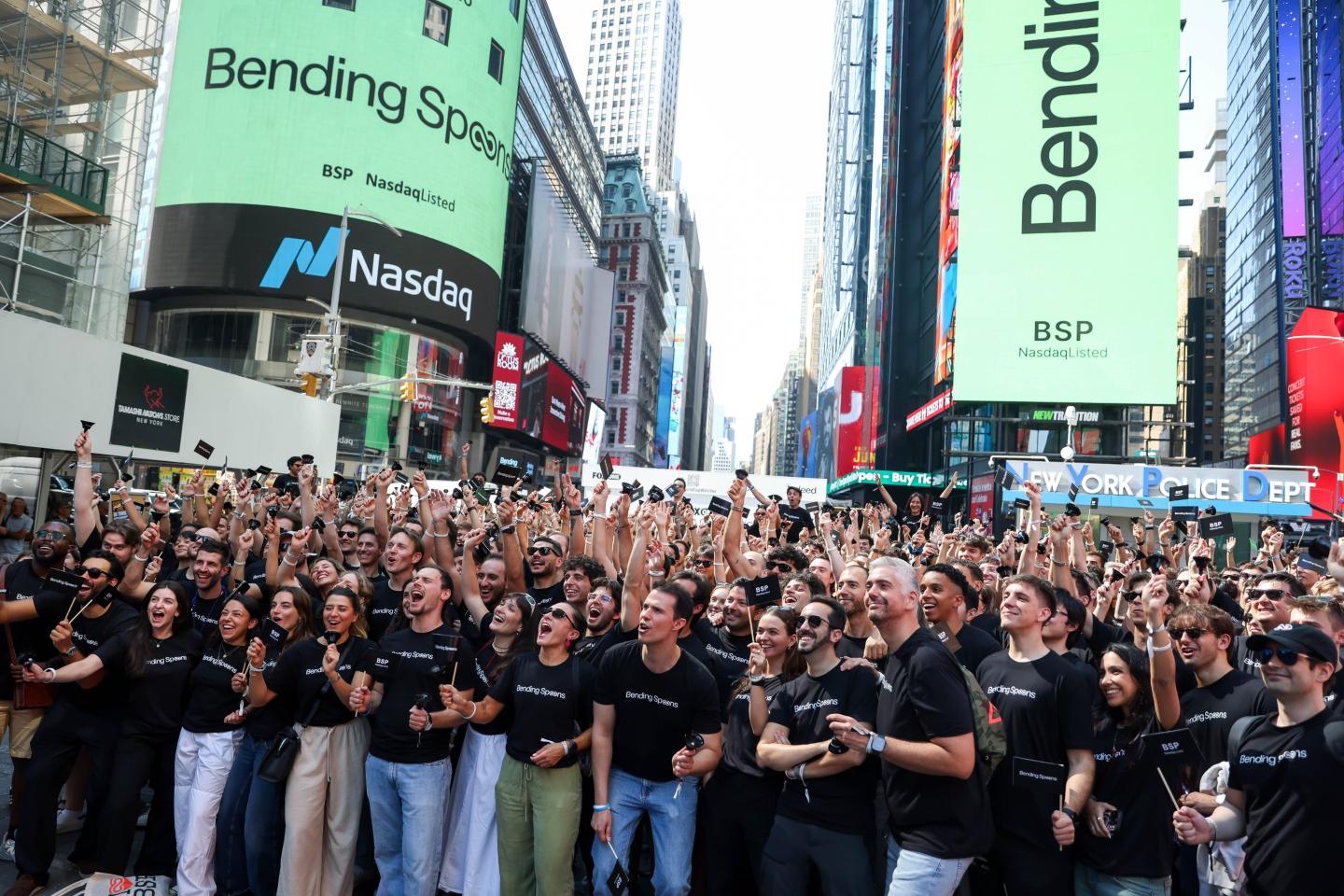
Bending Spoons, the Milan-based company that has bought more than 50 businesses, including AOL, Vimeo, Eventbrite, Evernote and WeTransfer, is close to a pure test of that idea. Its model, as BofA describes it, is to buy durable but under-optimized subscription businesses, cut costs, raise prices and use the cash to buy more.
BofA’s analysts, Omar Dessouky and Ethan Liu, built their Nov. 16 report around one line: “Inconvenience is the main moat against AI.” People keep paying because finding the subscription they forgot, researching alternatives or moving years of notes is a chore. An agent does chores.
“Subscribers who derive no value from their subscription have switching costs that are limited to the effort required to identify and cancel the unused subscription – an AI Agent task,” the analysts wrote. Experts they spoke to estimated that “10% to 40% of payers may not use the products they pay for.”
BofA rates about 29% of Bending Spoons’ projected 2027 revenue as high risk from AI agents. That’s AOL ($778.8 million in BofA’s 2027 estimate), where AI can compare the bundled security add-ons it sells on convenience and AI assistants can replace its tech-help subscriptions; Eventbrite ($403.1 million); and Evernote ($125.5 million), where “AI assistants become a new ‘second brain.’” WeTransfer is medium risk. Vimeo is low, because big video libraries are hard to move and AI may get more people making video. BofA hasn’t rated the other 53%.
Bending Spoons says it hasn’t seen this happening. “We closely monitor our businesses’ KPIs and haven’t seen any signs that AI agents are driving cancellations or switching to alternative products,” a company spokesperson told Fortune.
BofA analysts largely concur, saying they “have yet to track data to test our hypotheses,” and they “have not yet seen data to suggest that is currently happening at large scale.” The savings from cancelling AOL, WeTransfer, Evernote, Eventbrite or Vimeo, they wrote, run from about $228 to $728 a year, “equivalent to a weekly cup of coffee.” Their preliminary conclusion: “the value gained from switching to cheaper or better solutions rarely exceeds the cost of staying put.”
They also see third-quarter organic growth risks “skewed mildly to the upside.” BofA rates the stock Underperform, with a $38 price objective against a $41.08 share price, mostly on valuation and on whether Bending Spoons can keep buying companies at its target returns. It carried net debt of 205% of equity at the end of 2025, by BofA’s count, and its recent deals include Airtable for $1.285 billion and Miro for $1.355 billion.
Paying not to go to the gym
Economists have measured the moat BofA is describing. In a 2006 study of 7,752 health-club members, Stefano DellaVigna and Ulrike Malmendier found people on monthly contracts paid more than $17 per expected visit when a 10-visit pass would have cost them $10 a visit, and that an average of 2.31 months passed between a member’s last workout and the cancellation.
Regulators have tried to shrink it. The Federal Trade Commission’s “click-to-cancel” rule was vacated by the Eighth Circuit in 2025 on procedural grounds; the agency reopened the rulemaking in March, according to law firm Jones Day.
In February 2000, Fortune asked, “How Much Are Your Eyeballs Worth?” Analysts then were valuing internet companies by “market capitalization per pair of eyeballs.” Lycos came out at $244 a pair. “Eyeballs aren’t earnings,” the story argued.
UBS cited that story Monday to make the opposite point: the next visitor may not have eyeballs at all. Bending Spoons reports third-quarter results Nov. 20, the first test since BofA’s report of whether its customers are still staying put.
Generative AI was used for research assistance and/or transcription of this article. The reporter independently reported and verified the factual claims in this article, and a human editor reviewed it before publication.