
Tati Lindenberg has a challenge on her hands. As global CMO of Unilever’s homecare division, she’s made her name by marketing to humans—often by playing on senses and emotions. But soon, she’ll need to market to a different kind of customer—one that doesn’t feel, sense, or care how big your company is. That is the AI agent.
“The store, online or offline, has always been where the decision is made. The AI answer is becoming a new kind of shelf,” says Lindenberg. “In that world, a brand needs to be recognised, trusted and preferred by people and by machines.”
In the U.K., 52% of shoppers have used AI for at least one shopping task in the past three months, according to McKinsey research. In China—where adoption of AI is more advanced—that figure rises to 80%.
The power of agents in decision-making is growing. Currently, most consumers use AI to conduct research and will make the ultimate decision on what to buy themselves. But soon, a substantial number could trust agents to handle the entire process.
Mastercard forecasts that one in 10 people will routinely use AI agents to shop and pay by 2030. Meta’s personal AI agent Muse, which is capable of researching products and making purchases, is expected to launch in the U.K. “within weeks.”
Purchases of Unilever’s beauty, wellbeing, and home care products are more likely to be delegated to AI, according to Nick Carroll, Mintel’s retail principal strategist. “In general, consumers are most interested in automating those less emotive and most regularly purchased categories,” he says. Mintel data shows household products are most ripe for disruption; 41% of consumers would feel comfortable automating these purchases.
Unilever isn’t the only company harnessing AI in the purchasing process. At the start of the year, JD Sports unveiled new tech that allows U.S. shoppers to make purchases using platforms such as Microsoft Copilot, Google’s Gemini, and ChatGPT in a single click. Similarly, John Lewis announced “a significant investment”in AI-powered shopping in March to ensure its products appear on those same platforms.
When AI becomes a customer
The increased use of AI agents by consumers has quickly become a topic of boardroom discussion. Nearly half (47%) of consumer products executives surveyed by EY believe the ability to influence AI recommendations will be essential to remain competitive over the next five years. But only 20% believe they can deliver on that objective today.
If companies don’t bridge that capability gap, there will be swift and material consequences. As EY points out, only 10% of consumers need to shift their behaviour to make a significant impact on revenue and profits.
The lack of confidence in this area reflects the complexity of the task at hand. AI agents work in a fundamentally different way to search engines, and little is known about their algorithms, with many viewing them as a ‘black box.’
What’s more, consumers are asking far more detailed queries than they would have asked traditional search. “A normal Google search is 3.2 words on average,” says Fredrik Kridahl, founder of AI search consultancy Hyper Agency. “An average query on an average prompt is 91 words.”
Perhaps most importantly, major brands don’t have the same automatic advantage as they do with Google. Kridahl points to research showing only 38% of URLs cited by AI rank in the top 10 for regular search engines and 31% rank outside the top 100. “AI doesn’t care about how big your company is,” he says. “It cares about the facts and giving the right advice.”
Marketing to machines
Consumer adoption of AI is contributing to a major shift in marketing strategy. Very Group digital director Sarah Hanna says AI search currently accounts for less than 2% of all traffic to its site. But she’s aware that figure will soon grow.
“Getting in front of AI agents is set to become just as important as traditional SEO,” she says. “Retailers need to ensure their product information is accurate, detailed and structured so AI can understand, recommend and compare their products effectively.”
JD Sports is doing similar work behind the scenes. Chief technology and transformation officer Jetan Chowk says the brand is working to ensure its offer is “visible, accessible and accurately represented” online. “We’ve been investing in our digital infrastructure to support this, making it easier for AI platforms to access up-to-date product information, pricing, and availability,” he says.
“Getting in front of AI agents is set to become just as important as traditional SEO.”
Sarah Hanna, digital director, Very Group
This is all part of what Steven Bailey, EY Americas commercial excellence leader, terms the “unglamorous” work of marketing to bots. “You need to be clear on price, promotion, product, persona, who is this for, and then differentiation and characteristics,” he says. “That has to be encoded and machine-readable in a way that maybe it didn’t before.”
Positive reviews on retailer sites and on social media are another vital component. If an agent sees a product is well rated, it will feel more confident recommending that option to a user. “We optimize metadata, product pages, and community platforms such as Reddit, so our brands surface correctly when people ask natural questions,” says Lindenberg. “If someone asks, ‘I need a quick clean up, what detergent should I use?’, we want Persil Wonder Wash to be in that answer, for the right reasons.”
Human connection still matters
All this back-end activity could be interpreted as a death knell for the more emotional marketing campaign. After all, an AI agent won’t be moved by initiatives such as the latest Dirt is Good campaign by Unilever, which focuses on ending period stigma in sport. Nor will it feel motivated by the ‘create the new’ call to action in this year’s JD Sports Christmas ad.
Yet experts believe this activity is, if anything, more important than before. EY’s Bailey still sees a clear place for “romance copy” in the agentic commerce era. “AI is rewarding things that are machine-readable, but it’s also a shining light on where you have gaps,” he says. “What this also means is that trust and humanness now become worth even more, because they are differentiators.”
Consumers still value brands that forge an emotional connection, Bailey adds. Not only does that inform their choices when they use AI for research, but shoppers are also far more likely to allow AI to automate purchases from these trusted brands.
“The danger is optimizing so hard for algorithms that we lose the distinctiveness that makes a brand worth choosing.”
Tati Lindenberg, Global CMO, Unilever
Even outside of creative campaigns, that distinctive voice and human element remains vital. Online descriptions need to “make the emotional and experiential dimensions more understandable to AI”, says Kathryn Gramling, global consumer goods, retail, and travel lead at Accenture—particularly in more emotion-led sectors such as fashion, beauty, luxury, and travel.
“That means communicating more than price, size, or features,” Gramling adds. “Brands need to give AI context around occasions, preferences, and experiences so it can understand not just what a product is, but why someone might choose it.”
That element is front of mind for Expedia Group, which is adapting to the growing use of AI agents to plan travel. “Atmosphere is easy for a person to sense from a photo, and hard for an agent to see,” says chief marketing officer Jochen Koedijk. “A hotel that feels right to people but is described poorly in its data can get skipped by an agent. So, part of our B2A [business-to-agent] work is turning atmosphere into evidence an agent can use, like what guests say about the place and which amenities point to a quiet weekend or a family trip.”
Ultimately, it comes down to remembering the human in the process. Consumers will still have brand preferences that will shape their buying habits—with or without the use of AI. “The danger is optimizing so hard for algorithms that we lose the creativity and distinctiveness that make a brand worth choosing in the first place,” Lindenberg says.
For her, the foundation of effective marketing remains the same as when she began her career. It’s about forging a connection with consumers. Lindenberg adds: “As AI makes content easier to produce, taste, originality, and human imagination become even greater competitive advantages.”
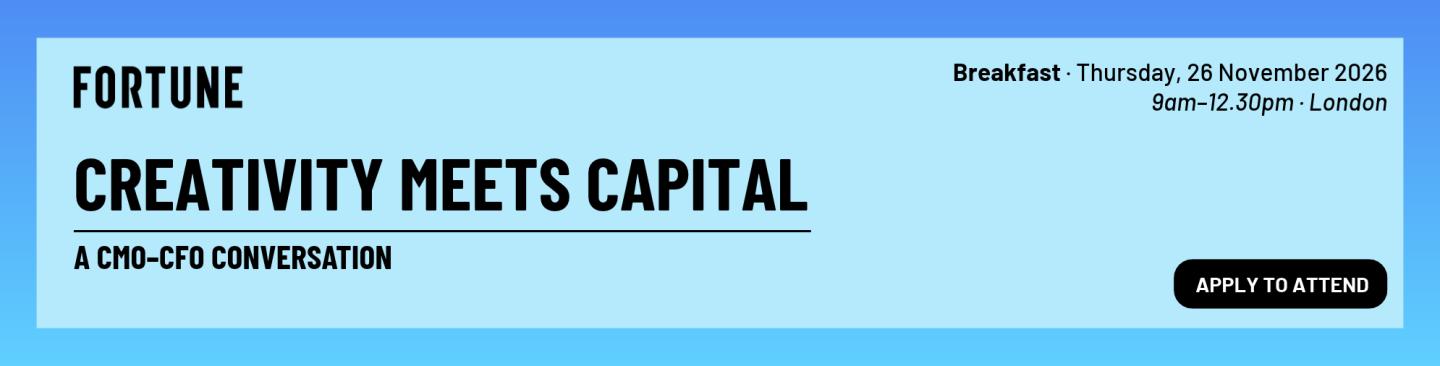
Quick note: Companies are facing growing pressure to demonstrate returns on every investment while continuing to build for the future. To further explore how CMOs and CFOs are collaborating to drive growth, register to join Fortune’s Creativity Meets Capital Breakfast on Thursday 26 November, 9am–12pm, at LinkedIn’s London office. Register here.