For two decades, Washington tried to drag its federal retirement process out of the paper age. Contractors poured millions into the effort, but the system stayed bogged down in paperwork. Then Airbnb cofounder Joe Gebbia showed up with a handful of engineers and, by his account, did in six months what the government had struggled to do for 20 years.
Gebbia, now the country’s first chief design officer, said the effort dates back to 2002, when federal records were digitized under President George W. Bush. The government had tried and failed for two decades to move retirement online, he said.
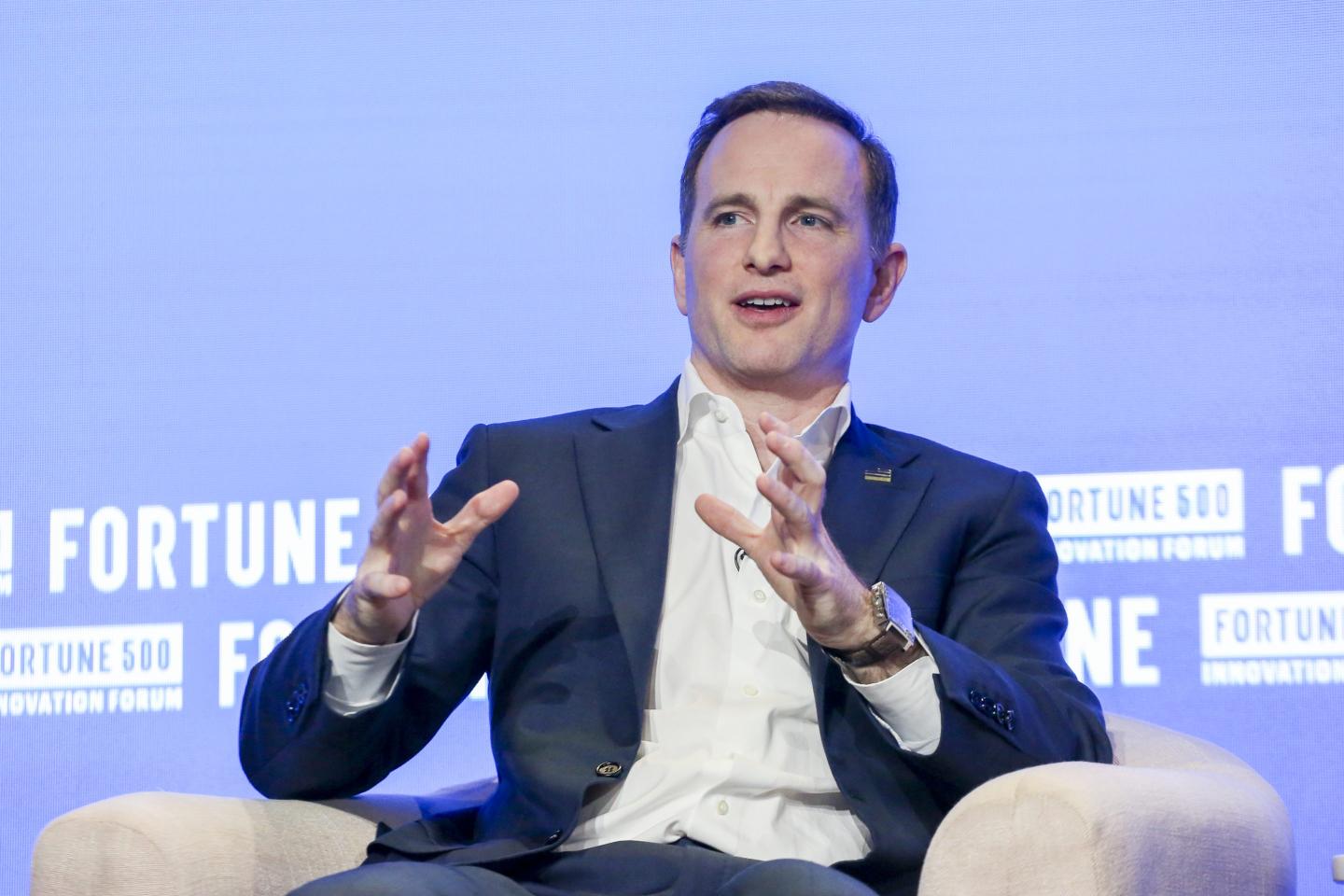
“There’s about $100 million spent on contractors that produce nothing,” Gebbia told Fortune editor-in-chief Alyson Shontell on Monday at the Fortune 500 Innovation Forum in Detroit. His team, he said, brought the retirement application process online for roughly $1.5 million.
The overhaul was an early win for Gebbia, who arrived in Washington in 2025 knowing little about federal retirement. The system ran on paper, with personnel files kept in a limestone mine in western Pennsylvania, and some retirees waited months for their full pension benefits. It also became his proof of concept for a much bigger job: fixing how Americans deal with their government online.
Bringing Airbnb’s playbook to Washington
Gebbia never expected to work in government. He was serving on Tesla’s board and running Samara, his prefab backyard-home startup, when a text from Elon Musk in January 2025 invited him to hear about the problems federal agencies were struggling to solve. One issue in particular caught his attention: retirement.
To tackle it, he turned to a lesson from Airbnb’s early days.
When Airbnb had about 30 hosts in New York City, Y Combinator cofounder Paul Graham urged its founders to leave California and meet those hosts in person. Those conversations revealed problems the founders couldn’t see from behind their desks.
Gebbia took the same approach with federal employees, interviewing recent retirees and people preparing to leave government service about their worries, frustrations, and what they needed from a new system.
“You need to understand who you’re designing for,” Gebbia said. “You need to be close to the problem so that you can understand it from their point of view.”
He recruited a couple of former Airbnb engineers and designers, and in roughly six months the team had built an online retirement application. A memo then went out across the federal workforce requiring employees to use it, Gebbia said.
The Office of Personnel Management said in July that its Online Retirement Application handled more than 155,000 applications over the previous year and ended paper processing for more than 95% of federal retirement applications.
Going digital hasn’t eliminated the wait, however. Retirement claims took an average of 73 days to process in October, according to OPM’s monthly processing report. Digital claims moved faster, at 59 days, than paper ones, at 150.
From retirement paperwork to 29,000 websites
The retirement project didn’t go unnoticed. Soon other cabinet members were calling. “Can you come fix this for our agency?” Gebbia recalled them asking.
Rather than tackle one website at a time, Gebbia pitched the White House on a broader role, which led to the creation of the National Design Studio and his appointment as chief design officer in August 2025.
The scale of that job is enormous. Gebbia said roughly 40 million people visit federal websites every day, and Americans spend an estimated 10 billion hours a year trying to get things done on them. Too often, he said, people simply give up.
“This is a design injustice,” Gebbia said. “We’re the United States of America. Our websites from our government can and should be as good as the next best website from the private sector.”
His team’s answer is America.gov, an AI-powered site launched Sept. 29 that draws on more than 29,000 government websites and lets Americans ask questions instead of hunting through pages of links. The launch had a rocky start: the chatbot contradicted some of President Trump’s public claims, then began declining “political questions,” the Associated Press reported.
Gebbia said the next phase will let users complete tasks, such as enrolling in a Medicare plan, without leaving the chat. The site is housed at the General Services Administration, a structure he sees as key to making the work outlast his tenure.
His benchmark is an Apple Store experience: not literally, he said, but as shorthand for good design and modern software.
“What if you didn’t have to go to 29,000 websites?” he said. “What if you just went to one?”
Gebbia on Jensen Huang
Gebbia also weighed in on the turmoil at Nvidia, where Jensen Huang resigned as CEO last week after admitting to an extramarital affair with a woman U.S. intelligence officials suspected of being a Chinese intelligence asset. Tech leaders, including Elon Musk, have since backed a petition urging Nvidia’s board to reinstate him.
Gebbia said his support for bringing Huang back comes with a caveat. “When I say reinstate, it means reinstate to then run a due diligence process effectively,” he said. That would be the right move for shareholders, the public, and AI, he argued, as long as the investigation is allowed to “play out as it should.”
“Look, Nvidia is like one of the greatest companies ever of all time,” Gebbia said. “And it got there because of founder mode, because it’s founder-led.”