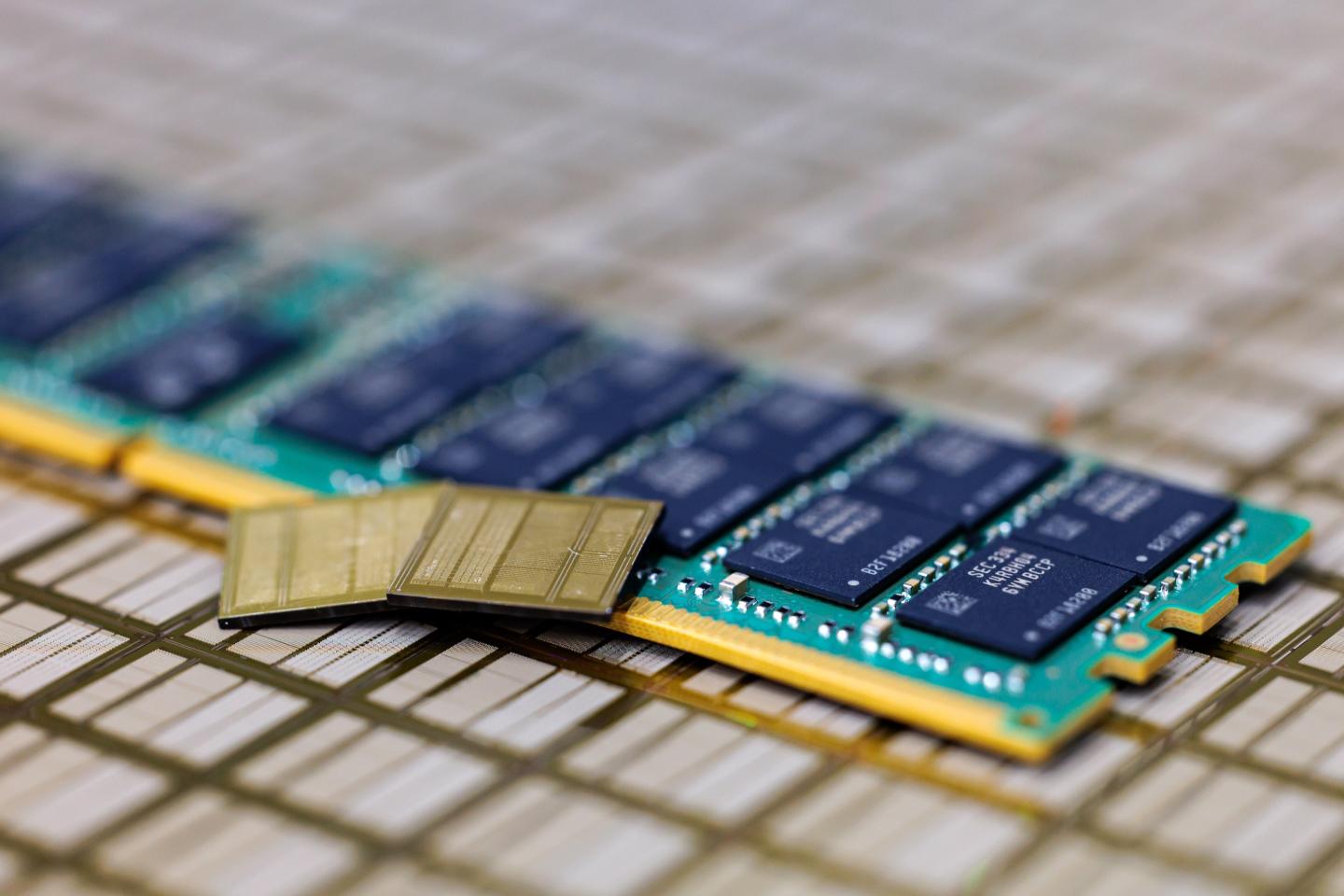
The CEO of Taiwanese memory maker Team Group says the global memory chip shortage is about to get worse, to the point where “even money can’t buy goods.”
Speaking on the company’s third-quarter earnings call on Nov. 2, CEO Gerry Chen (Chen Ching-wen) said the most severe stretch will run from now through the end of the second quarter of 2027, according to a BigGo Finance report. He sees “no downward price trend whatsoever” next year and doesn’t expect supply and demand to balance until the second half of 2028 at the earliest.
The warning reaches well beyond memory makers. The DRAM and NAND flash chips that go into AI servers also go into PCs, smartphones, and cars, and AI buyers are winning the bidding war. That leaves device makers choosing among higher prices, thinner margins, and fewer units.
AI servers are absorbing most of the world’s memory
Chen said AI servers and enterprise applications are taking most DRAM output. The industry’s biggest suppliers, Samsung, SK Hynix, and Micron, have shifted capacity toward the high-bandwidth memory used in AI chips, leaving less conventional memory for consumer devices, as Fortune reported earlier this year.
The money behind that demand is enormous. A recent Stateline analysis called data centers “the largest financial bet in US history.”
The shift shows up in Team Group’s own business. Business-to-business sales made up 64.6% of revenue in the first three quarters of 2026, up from 24.6% a year earlier. Chen attributed the change to market demand rather than a strategic decision by the company.
DDR5 prices are up more than fivefold in a year
Contract prices for a 16-gigabit DDR5 chip rose from $8.70 in October 2025 to $48 in September 2026, according to figures cited on the call. That is more than five times the price of a year earlier.
For Team Group, the squeeze has been a windfall. Third-quarter revenue hit a record NT$10.14 billion (about $312 million), up nearly 34% from the prior quarter. Net profit reached NT$3.62 billion (about $111 million), and gross margin climbed to 49.3% from 42.8% in the second quarter.
Device makers sit on the other side of that trade. Apple has reportedly cut component orders for its iPhone 18 Pro models after raising their starting prices by $100, and IDC expects global smartphone shipments to fall 16.7% this year. Consumers are likely to keep absorbing the cost, through pricier PCs and phones or through machines that ship with less memory at the same price.
Contracts no longer guarantee supply
The most striking part of Chen’s warning is that money and supplier relationships may not be enough. “We have contracts but can’t get enough volume, so we have to go to the spot market and pay a premium to grab supply,” he said, according to Tom’s Hardware. He put the gap between spot and contract prices at 30% to 50%.
New capacity will arrive slowly. Team Group’s new plant in New Taipei City is slated to begin production in the second quarter of 2027. SK Hynix said last month that the shortage will last until 2030, with long-term agreements already covering more than half of its capacity for 2027 and 2028. Harvard Business School professor Willy Shih expects new fabs to reach volume production only in late 2027 or 2028, and has warned that memory booms have always ended once that supply arrives.
What the Nvidia probe could mean for memory supply
The investigation into Nvidia CEO Jensen Huang adds a new variable. Nvidia’s board said on Nov. 8 that it would open an independent probe into Huang’s affair with Megaspeed executive Alice Huang, who is suspected of spying for China and is no relation. President Trump has since said the FBI is “looking into” the matter.
So far, the scandal has not directly touched memory supply. Nvidia, No. 16 on the 2026 Fortune 500, relies on Samsung and SK Hynix for the advanced memory in its AI accelerators, so the exposure runs through export policy. If Washington responds by tightening AI chip controls on China, Korean memory makers could face stricter end-user checks that raise compliance costs and delay shipments, the Korea Herald reported.
Even then, the effect on the broader shortage may be limited. South Korea’s government expects deliveries under existing contracts to continue without disruption, and Hanwha Investment & Securities analyst Park Se-yeon cautioned against tying Huang’s personal controversy directly to Korean chipmakers’ outlook, according to Korea JoongAng Daily.
The next signals arrive quickly: Nvidia reports third-quarter earnings on Nov. 17, and three House committee chairs have requested a closed-door briefing on the case for Nov. 18. For memory buyers, though, Chen’s outlook rests on a simpler problem. “How can prices fall when there’s nothing left?” he said.