
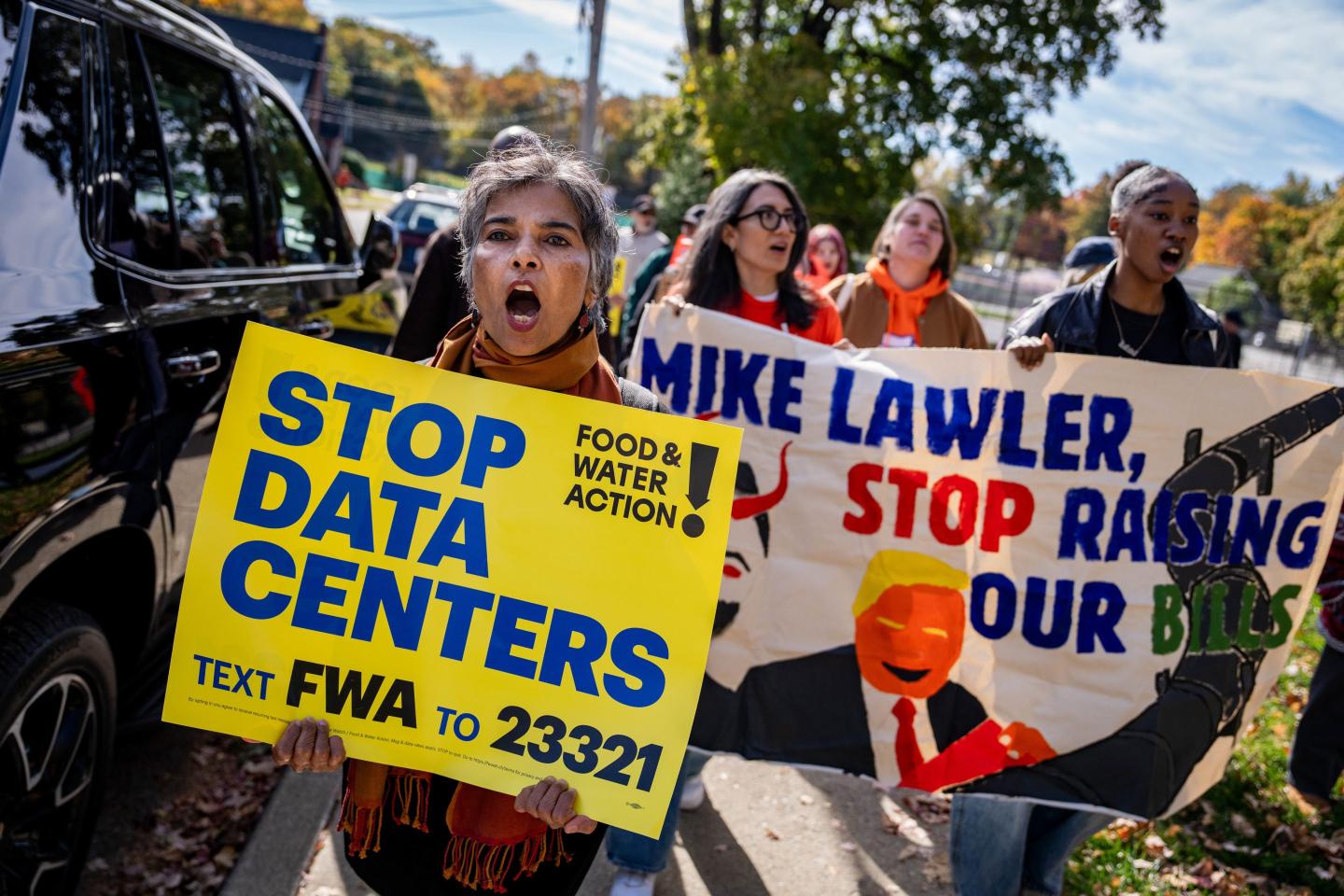
Two days after what appears to be voters rejecting data centers in town after town, OpenAI went shopping for something it can’t build: permission.
On Thursday, the company published a National Community Compact, in which the company pledged to pay for the electricity and grid infrastructure of the data center campuses it owns and operates. It also pledged to post financial guarantees before major spending begins, so other utility customers aren’t stuck with the bill if a project is delayed or canceled. The company told Fortune this has been months in the making and is something they’ve been pledging in their data center campuses already—the compact is simply the first time OpenAI put in writing a number of pledges it has already undertaken.
Mining and energy companies have a name for what OpenAI is after: a social license. (If you’re interested, you can read my grad school capstone about social license in Peru, which has since been enacted into law). These are a type of Community Partnership Agreements (CPAs) that entails getting a community’s ongoing consent to operate: No zoning board grants it, and no tax abatement buys it. Instead, companies earn it by showing the people next door that a project leaves them better off—or at least no worse off. Lose it, and permits stall, lawsuits pile up, and local officials find reasons to say no.
So following the Democratic wave on Tuesday, the AI industry found out how little of that license it had left. And distinctly, the midterm turnout wasn’t a cry from voters to stop the buildout, but simply to put a new price tag on it, and OpenAI is the first major AI company to agree to pay it since the votes were counted.
Limits, not bans, on data centers
Data centers were on the ballot in roughly 40 localities across the country. By Wednesday morning, about 28 measures had passed in 25 localities, all of them opposing data centers. Chief among them were the 18 municipalities in Ohio, which already has 125 data center moratoriums.
Sunbury, Ohio, banned data centers over 25 megawatts, 79% to 21%, after Amazon proposed a $2 billion campus there. In Trenton, Ohio, where Amazon Web Services is already building a 250-megawatt data center, a ban passed 80% to 20%. In Hubbard, Ohio, a ban won 76% to 24%, and the mayor has since said a proposed 300-megawatt project is dead.
But voters weren’t saying no to data centers: The ballot measures were to place limits on data centers, rather than full-out bans.
In Perry, Ohio, 87% of voters required hyperscale developers seeking tax breaks to post financial guarantees and meet noise limits, the same safeguard OpenAI offered two days later. Grove City, Ohio, banned nothing. By 55% to 45%, it required a public vote on any project over 50 acres, 20 megawatts or 500,000 gallons of water a day. Most of the bans set a size threshold, meaning a modest server farm can still come to town, but a gigawatt campus can’t.
This wasn’t limited just to the Democratic party: Former Ohio gubernatorial candidate Vivek Ramaswamy pledged a moratorium on construction until the legislature acted, and Texas Gov. Greg Abbott had already paused new grid connections for data centers in August. The common complaint was the electric bill: More than 70% of Americans polled said they’d oppose a data center planned near them, with rising power prices the top reason.
Swapping tax breaks for training programs
Corporations largely have benefitted from local/municipal/state/federal praxis: Get a tax credit for coming here to my jurisdiction. The examples are endless: Think of the $33 billion taxpayers have spent on getting a sports stadium built, of which they rarely see the full amount brought back into the community. Perhaps the most famous example of tax incentives proving futile is none other than Amazon’s HQ2 debacle, in which Newark, NJ, offered $7 billion in tax incentives to Amazon to locate their second headquarters there, and New York City offered “only” $3 billion. Amazon was always going to pick Queens, but the company was smart enough to play more than two dozen jurisdictions across the country against each other to gain the biggest tax reward.
So the AI buildout is no different. For most of the boom, the industry’s offer to communities was simple: We bring tax revenue and construction jobs, you bring the tax breaks. But Tuesday showed that offer was no longer on the table.
Now, hyperscalers are making a new offer, which looks a lot like a social license agreement. In January, Microsoft launched a “Community-First AI Infrastructure” plan, pledging to pay its own way on electricity, pay full local property taxes without asking for tax breaks, replenish more water than it uses, and offer free AI training in local schools and community colleges. A week later, OpenAI said every Stargate campus would get its own community plan. By this fall, Google, Microsoft, Meta, Oracle, xAI, OpenAI, and Amazon had signed a non-binding White House pledge to build or buy the power their facilities need.
That’s repricing in action. Instead of asking towns for discounts, the industry now offers to cover the grid upgrades, the water, the training and, in OpenAI’s case, a guarantee against walking away. Previously, every one of those costs used to fall on the community.
Bans don’t make demand for computing power disappear. They move it. Harwood, the lone town that voted the industry’s way, sits near a data center that Applied Digital is already building. The projects pushed out of Sunbury and Hubbard will look for counties that still say yes, at whatever price those counties set.
While it is absurd to think of some newly-elected members of the Democratic wave advocating to put “a pause on advanced AI development, regulation of this out of control industry, and a ban on artificial superintelligence,” as Congresswoman Yassamin Ansari (D-Ariz.) posted on Election Day, it isn’t all that obscene to think that voters came out to rethink how the AI buildout is working in their communities and for them.