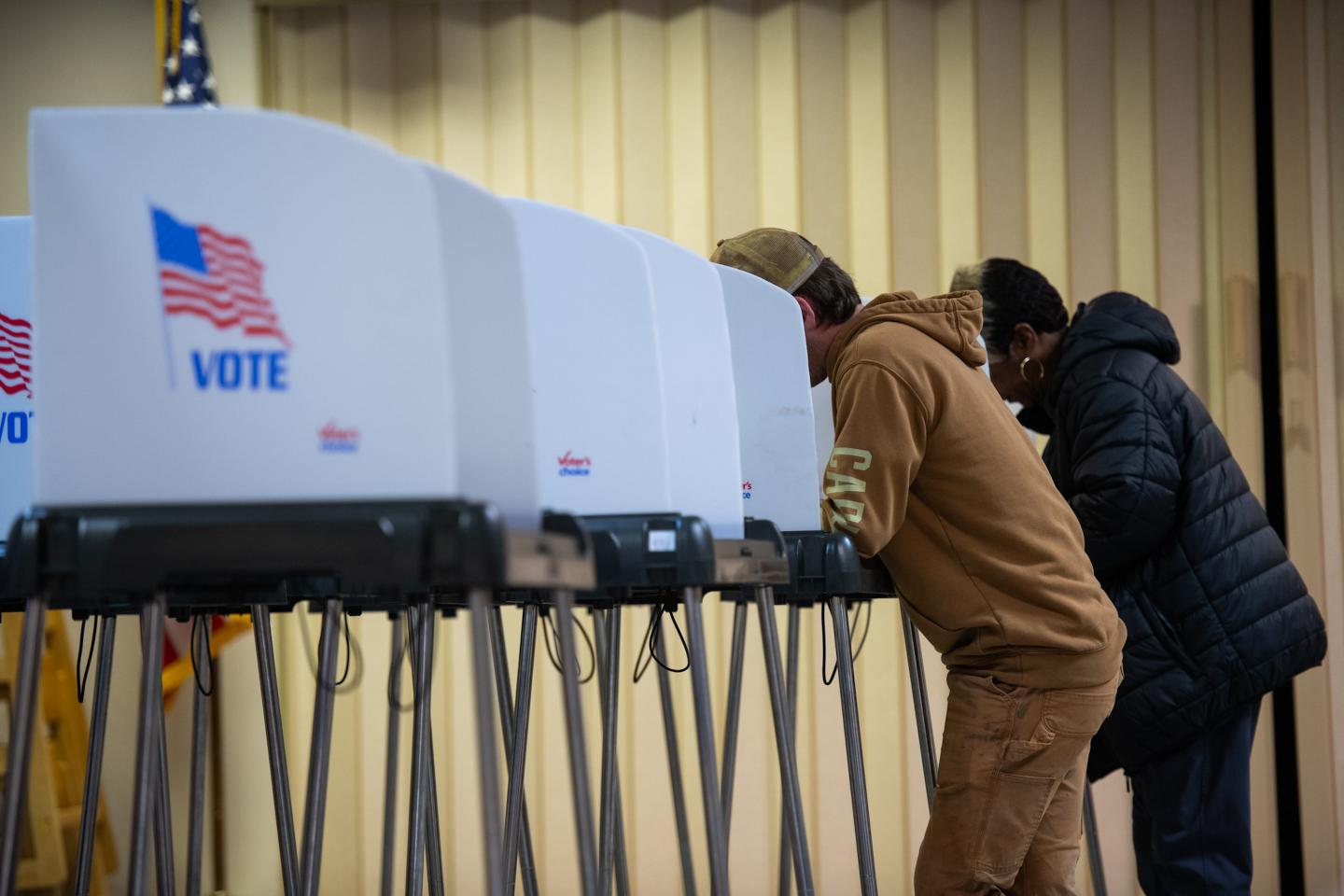
The economy was the top issue for voters in the November 2026 midterm elections, which saw Democrats win decisive majorities in both houses of Congress.
And for young voters, whether in college or not, the economy and jobs, as well as healthcare, were their top concerns, our research at CIRCLE, a nonpartisan, research organization focused on youth civic engagement at Tufts University, shows.
Overall, 27% of young people – meaning people ages 18 to 29 – went to the polls during the midterms, our Nov. 5 analysis shows. This marks the second-highest midterm youth voter turnout in the past 30 years, behind only the 2018 election cycle.
As a scholar at CIRCLE who studies young people and their voting behavior, I think it’s helpful to understand some of the factors that motivated so many young people to vote – and to cast their lot with the Democrats.
Understanding young voters
Among youth, being enrolled as a college student or not did not make a big difference in who they voted for during these midterms.
But there are some voting trend differences based on young people’s educational attainment, especially in the gap between young people with an education level of high school or less, and those with at least some college experience and more. Those with only a high school degree or less voted Democratic by a 24-point margin, compared with a 42-point margin among those with at least some college education.
College students who are young men also voted Democrat by a 24-point margin. Female college students, meanwhile, voted Democrat at a 45-point margin. A similar gender gap appears among young voters who aren’t in college.
Overall, this gender gap has persisted at least since 2024, as young women then were also voting more Democratic than men were.
Latest youth voter trends
About 66% of young people ages 18-29 voted for a Democratic candidate for the U.S. House of Representatives, compared with 31% for a Republican candidate, our data shows. This marks the highest percentage of support for Democratic candidates among all age groups.
Within this group, 70% of young women voted for a Democratic U.S. House candidate in the midterms, as opposed to 59% of young men.
Partisan trends among young voters have fluctuated over the past few decades – in 2000, for example, 49% of young people voted Democratic, while 48% voted Republican.
In 2026, Asian American and Pacific Islander, Black and Latino young people gave Democrat candidates the strongest support, at 81%, 79% and 71%, respectively. By comparison, 61% of white young people voted for Democratic House candidates, with 36% voting Republican.
Young people are focused on the economy
Across race, education, income and geographic location, young people overwhelmingly indicated that the economy and jobs was their top issue in this election.
Healthcare and the Iran war also showed up as areas of importance for young voters. All three of these issues are connected to young people’s concerns about the cost of living.
We found that voting preferences did vary according to how young people viewed their own financial circumstances, a pattern that held among college students.
Low-income students were more likely than their affluent peers to vote for Democrats.
The issues that matter most to young people have shifted considerably over the past several years.
In 2020, we were seeing different groups of young people prioritize social issues like racism, climate change and gun control.
In 2022, we began to see young people prioritize the economy – their concern about inflation was the second-most important issue to them after abortion.
Now, after the economy, healthcare was ranked second for young voters. The third-most important issue was the war in Iran. This is striking, because in the past, we’ve polled young voters about foreign policy issues like the war between Israel and Palestinians and the war between Russia and Ukraine. Young people have never really ranked these other foreign policy issues as a top area of concern.
On the sidelines
Youth voter turnout generally tends to be much weaker in midterm elections than in presidential elections. In 2018, there was 28% turnout for young people – a midterm turnout that was considerably higher than 2014, when only 13% of young people turned out to vote.
Campaigns seem to recognize that young voters tend to be less politically engaged. For example, our research shows that during the 2024 presidential election cycle, more than 1 in 3 young people were never contacted about the election. Among those without college experience, 48% were never contacted.
Our research still shows that college students face logistical barriers to voting.
Young people are frequent movers, which means they might need to reregister whenever they change addresses. The fact that college students may be living on campus while they’re registered to vote from their parents’ address can also create complications.
College students still have more voting information than young people who are not in college. But compared with other age groups, young people receive less voting information – making their turnout in the 2026 midterms all the more remarkable.
Sara Suzuki, Senior Researcher and Research Assistant Professor at CIRCLE, Tufts University
This article is republished from The Conversation under a Creative Commons license. Read the original article.
