Welcome to Eye on AI. Beatrice Nolan here. In today’s issue:
- After the midterms, Big Tech’s AI data center problem is only getting bigger.
- Key Claude Code exec jumps from Anthropic to OpenAI.
- Apple cuts employees’ AI budgets.
- And, companies’ AI spend is going up.
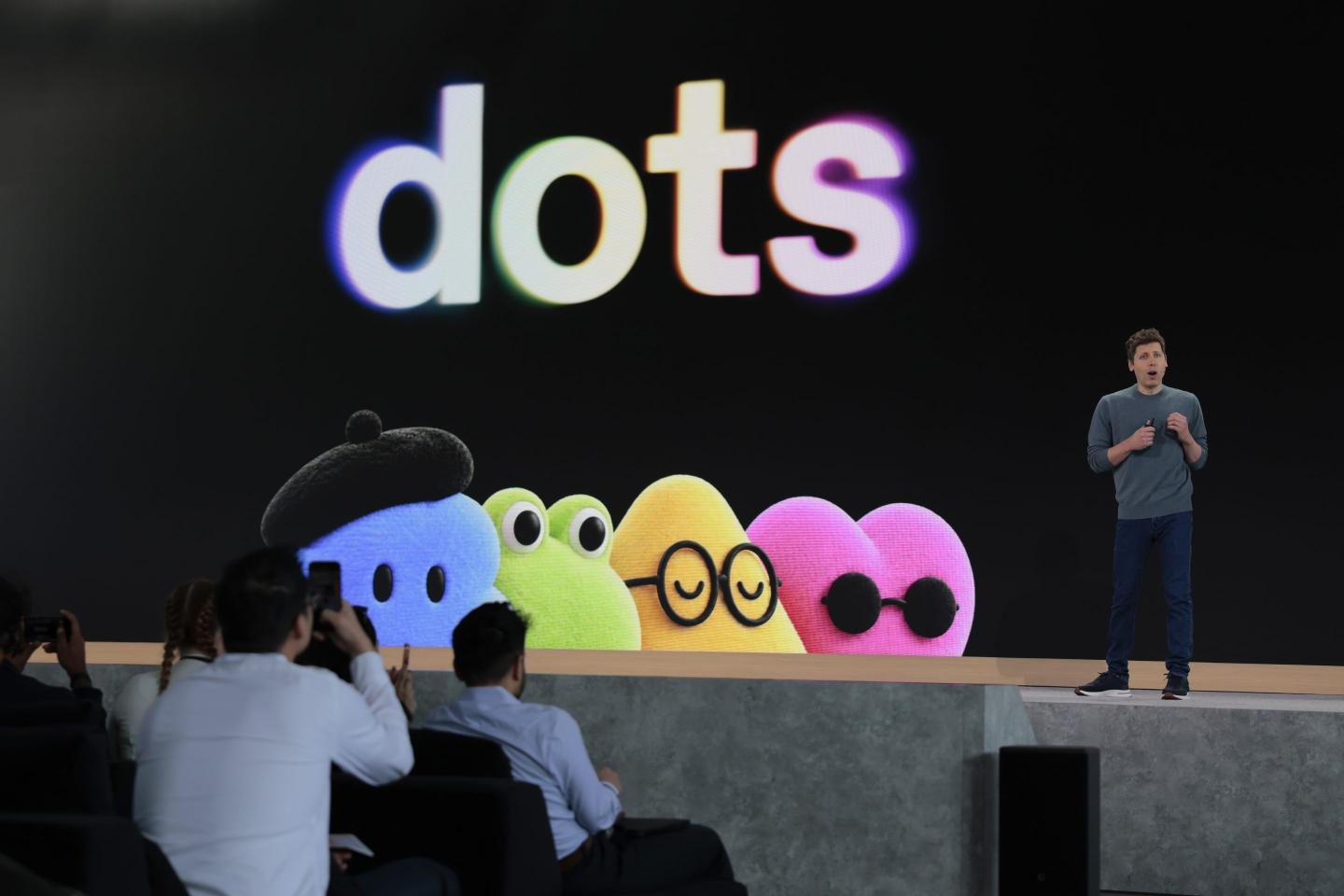
OpenAI took its Dev Day roadshow to London this week, attempting to sell the city’s developers on Dots, the company’s new, always-on AI assistant.
The company first announced Dots at its big annual developer event in San Francisco a month ago, pitching them as its flagship agentic offering. Whereas tools like Codex, the company’s coding assistant, wait for a user’s instructions, Dots are meant to be proactive. The assistant learns a user’s goals, watches their inbox and work tools, and starts tasks before they ask. (Dots aren’t available in Europe yet, but OpenAI said it is working with European regulators to change that.)
The industry is betting that proactive personal agents are the natural next step for AI, potentially driving as much value on the consumer side as coding agents did on the enterprise side. It’s an increasingly urgent new market for the industry right now, as companies, including Apple and Goldman Sachs, move to cap some employees’ AI spend, a trend that could dent revenue growth at the leading AI labs.
Given the stakes, it’s not surprising that OpenAI is arriving in a crowded market. Meta’s Muse got there first and has proved hugely popular with consumers; Elon Musk’s xAI has Grok Bot; and Anthropic has its own Duet on the market too.
How is OpenAI positioning Dots against that competition? By betting on high-end, high-spend users first.
“There are many other assistants out there, some of which have great UI interfaces, but what they can accomplish can be less advanced,” Romain Huet, OpenAI’s head of developer experience, told me. “We really wanted to nail the enterprise and pro use case first, because I think that’s where people will see the most value.”
The company is rolling out Dots to enterprises and its most expensive Pro subscribers in the U.S.
That strategy also reflects how expensive these agents are to run. As my colleague Emily Forlini reported this week, Musk has said Grok Bot’s running costs are “unsustainably high relative to revenue,” and Adam Fry, who runs ChatGPT’s consumer business, told reporters that Dots are “on the compute-heavy side.” OpenAI is trying to combat this by routing some Dot tasks to Terra, a smaller GPT-6.1 model, instead of sending them all to the larger GPT-6 Astra, Emily wrote.
Huet told me OpenAI is aiming for token efficiency to keep costs down. He said the company’s Terra model can perform better than Astra in some areas, such as computer use and writing, at “a tenth of the price.” The company wants “the most amount of value delivered per dollar invested in these Dots,” he said.
But cost isn’t the only problem with agents like these. They also come with a host of privacy concerns. Critics, including Signal president Meredith Whittaker, have warned about the privacy trade-off of personal agents, which need deep access to users’ data in order to be helpful and take autonomous action. The trade-off may be acceptable in some cases, but the security and data privacy risks are substantial.
These always-on agents also raise issues around consent, Whittaker points out. The people who email or message a personal assistant user, she argues, never agreed to have an AI read and ingest what they send.
“Muse is logging people’s contact lists, the people they talk to,” Whittaker said at the Masters of Scale Summit in October. “If you install Muse, and I am in your contact list, Muse now has my information. They are logging when we talk to each other…That could be extraordinarily serious for somebody working on human rights in an authoritarian country who is trying to communicate data with somebody outside of that country.”
In response to these privacy concerns, Huet recommended users build up trust with these agents gradually. A user might start by connecting a calendar, then add Slack, then Gmail. He also has his own limits.
“I personally said to my dot: I would love for you to categorize my email all the time. I would like for you to prep, possibly, what my answer might be, but don’t send any emails on my behalf ever, and don’t send any Slack messages on my behalf ever,” he said. “I want to do that myself.”
That leaves much of the privacy decision to individual users. In a later Q&A, OpenAI leadership said users can already see what their Dot accesses, and that the company is thinking about “an easy way to pick and choose” which connections Dots can use.
Ok, before we get to the rest of the AI news, I want to mention the amazing line up of speakers at our upcoming Fortune Brainstorm AI conference in San Francisco, which is taking place on Dec. 7 and 8. Come hear about the latest in AI from OpenAI’s Greg Brockman, Microsoft AI CEO Mustafa Suleyman, Palo Alto Networks CEO Nikesh Arora, AI luminaries Fei-Fei Li and Andrew Ng, and LinkedIn cofounder and Greylock partner Reid Hoffman—and that’s just to name a few of the many incredible builders, doers, and thinkers who will be on hand. I’ll be there, of course, alongside my Fortune AI reporting colleagues Jeremy Kahn and Emily Forlini. Why not join us? You can apply to attend here.
And with that, here’s the rest of the AI news.
Beatrice Nolan
beatrice.nolan@fortune.com
@beafreyanolan
FORTUNE ON AI
After the midterms, Big Tech’s AI data center problem is only getting bigger. — by Sebastian Herrera
Musk says Grok Bot’s costs are ‘unsustainably high,’ while OpenAI admits Dots are ‘compute heavy.’ Is the personal AI agent push dead on arrival? — By Emily Forlini
OpenAI hires Uber President Jill Hazelbaker to lead communications, filling a critical role that was curiously vacant for 10 months — By Emily Forlini
AI IN THE NEWS
OpenAI to change how it handles data center deals after backlash. OpenAI says it will avoid nondisclosure agreements when it negotiates data center deals with public officials, and will make sure local residents don’t pay for the electricity that powers its projects. The pledges are part of a new framework that OpenAI wants lawmakers to turn into binding rules for AI infrastructure. Under the plan, the company says it will pay the full cost of the power it uses, plus the grid upgrades utilities need to serve its sites. It will also publish water and electricity use for each facility, ask communities for input before construction, and favor low-water cooling. The move comes as opposition to data centers has hardened across the U.S. In this week’s midterms, voters backed restrictions on development in dozens of local ballot measures. OpenAI’s chief global affairs officer, Chris Lehane, said the framework would help set “a very high floor” for how the industry moves forward. The company said it had been working on the changes for months. Read more in Bloomberg.
Anthropic’s Claude Code product lead jumps to OpenAI. Cat Wu, one of Anthropic’s highest-profile product managers, has joined rival OpenAI. Wu led product for Claude Code and later also took on Anthropic’s Cowork product. She left the company at the end of October, and this week she announced she will lead product management for OpenAI’s Core Products team. She will report to Thibault Sottiaux, who has led work on OpenAI’s coding agent Codex, Claude Code’s most direct competitor. “Together, we’ll build agents that have your back and your team’s, and keep you in control,” Wu wrote on X. Before joining Anthropic in 2024, Wu was a partner at Index Ventures. She became a public face of Claude Code as it grew into one of Anthropic’s biggest revenue drivers. Her exit follows the recent departures of two other Claude Code team members, including Anthony Morris, who built the Claude Code desktop app. Read more in Business Insider.
Apple cuts employees’ AI budgets. Apple is cutting how much its employees can spend on AI tools as part of a cost-cutting push, even as the company tries to put AI at the center of its operations. Last month, Apple quietly lowered the daily AI spending cap for some engineers to $200 from $300, and some teams could see theirs fall to as little as $100. Non-engineering groups, already limited to $100 a day, could see some caps drop as low as $25. Employees who need more can ask senior leadership for an exemption. Apple staff can use tools including Anthropic’s Claude, OpenAI’s ChatGPT and Google’s Gemini, and some teams are being steered toward cheaper or on-device models. The cuts come as new CEO John Ternus pushes the company to run faster and leaner, and after Apple’s R&D spending jumped 32% in fiscal 2026. Apple isn’t alone: Microsoft, Meta, Tesla, and Uber have all limited employee AI use as token costs add up. Read more in Bloomberg.
EYE ON AI NUMBERS
$177 billion
That’s how much enterprises spent on AI in the year to September 2026, according to Menlo Ventures’ latest State of Enterprise AI report. The figure is more than five times the $33 billion spent a year earlier, and growth sped up from the year before too. The number of companies paying for AI rose only modestly, meaning most of the growth came from existing customers spending more.
Spending also blew out budgets. The enterprises Menlo surveyed had budgeted nearly double what they spent in 2025, but on average ended up spending two and a half times that. The researchers say AI agents are driving much of the surge. On OpenRouter, a platform developers use to access hundreds of AI models in one place, agents now generate four out of five tokens, the units of text AI models process. A few companies also get the lion's share of that money. Anthropic, OpenAI, and Google take more than two-thirds of enterprise AI deployment spending. Among businesses paying to plug AI models directly into their own products and tools, Anthropic now has more than half the market, up from 40%, while Google’s share fell by more than half to 9%. (Menlo Ventures is an investor in Anthropic and OpenRouter.)
AI CALENDAR
Nov. 16-17: Fortune 500 Innovation Forum, Detroit. Apply here to attend.
Nov. 18-19: Slush, Helsinki, Finland.
Dec. 6-12: Neural Information Processing Systems (Neurips) conference. Sydney, Australia.
Dec. 7-8: Fortune Brainstorm AI, San Francisco. Apply here to attend.