

Good morning. On Fortune’s radar today:
- Apple CEO John Ternus isn’t talking about “the biggest risk to the Apple ecosystem.”
- Midterms: Are expectations for the Democrats today too high?
- Markets: “Tech wreck.”
- The Fed’s Warsh is behind schedule, if history is any guide.
- How long you have to work to buy one gallon of gas.
- The bitter outlook for candy.
ONE BIG THING
What new Apple CEO John Ternus isn’t talking about: “They don’t want to talk about personalized agents. They’re the biggest risk to the Apple ecosystem”
John Ternus, Apple’s new CEO, spent his first two months in the role celebrating a batch of new products, particularly the release of the foldable iPhone Duo. On Monday, the 51-year-old executive introduced himself to Wall Street for his first quarterly earnings call.
The reception was not so friendly.
While Apple beat September-quarter earnings expectations, investors traded the stock down after hours because of the company’s outlook on margins, which it said will continue to be squeezed by a memory chip shortage and slowing growth in its services segment.
Investors don’t seem convinced its revamped Siri AI product has the winning formula for the AI age. “We’re going into this [holiday period] with more downside than upside,” Apple investor Gene Munster told Fortune’s Sebastian Herrera. On X, Munster wrote after the earnings posted that, “It’s clear they don’t want to talk about personalized agents. They’re the biggest risk to the Apple ecosystem.”
MIDTERMS
For Democrats, election expectations are high. Maybe too high.
Americans will vote in congressional elections today. Midterm ballots usually go badly for the White House as voters register their complaints against the administration. And with high inflation, an unending war in Iran, and a sluggish job market, Americans have much to complain about.
President Trump said these elections are “the most important midterm, I believe, in our lifetime." But the polls show a potential landslide for Democrats in the offing:
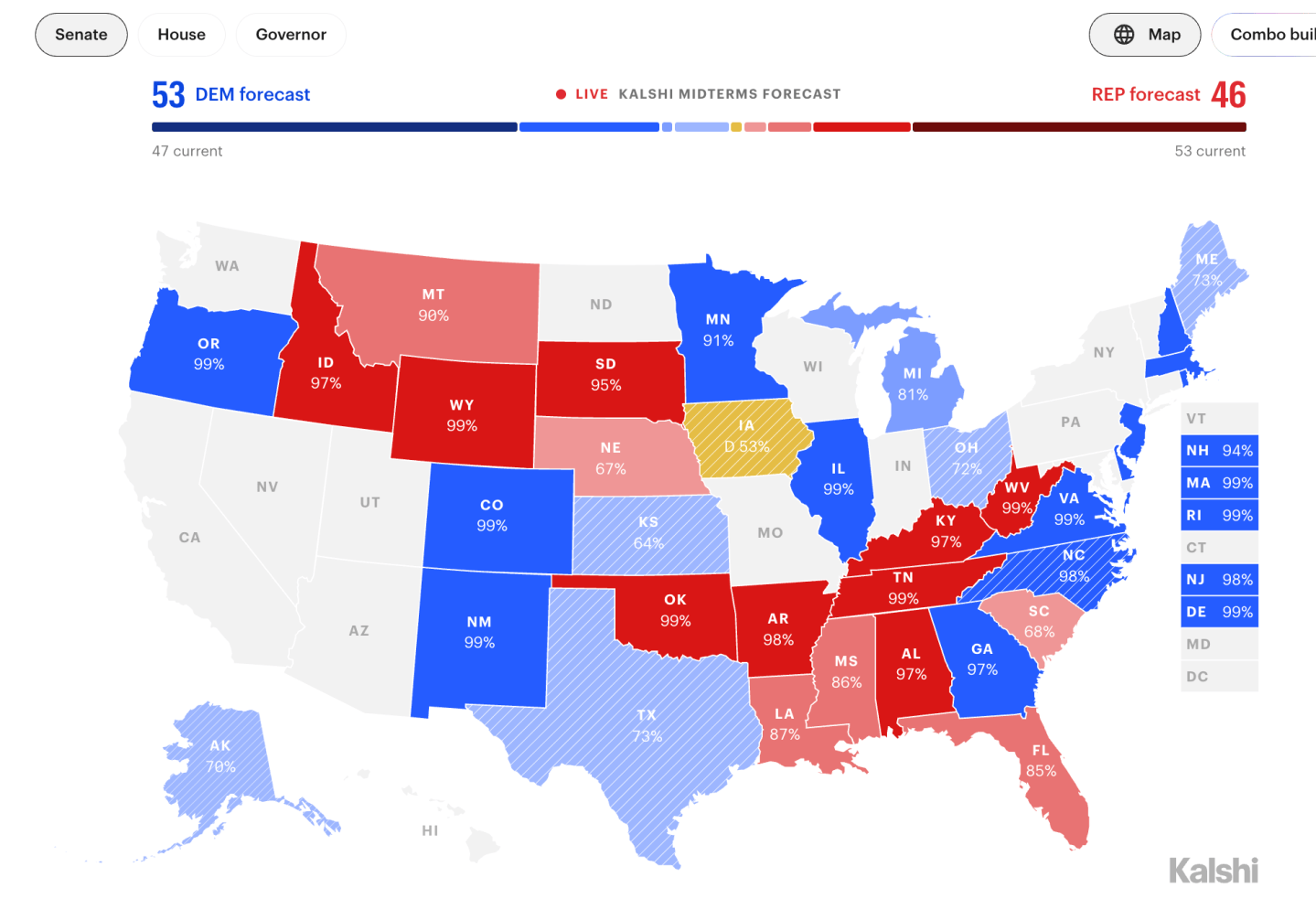
- Bets on the Kalshi prediction market show 75% of bettors think the Dems will take the Senate (with a 53-seat majority, below) and 94% for the House.
- On Polymarket, 77% think the Senate will go blue, 95% for the House.
- Election forecaster Nate Silver puts the probability of Democrats winning the House and Senate at 95% and 80%, according to Axios.
- Democrats have a 14-point lead in generic ballot polling from AtlasIntel.
This sets up a couple of problems. If the polls are wrong, it will set off another round of garment-rending about why mainstream political polling is frequently inaccurate. (In Brazil, Lula was not expected to win the presidency and Israel’s Netanyahu did unexpectedly well.) And if the Democrats fail to take the Senate, the result will look like a disappointment—even though a Senate takeover was unthinkable this time last year.
MORE FROM FORTUNE
What’s at stake in the midterms for you, your business, and your money, according to Fortune’s editors | Fortune Daily
Cheap flights in Europe face a fuel cost reckoning as Ryanair’s CEO says fares could rise up to 20% next year because of the Iran war - Marco Quiroz-Gutierrez
‘Fastest entertainment property in history’: GTA VI arrives to test a thin November box office - Andrew McGowan
How Trump’s trade policy is handing Asia to Beijing - Ted Osius
Sweetgreen managers could earn more than $200,000 a year under a new pay plan, as the salad chain bets higher pay will lift sales - Courtney Vinopal
Anthropic’s growth slowed and costs jumped in the third quarter, updated IPO filing shows - Bea Nolan
THE MARKETS
“Tech wreck” continues: Traders punish anything linked to AI and rotate into non-tech stocks
Apple and Palantir both beat expectations on their earnings calls last night, and so, of course, traders punished both companies by bailing out of their stocks. Apple was down 1.83% at the close and lost a further 4.71% in overnight trading. Palantir closed down 3.13% and lost another 6.29% overnight.
Nasdaq futures were up 0.23% this morning, but that’s the only good news. Stocks sold off in Asia and Europe, and futures in the S&P 500 were down before the open in New York.
What’s happening is a “tech wreck,” as a note from Goldman Sachs put it on Tuesday: Traders are running as fast as they can away from anything linked to AI. But they are rotating into non-tech stocks. The equal-weight version of the S&P 500 (which represents each stock equally) actually rose yesterday. Over the last month, the equal-weight version is up 4% while the market-cap weighted version (which reflects the stocks’ real-life value) is down 3%.
- The S&P 500 closed down 0.51% yesterday. Futures are down 0.12% this morning.
- In Europe, the Stoxx 600 was down 0.44% in early trading, and the U.K.’s FTSE 100 fell 0.58% before lunch.
- Asia: South Korea’s KOSPI was down 3.59%. Japan’s Nikkei 225 was closed for a national holiday. India’s Nifty 50 was up 1.18%. China’s CSI 300 was down 0.2%.
- Brent crude was $106 per barrel.
- Bitcoin rose slightly to $76,908.
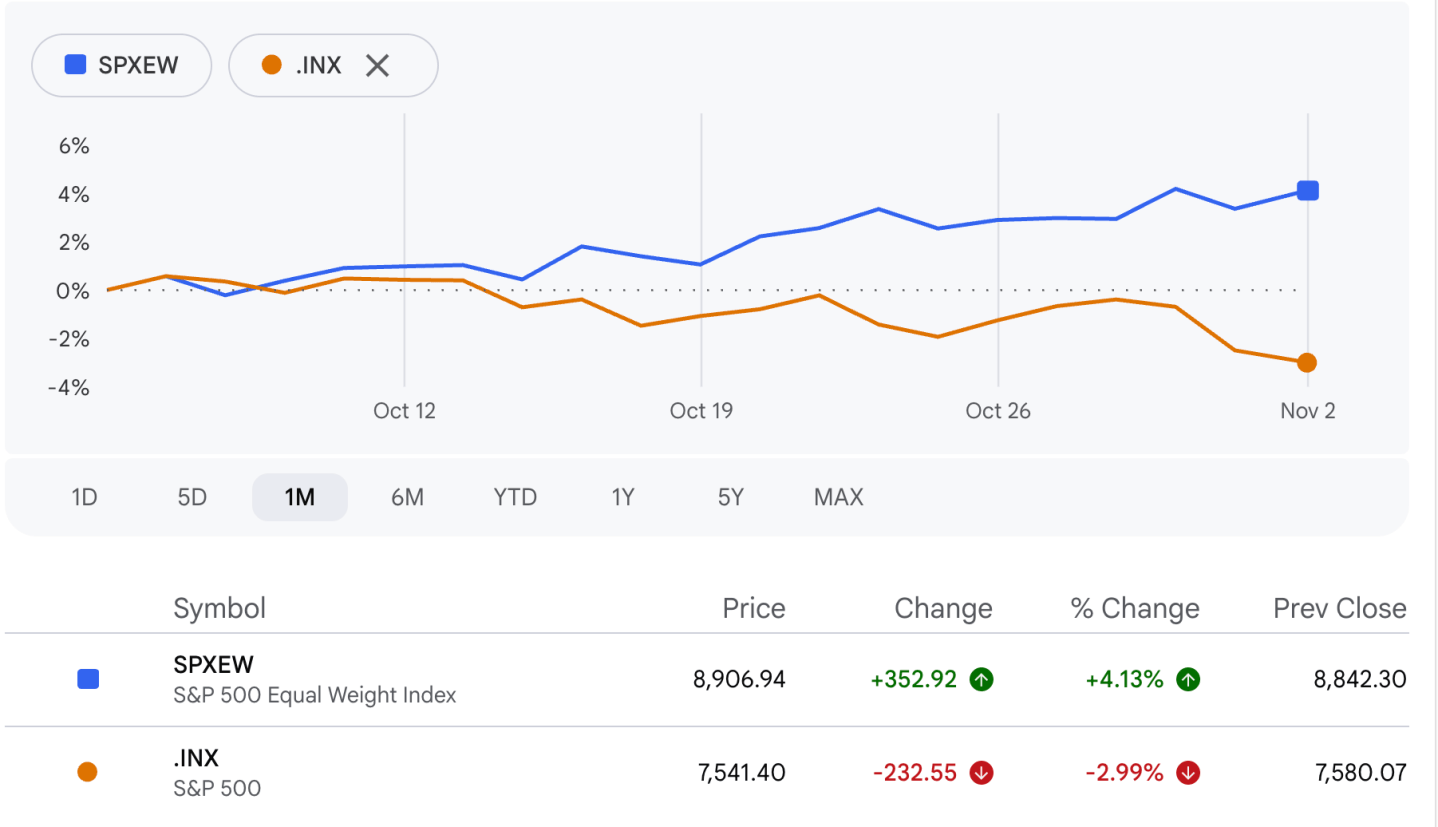
CHART OF THE DAY
The Fed’s Warsh has a way to go to control inflation, if history is any guide
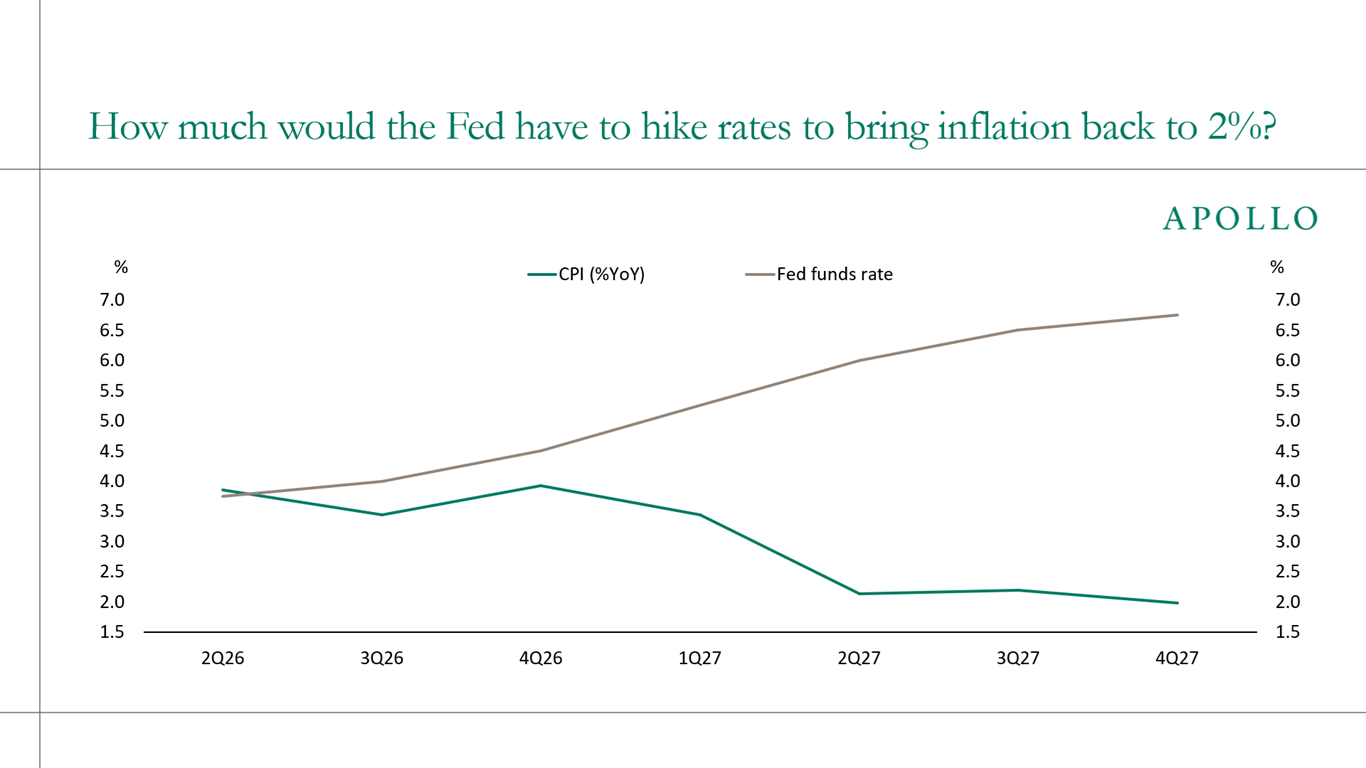
Apollo’s chief economist Torsten Sløk looked at the relationship between Fed interest rates, GDP, and inflation to see what history says the Fed rate should be in order to force inflation back to the target rate of 2%.
It’s bad news for those hoping that Fed chairman Kevin Warsh will usher in a period of relatively lower rates.
Sløk’s research suggests the Fed would need to raise the base rate by approximately 4 percentage points, to 6.75%, by the end of 2027 if he’s going to bring inflation back to the Fed’s target of 2%. Even with the aggressive hikes, inflation wouldn’t reach target until the second quarter of next year.
That action doesn’t fall in line with the expectations of Wall Street, which is generally of the opinion that the Fed is in a one-hike-one-hold pattern for the foreseeable future. There’s also the small matter that the FOMC will be voting less frequently on the base rate, as communicated by the central bank chairman in his last press conference.
NUMBER OF THE DAY
9.5 minutes
Much has been made about the price of fuel in the run-up to the midterms, after voters made it clear affordability was a key issue in the presidential elections two years ago. As crude oil is comfortably above $100 a barrel as this year’s November midterms rolled around, Pew Research asked how that compares to previous spikes.
The nonpartisan research group reported that the typical American would have to work 9.5 minutes to afford a gallon of regular gas in October 2026, and work 14.4 minutes for a gallon of diesel.
Counterintuitively, that’s actually lower than recent periods. Throughout much of 2011 through to 2014, the equivalent gallon of fuel per minute worked was around 13.5 minutes for gas and 14.6 for diesel.
THE FRONT PAGES TODAY
Nvidia orders data centre clients to reduce China exposure - FT
U.S. strikes Iran’s Qeshm Island as Vance hopes for ‘negotiated settlement’ with Tehran - CNBC
Trump Surprises Republicans With Election-Eve Speech About Reflecting Pool - WSJ
Aramco Profit Beats Estimates After Refining Boom, Oil Surge - Bloomberg
Supreme Court Rejects Trump Administration Request to Intervene in California Ballot Case - NYT
Florida Learjet crash victims ID’d as tech entrepreneur, toddler kids, wife and nanny - NY Post
ONE MORE THING
Holiday inflation: The bitter outlook for sweets
Increasing prices at the grocery store are nothing new, but inflation might feel sharper because of what’s in our shopping carts at this time of the year.
Millions of shoppers across the U.S. have just stocked up on candies for trick-or-treaters, and many will now be preparing for next month with purchases of advent calendars. But production costs of cocoa and candy have soared ahead of even the elevated levels of food inflation experienced over the past few years.
In September, the U.S. Bureau of Labor Statistics found around two-thirds of confectionary sales came from Halloween, Christmas, Valentine’s Day, and Easter. It also found that between December 2019 and the most recent data in November 2024, the producer price index for confectionery materials (like cocoa powder and corn sweeteners) had increased 87.6%. The import price index for sugar and confectionery product manufacturing increased 73.3%.
- ➡️ Would you like to sponsor this newsletter? Contact advertising@fortune.com for details.
- ➡️ If you would like to receive this information in your inbox every morning before the markets open in New York, sign up here.