
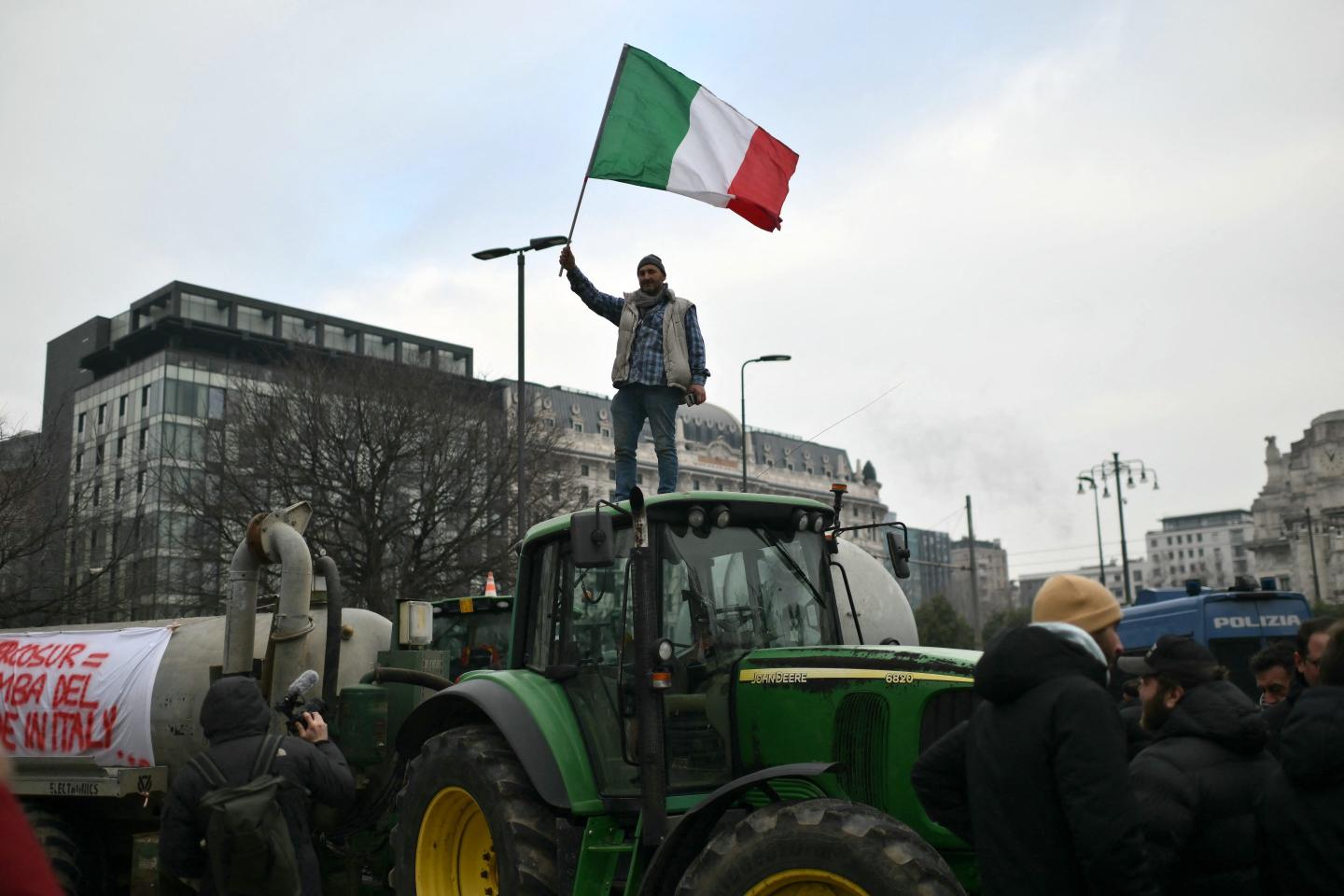
Farmers tipped two bins of manure in front of Turin’s city hall Friday morning, just before tens of thousands of people set off on a march against living costs and military spending. The farmers were acting “against those who want to turn Turin into the city of arms companies,” a speaker told the crowd over a microphone.
Turin was one of more than 50 Italian cities that held protests Friday during a general strike called by the grassroots union USB. Farmers marched alongside truck drivers, students and taxi drivers. The same morning, Istat reported that Italian inflation rose to 5.4% in October, its highest level in more than three years. That’s higher than in the U.S., where prices rose 3.7% in the year through September, and far above China’s 0.9%. Italian energy prices were up 31.4% from a year earlier. Gas and diesel prices are so high that people were spotted riding horses through the streets of Naples.
For Italian farmers, Friday was the latest round in a month-long fight over the cost of running a farm. In mid-October, truckers and farmers began blocking roads, ports and fuel depots across the south. Diesel costs roughly a third more than it did before the Iran war, and a temporary diesel tax discount expired earlier this month. “It’s a peaceful protest and it’s for the benefit of the people,” said Vincenzo Aleccia, president of a trucking group in the Sicilian port of Trapani.
Empty supermarket shelves
The blockades cut off the supply of two of Italy’s best-known foods. Since buffalo mozzarella has to be made within 60 hours of milking, and with trucks stopped, milk couldn’t reach dairies near Naples. Pier Maria Saccani, director of the consortium that oversees Mozzarella di Bufala Campana DOP, said about 1 million liters went unused in a single day.
“Yesterday, no mozzarella was produced,” he told the AP, putting the loss at €3 million in 24 hours. Saccani said producers’ costs had already risen about 30% before the blockades, and that they had absorbed most of the increase themselves.
Pasta makers ran out of ingredients. Rummo, based in Campania, suspended production, and La Molisana halted its plant in Campobasso. Puglia grows about a quarter of Italy’s durum wheat and mills much of the country’s semolina, per Il Sole 24 Ore. Supermarkets in Naples posted apologies on empty shelves, and Sicily ran short of fresh pasta, cheese and meat.
A north-south divide
The regions that grow much of Italy’s food were the ones that ran out of it. Retail group Federdistribuzione said fresh food rotted in warehouses in Campania, Puglia and Calabria. “We realized we were only hurting half of Italy, our half, the south,” Giuseppe Richichi, president of a Sicilian truckers’ association, told AFP.
While protests in Milan and Bologna drew the headlines, the southern blockades were largely ignored. “It’s become impossible to face the costs of fuel,” Luigi Di Benedetto, who manages an agricultural business in Caltagirone, Sicily, told EUobserver.
On Oct. 22, Prime Minister Giorgia Meloni’s government approved a €175.2 million aid package for truckers, farmers and fishermen. That brought total aid to €540 million in tax credits. The last southern pickets came down the next day, but Richichi said the government was only paying money it already owed.
The pressure on food prices goes back decades. Istat data show consumer prices rose about 63% between 2000 and 2025, while food prices rose about 90%.
Italian farmers have marched on cities before. In February 2024, they drove tractor convoys into Rome to protest EU green rules, cheap imports and high costs. Meloni’s government has taken a hard line on this year’s protests. Before Friday’s marches, the Interior Ministry made preventive arrests, and transport workers dropped plans to strike after Transport Minister Matteo Salvini threatened sanctions. In Turin, police briefly used a water cannon to push back protesters who approached the prefecture.