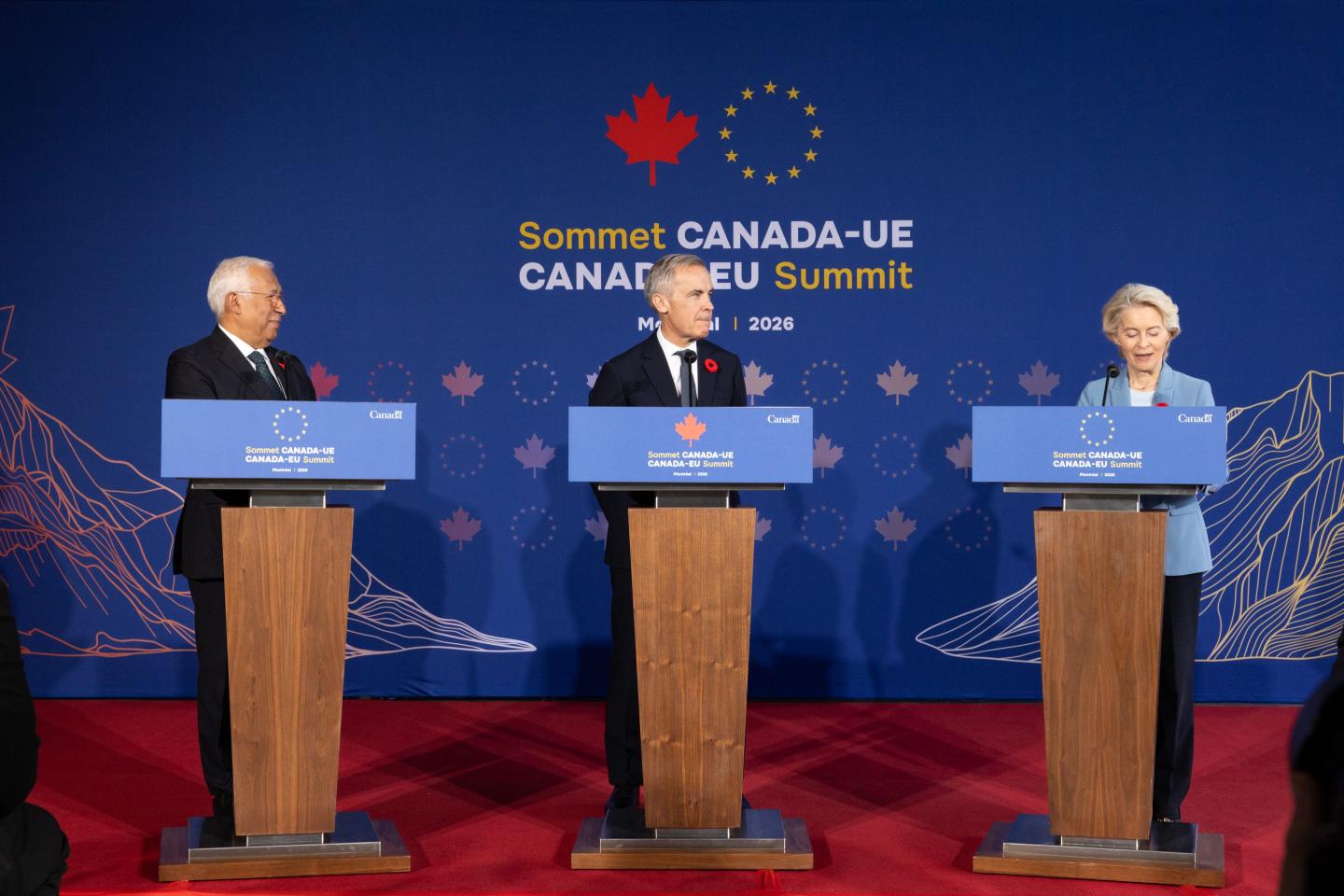
Canadian Prime Minister Mark Carney said Friday he expects to conclude negotiations with the European Union in June to make Canada the bloc’s first “associate member,” as both sides forge an unprecedented alliance to protect their sovereignty in a changing world order.
U.S. President Donald Trump’s trade war and threats against traditional allies have accelerated efforts by Canada and Europe to reduce their dependence on Washington and strengthen their economic and security ties.
“What brings us together goes far beyond geography. We see the world through the same eyes,” European Commission President Ursula von der Leyen said. “These headwinds won’t stop blowing. This change is permanent.”
Carney said the alliance would help Canada and Europe withstand economic pressure and make their own decisions rather than be dictated to by more powerful countries.
Trump has suggested Canada’s proposed EU arrangement could be a “hostile act” and threatened tariffs on Europe if he considered it unfriendly.
The move is aimed at reinforcing sovereignty, Carney says
Asked whether Trump could eventually be invited to join the alliance, Carney did not directly answer but insisted it was not aimed against any country.
“It is about reinforcing sovereignty. Why? So we can live our lives as we choose, our people can live their lives as they choose and have the full freedoms that people enjoy in the European Union and in Canada,” Carney said.
“It’s not against anything, it’s for,” he said.
Carney, von der Leyen and European Council President António Costa launched the “Alliance for the Future” at the end of a two-day summit in Montreal, announcing progress on digital trade, European investment in Canadian critical minerals and artificial intelligence.
“Today we move toward associate membership for Canada, and we launch a new alliance for the future,” Carney said.
But the joint declaration made no mention of associate membership, despite both Carney and von der Leyen championing the designation. Instead, the leaders agreed to define an “ever-closer association” by their next summit in 2027.
Carney said Canadian Cabinet ministers and European commissioners would meet in March before he attends European Council meetings in June, where he intends to conclude negotiations on the proposed relationship. Costa confirmed the invitation and said more details would be announced then.
Von der Leyen said Friday there was broad support for bringing Canada closer to the EU, despite disagreement over what to call the relationship.
“On one thing I’m absolutely sure, having spoken about it in the last weeks, is the broad support of having Canada much, much closer to the European Union,” she said.
A new economic partnership
Canada and the EU already have a free-trade agreement that eliminated most tariffs. They wrapped up negotiations Friday on a new digital trade agreement to make it easier for businesses to sell across the Atlantic.
Canada also signed an agreement allowing the European Investment Bank to finance Canadian critical minerals projects, potentially opening a new source of investment for the country’s mining industry.
Canada will also join a European supercomputing initiative that Carney said could transform research. He said Europe’s JUPITER supercomputer could complete in one day calculations that would take Canada’s most powerful research computer six months.
“A tech startup in Vancouver will have a smoother path to customers in Berlin,” Carney said. “Bottom line: less red tape, more growth, more opportunity.”
The two sides also concluded negotiations on a competition agreement intended to curb anti-competitive practices and lower prices for consumers. They will explore linking their instant-payment systems to make cross-border transfers faster and cheaper.
An alliance beyond Canada and Europe
The broader Alliance for the Future could eventually include other like-minded countries, with Canada and the EU at its core.
Costa said the two sides wanted to create a relationship unlike any previous EU partnership with a country outside the bloc.
“Our relationship is so special that we want to create something new: to go beyond a simple association, everything short of full EU membership,” Costa said.
The leaders also agreed to study the feasibility of exporting Canadian liquefied natural gas to Europe and explore new undersea cables connecting Canada, Europe and Asia.
Canada and the EU will begin negotiations on expanding Canadian participation in Erasmus+, the European student exchange program, and explore ways to make it easier for young people to study and work across the Atlantic.
The two sides also agreed on a new border security arrangement and pledged closer cooperation on defense, cybersecurity, Arctic security and countering foreign interference.
The United States accounted for 71.7% of Canada’s merchandise exports in 2025. Carney wants to double exports to other countries over the next decade.