
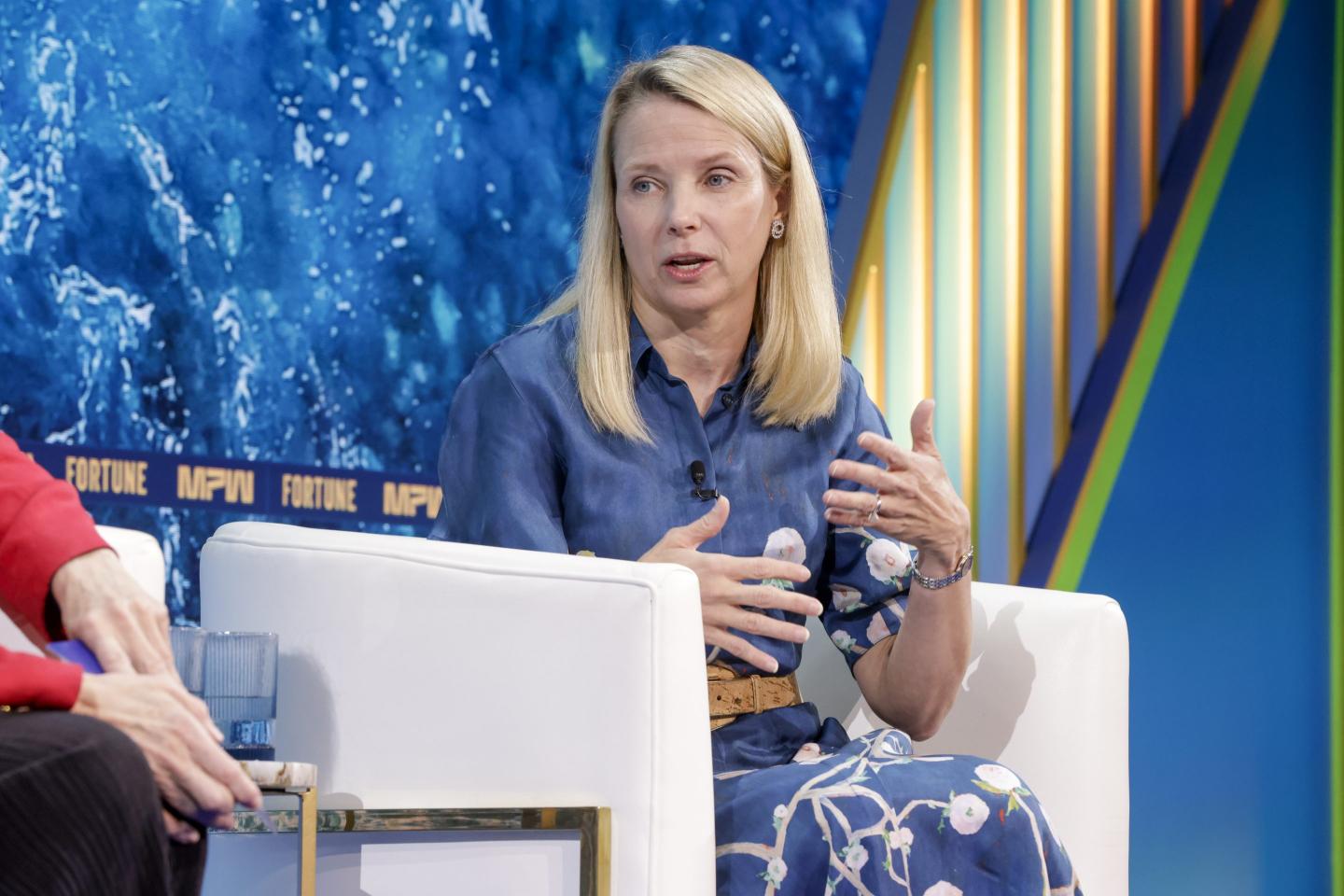
For the past two days, Marissa Mayer has been a main character on social media. The reason? A New York Times story about her startup Dazzle AI that opens with an anecdote: as reported by the Times, the former Yahoo CEO turned to her personal AI assistant to ask it to help her describe her daughter in three bullet points for a school presentation for her birthday.
The example of a use case for an AI assistant—Dazzle is targeting busy moms—has prompted (no pun intended) criticism from all corners—tech skeptics, AI competitors, and the very moms Dazzle is trying to win over to its platform. People have been promised that AI will free them from grunt work and give them time back. But when so much remains uncertain about how AI will impact our future, many remain fearful about how AI will change our relationship to humanity, to each other. And here is an example that seemed to say AI can be used for something at the emotional core of parenting.
Mayer was with us at the Fortune Most Powerful Women Summit earlier this month, also talking about Dazzle, so I reached out to her yesterday to see if she wanted to respond to the backlash. We spoke this morning, and she added some context to what the Times reported. She was testing Dazzle, she told me—specifically its ability to differentiate between her two identical twin girls in photos and give her an answer about one daughter, not the other. She considered this specific prompt not a difficult task to outsource, but a test of how her product would do. “I wasn’t making a conscious decision to outsource. I was making a decision to test the product to see how well it did on a difficult question,” she told me.
Whether or not Mayer intended, the anecdote has served as a lesson in how individual AI use still is. “I wasn’t trying to suggest, everyone use the product like this. We have suggested use cases, and this wasn’t one of them,” she says. “This is an individual experience, and we’ve seen that pretty much everyone uses it a different way.”
Indeed, as AI companies compete to win in the market for personal AI assistants, from Muse to Instinct, the question of what should be outsourced is deeply, well, personal. Nathalie Mansueti Stratton is the cofounder of Hearth, which makes a smart whiteboard and calendar for the home. She tells me that moms who pay more than $600 (plus a subscription) for Hearth want AI to “handle logistics—and nothing more.” They are looking for AI that frees them from logistics and coordination from meal plans to school forms to “spend their mental energy making magic with their kids.”
Leslie Feinzaig, an early-stage investor with Graham & Walker, agrees. “The real opportunity in family AI is for tech that takes care of the gruntwork so that parents can get time back to work, to rest, and to spend time with our kiddos,” she told me.
That’s what Mayer has been trying to say, too—but what one person considers “grunt work” might be a meaningful part of parenthood for someone else.
Mayer has been at the center of commentary about women, motherhood, and ambition since she famously took only two weeks of maternity leave while at the helm of Yahoo. “I didn’t particularly view this as a commentary on my parenting because I was going to do a slide anyway,” she says of this week’s backlash. “I’m not trying to get in between the parenting interaction people have with their child or how people connect with their kids,” she adds. “What I’m trying to do is give them time.”
Emma Hinchliffe
emma.hinchliffe@fortune.com
The Most Powerful Women Daily newsletter is Fortune’s daily briefing for and about the women leading the business world.
ALSO IN THE HEADLINES
Anthropic has officially unveiled its IPO plans. Its S-1 paperwork became available yesterday. We learned more about its structure. Daniela Amodei, No. 22 on the 2026 Most Powerful Women list, is one of seven founders with more than 200 million shares each. That will make all of them billionaires.
The new Kim Kardashian bio. Citizen Kim, out today, is an in-depth authorized biography of the reality superstar. Anna Wintour connected Kardashian to writer Jonathan Van Meter. He's been following her for the past five years. Why did Kardashian agree? "I just thought to myself: You know what? There’s so many stories out there. Why wouldn’t I want something that was a little bit more authentic and just completely real?" she says.
Game 6 of the WNBA finals will be at 12:30pm on Thursday. The scheduling snafu is an "embarassment" for the league, some are arguing, and shows how far there still is to go in women's sports, where games can still get prioritized below other venue commitments. The Golden State Valkyries (so 9:30am PT for that team's fans!) are up against the Atlanta Dream in the finals, and the game's time and location weren't even scheduled until Monday.
New Fortune 500 female CEO alert. Manpower Group, the workforce solutions company that ranks No. 247 on the Fortune 500, just tapped Becky Frankiewicz as CEO. She was promoted from president and chief strategy officer and used to run PepsiCo's Quaker Foods North America business. She starts on Jan. 1.
ON MY RADAR
The social society helping women join the AI boom Wired
Natalie Nakase’s unlikely journey: a 5-foot-2 walk-on, coach in Japan, and now in the WNBA Finals The Athletic
Maria Bamford asks for the check New Yorker
PARTING WORDS
"Every time has dark moments, but it feels like there’s a lot of really heavy stuff going on. It’s just ever-present in our face, and so it does feel like the biggest service you can do right now as an artist is to deliver some joy."
—Natalie Portman, on the cover of Harper's Bazaar