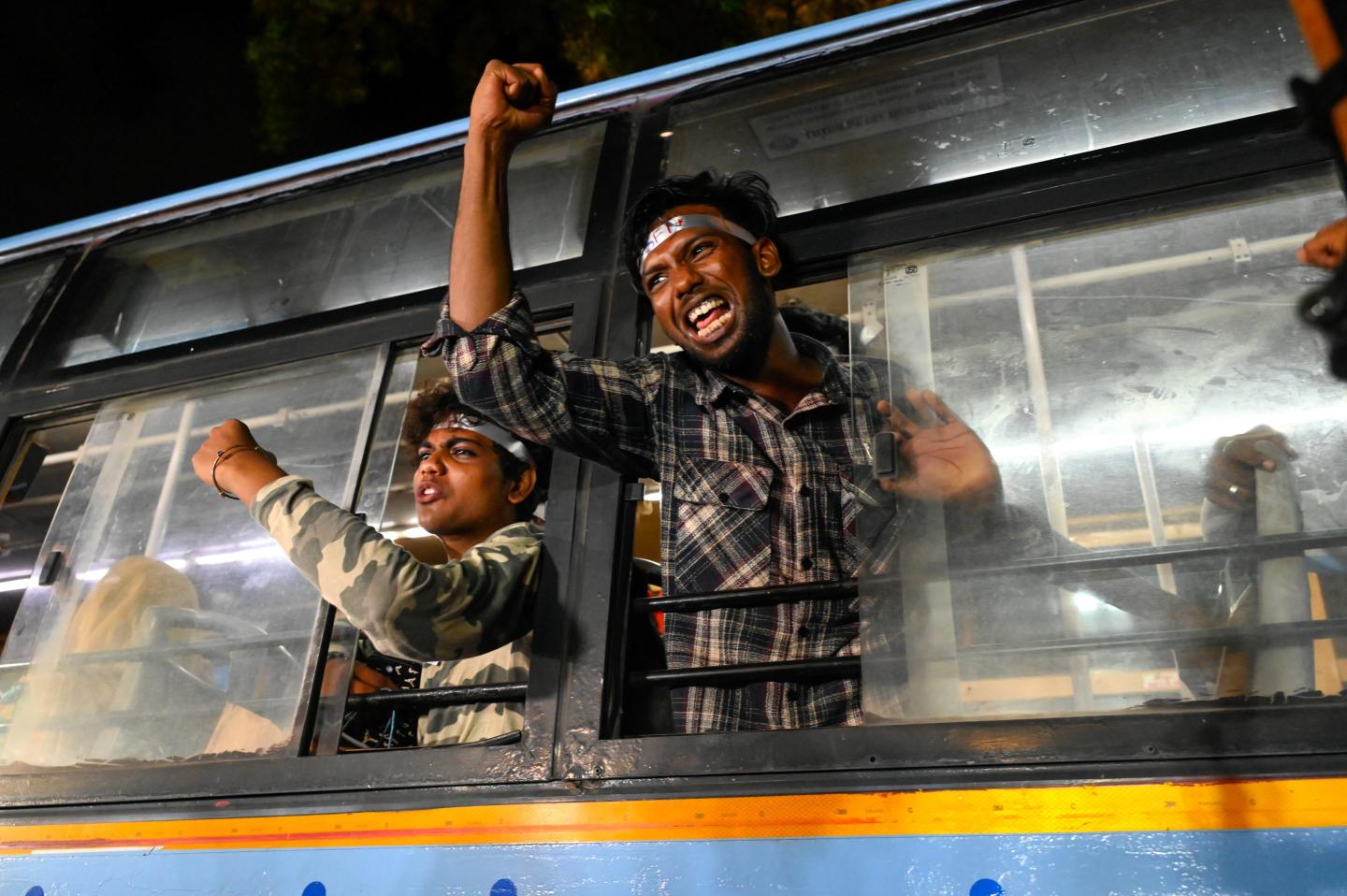
Five months after its founding, India’s Cockroach Janta Party, known as the CJP, has revealed what youth-led democratic movements can achieve – and how hard they are to sustain.
The movement was formed in May 2026 to protest the government’s cancellation of medical school entrance exams and after India’s Chief Justice Surya Kant likened unemployed youth to cockroaches. By July, the largely Gen Z movement had scored an early victory with the resignation of Education Minister Dharmendra Pradhan.
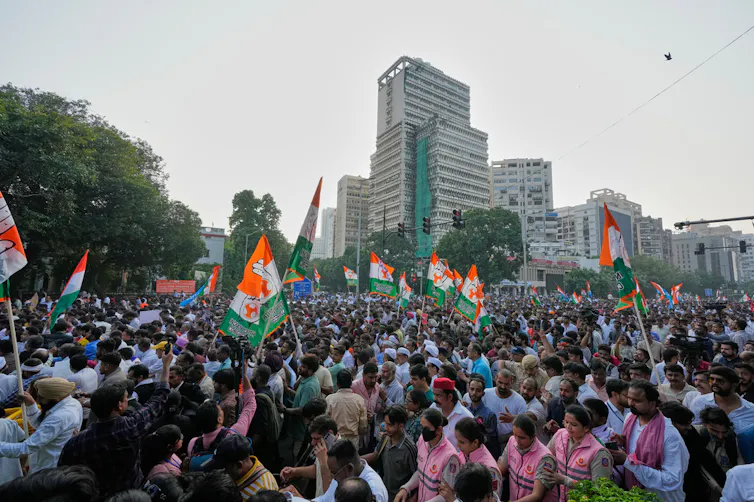
The CJP has since moved on to a much larger political issue: The Election Commission’s reported deletion of approximately 130 million names from the voter rolls. Since Oct. 2, protesters have descended on the streets of Delhi, Mumbai and other cities demanding the resignation of Chief Election Commissioner Gyanesh Kumar, halting the deletions pending an independent inquiry, and the restoration of the old electoral rolls before the next elections.
In the process, the CJP has encountered strong government resistance.. Amid a crackdown on protests, two of the movement’s spokespersons – Ashutosh Ranka and Saurav Das – were detained, while Prime Minister Narendra Modi and his right-wing populist Bharatiya Janata Party, or BJP, have refused to bend on the voter roll issue – instead accusing protesters of undermining democracy.
Nonetheless, as a long-time scholar of Indian political parties and social movements, I believe the CJP’s protests have revealed people’s deep-seated anxieties over democratic erosion in a country of nearly 1.5 billion. Through courage and acerbic wit, the CJP has done something that has eluded conventional opposition parties over the past 12 years: puncturing the ruling party’s aura of invulnerability. In doing so, I believe the protests have challenged the government’s view of who “the people” are, what democracy means, and who speaks for youth, women and the politically marginalized.
Defining ‘democracy’ and ‘the people’
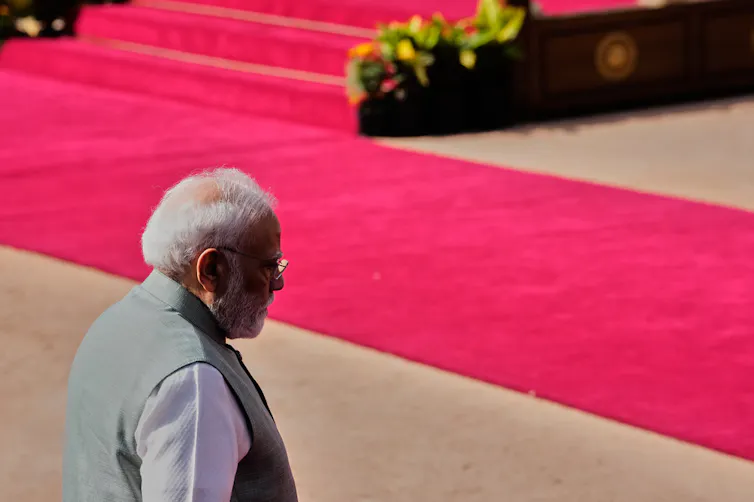
Modi often describes India as the “Mother of Democracy,” a reference to its civilizational heritage and to Bharat Mata, the Hindu mother goddess. Democracy, he insists, is not a Western import but a native inheritance. The implication is meant to be reassuring: India has always been democratic and always will be.
But some outside monitors disagree. Sweden’s V-Dem Institute classifies India as an “electoral autocracy,” meaning that although it regularly holds multiparty elections, it fails basic democratic benchmarks such as legislative and judicial checks and balances and citizens’ active political participation.
Judged by how the country treats dissent, the record is damning: using anti-terrorism laws to jail activists without trial, barricading protest sites, internet blackouts and police brutality.
By contrast, the CJP considers peaceful protest, along with upholding the country’s constitution, essential elements of democracy. Demonstrators regularly circulate images of B. R. Ambedkar – the chief architect of the Indian constitution – on posters, in slogans and in songs. Like Ambedkar, 30-year-old CJP leader Abhijeet Dipke is a Dalit, or untouchable within the Hindu caste system.
Critics argue that the BJP defines the nation through Hindu civilizational identity, which is exclusionary because it rejects India’s rich Muslim historical traditions and casts doubt on the political loyalties of the country’s Muslims, who constitute about 14% of the population – 197 million people. By contrast, the CJP draws no line between insider and outsider by faith, caste or birth, and it defines community by shared commitments.
The voter roll struggle shows what is at stake in the question. The Election Commission says the revision will remove duplicate entries, deceased voters and noncitizens. But critics worry that the burden of proof falls on voters. Consider how hard it is for poor Muslims, Dalits and migrant workers to produce decades-old birth, education and land certificates. Moreover, those whose names are struck from the electoral rolls fear being branded illegal immigrants.
Cracks appear in BJP’s dominance
While the BJP had held the prime minister’s office before, Modi’s 2014 election marked a sea change in Indian politics, disrupting the Congress Party’s dominance.
The BJP owed it electoral success in part to attracting young and first-time voters with promises of employment, economic growth and what is known in Hindi as “achhe din aane waale hain,” or “good days are coming.” Since the BJP took office in 2014, the country has charted strong GDP growth, but the macroeconomic success has been belied by ongoing and rampant inequality that falls especially hard on the poor and young.
The BJP claims to have fulfilled some of its more targeted campaign promises, such as engaging in merit-based public sector hiring. Yet 40% of Indian college graduates under 25 are unemployed. Paradoxically, the unemployment rate for youth who cannot read and write hovers around just 3.4%. For college graduates, who are the CJP’s main constituency, it is nearly nine times higher at roughly 29%.
Seizing on this building discontent, the CJP uses the slogan “Achhe Din” ironically, on posters and memes. Its manifesto opens: “If you are going to call us cockroaches, the least you can do is pay our rent.” It calls for making “lazy” – a code word for the unemployed – a protected political identity.
Underlying the joke is a serious point: that stigmatization of the jobless offends millions of impoverished people, something critics note is protected in the dignity and equality guarantees of articles 21 and 14 of the Constitution.
Who speaks for women?
The BJP has gained women’s electoral support through a combination of targeted welfare schemes, support for increased women’s representation in legislatures and endless talk of women’s empowerment, or “nari shakti.”
However, masses of women protesters have challenged state-defined women’s empowerment. They stop police vans carrying detainees, scale barricades and criticize the prime minister.
One of the most prominent among them is Neha Bora, a Ph.D. student and president of the left-wing All India Students’ Association, whose blunt messages to Modi has seen her profile skyrocket. Modi has said he has been subject to vulgar abuses by the protesters and was shocked by how “our daughters” could use such foul language, but he viewed them as “misdirected children” and was ready to forgive them.
The throngs of women who are protesting express deep discontent with the government’s paternalism. They challenge its Hindu-inflected understanding of empowerment and insist on speaking for themselves rather than being spoken for. They express outrage at the government’s brutal response to their peaceful protests. They describe how the police have beaten and sexually harassed them, while anonymous self-styled guardians of religious morality engage in doxing, threats of rape and acid attacks, and circulate demeaning AI-generated images of them. For protesters, that record sits uneasily besides the prime minister’s denunciation of violence against women.
‘Cockroaches never die’
The CJP motto, “Cockroaches never die,” has wide resonance. Protesters have survived, but not escaped, violence, incarceration, internet blackouts and police blockades. The sunglass-wearing cockroach mascot makes a mockery of leader-centered nationalist branding.
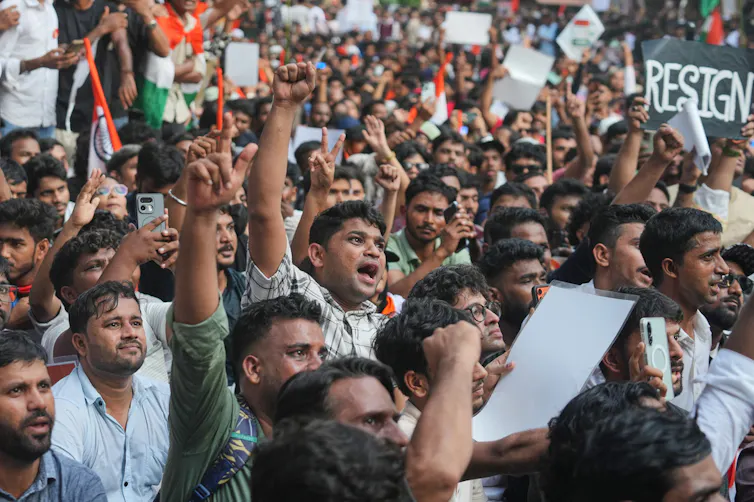
Recent youth-led uprisings in Bangladesh and Nepal have shown how quickly online mobilization can outrun official control. What distinguishes the CJP is that it pairs humor with legal and technical infrastructure. Its online portal Saakshi vault, which means “witness,” collects photos and videos of police violence that protesters upload; volunteer lawyers use these to issue complaints against officers.
The CJP’s recent and remarkable successes do not mean that the movement is likely to disrupt the BJP’s hold on power in the next parliamentary elections in 2029. For now at least, the CJP is fairly concentrated in urban strongholds and would need to build organizational infrastructure and develop long-term demands.
However, a generation that a government minister wrote off as lazy and expendable has exposed the cracks in the system that the chief justice defended. Whatever form it takes, the movement provides a vision and reminder of what democracy looks like.
Amrita Basu, Professor of Political Science, and Sexuality, Women’s and Gender Studies, Amherst College
This article is republished from The Conversation under a Creative Commons license. Read the original article.
