
At a time when every company is warning employees not to blindly trust in anything—even corporate emails, lest they be from fraudsters trying to manipulate and socially engineer—trust has become more challenging to engender and maintain.
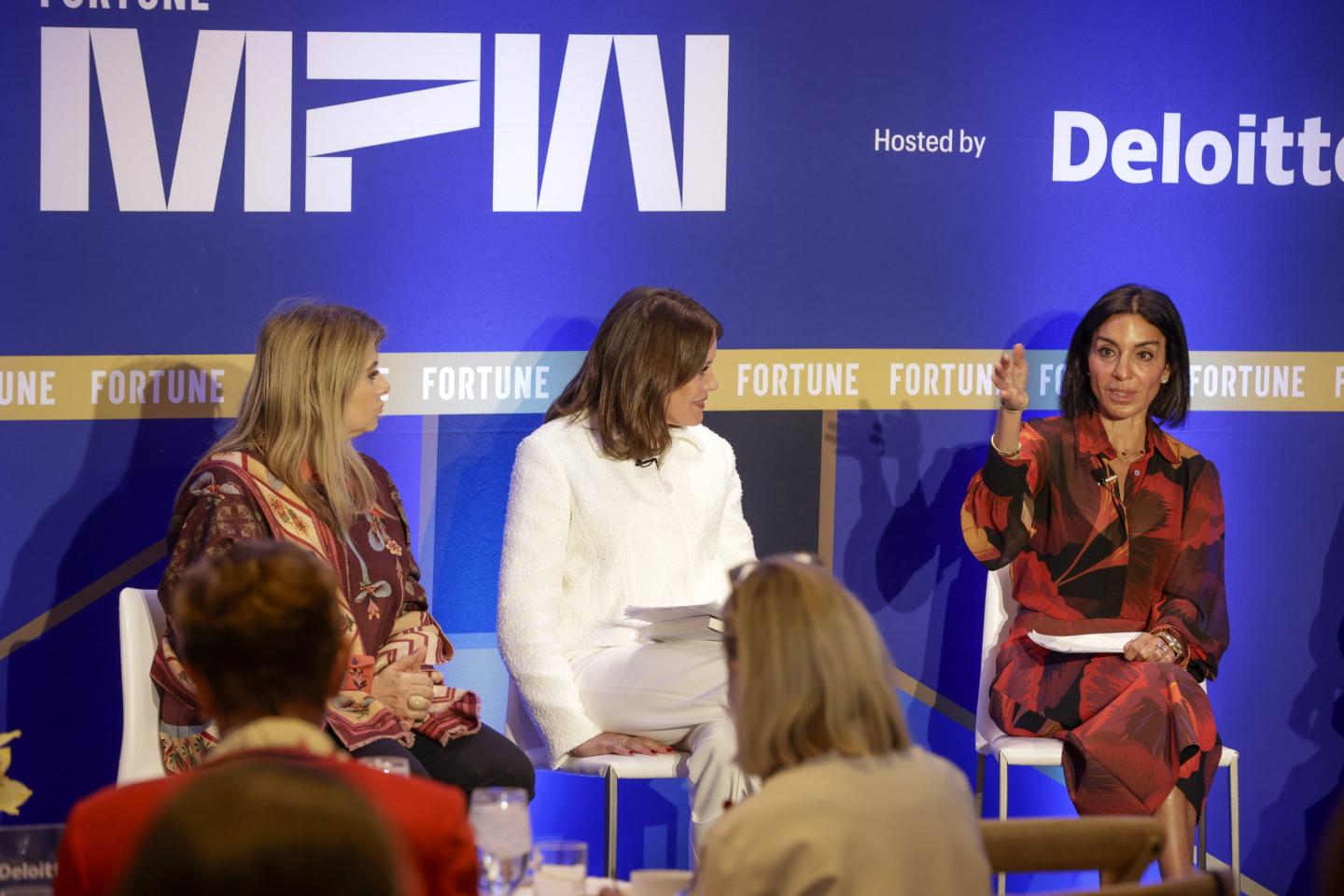
Advisory firm Deloitte breaks it down into four factors, said U.S. Human Capital Practice leader Simona Spelman, who spoke at Fortune’s Most Powerful Women Summit in Santa Barbara, Calif., last week. Those pillars are reliability, transparency, capability, and humanity, said Spelman, who added trust seems like a “soft” word, but has the power to galvanize or drag on momentum as companies try to advance. Moreover, maintaining balance among the four pillars on a go-forward basis will continue to be an evolving issue to measure as companies press further into AI, particularly after some layoffs have been blamed on replacing employees with AI instead.
“Getting the right balance of those four things is really what measures trust,” Spelman said.
That means a single factor that veers into distrusted territory drags down the whole trust infrastructure, even when a leader is strong everywhere else. Spelman, who shared additional data after the panel, said 82% of employees are motivated to give their best when they distrust none of the four factors. One distrusted factor cuts that to 37%, a drop of more than half. A second brings it down to 28%, and by the time all four factors are distrusted, only 7% of employees are motivated. Meanwhile, a robust 96% of employees who trust their leader on all four factors are motivated to work.
“So think about that,” Spelman advised the room.
Jennifer McCollum, president and CEO of gender equity and workplace inclusion nonprofit Catalyst, said periods of massive transformation offer “a huge opportunity to either engender trust or really screw it up.” Catalyst’s research has shown how large the gap can be. McCollum, who spoke on a panel with Spelman, said Catalyst found 68% of leaders claim they have plans in place to reskill employees, but among employees, only 34% said they believe their organizations make AI training open to everyone.
“Our intentions are good, but we can really get it wrong,” McCollum said.
The same study found only one-third of employees believe their leadership teams act with integrity during business disruption, and just 16% said leaders remained confident and supportive during AI-driven change. Employees are watching how leaders carry themselves during the transition, she said.
There’s also a hidden double bind for women, McCollum warned. Forthcoming research will show that when women use AI at work, their credibility is questioned—but when they don’t use AI, their capabilities are questioned. The evolution of the double bind means shifting challenges as new generations enter the workforce, she said.
Therefore, as AI spreads, technology alone will eventually cease to be much of a competitive advantage, noted Francesca Cornelli, dean of Northwestern University’s Kellogg School of Management. What will set companies apart, Cornelli said, is “investment in the people, in the human capital.”
Moreover, how a company introduces AI matters. When a leader announces that a new tool will simplify processes, there’s an inadvertent message sent to employees.
“All they hear is, ‘you won’t need me anymore,’” Cornelli said.
People become more invested when AI is framed as a way for everyone to help the company get better—but only if the investment is real.
“If you just use words, people will see through it,” she said.
Spelman cited a statistic showing the imbalance: About 93% of AI investment goes to the technology while 7% goes to the human side.
“You can sit here and say, ‘yes, we’re invested,’” she said. “But if you’re only spending 7% on what the impact is to the work, the workforce, or the workplace, you’re really missing the mark.”
As technology and knowledge become democratized, she said, businesses will be set apart by “enduring human capabilities like empathy, curiosity, and judgment.”