
Good morning. On Fortune’s radar today:
- Can CoreWeave handle all that debt? Maybe!
- Markets: At the end of a storm there’s a golden sky.
- Maps showing the states that are most opposed to AI data centers.
- Chart: The cost of AI is falling extremely quickly.
- Inflation is mostly gasoline.
- The Republican billionaire accused of fueling an infestation of rats in Chicago.
ONE BIG THING
CoreWeave investor explains how the loss-making AI ‘neocloud’ provider plans to claw its way out of a $52 billion hole
CoreWeave—and the vast amount of debt it has taken on to fund its business—dragged down the entire stock market this week. According to its Q2 earnings release, it had operating lease liabilities of $16.3 billion and total debt of $35.6 billion. The company only made $4.6 billion in revenue for the first six months, and its operating expenses exceeded its sales, leaving it with a net loss of $1.4 billion on the bottom line in the period.
To put it simply, how will a company that makes no money pay back $52 billion in combined debt and lease commitments?
The short answer is that the company has $103.7 billion of “remaining performance obligations” (RPOs), 41% of which is scheduled to be paid to CoreWeave through 2028, its Q2 disclosure states. Those RPOs are “take or pay” agreements that CoreWeave’s customers cannot weasel out of.
Not everyone is a believer. “If CoreWeave is counting on Microsoft to honor its contracts and bail them out of extreme debt and losses I have a bridge in Brooklyn I’d like to sell them,” Francine McKenna, the accountant and investigative journalist who has taught at The Wharton School, told Fortune.
MORE FROM FORTUNE
Why OnlyFans Won’t Let AI Take Over | Fortune Daily
The ultra-rich are piling into Rolexes, rubies and Klimts as inflation hedges—but the real return may be about more than money - Molly A. Wallace
‘Europtimism’ clashes with 1 in 3 founders wanting out. We need the EU to finally become a true single market - Sophie Dembinski
Gen Z founders are hiring while Boomers’ corporate America freezes out—‘I’ve already proven to myself that I can thrive in this’ - Muskaan Arshad
‘I told you so’: China’s chip sector is making breakthroughs—and U.S. export controls are the reasons why - Nicholas Gordon
Exclusive: ‘I’ve seen this movie before’: A Michigan-raised ex-Tesla exec raises $45 million to break China’s grip on batteries - Nick Lichtenberg
ADP CEO Maria Black says employees who trust their CEO and senior leaders are 41% more likely to be engaged at work - Amanda Gerut
Marissa Mayer: Anyone who says they know how AI will play out is ‘either lying or arrogant or both’ - Amanda Gerut
Supermicro promised a new CFO in December 2024. A $2.5 billion smuggling case and a co-founder’s arrest later, it has one - Amanda Gerut
THE MARKETS
The bloodletting in stocks is stanched as investors buy the dip and rotate out of tech
After a grueling couple of days for tech stocks—propelled by drama and speculation around CoreWeave’s debt—traders bought the dip in the last 24 hours and stocks rose globally. U.S. futures are up before the open in New York, too.
Much of the gains were in non-tech stocks. While the S&P 500 gained 0.33% yesterday, the tech-heavy Nasdaq was flat, and the equal-weight S&P was up a solid 1.36%. Deutsche Bank’s Jim Reid noted that “378 names in the S&P 500 were higher on the day.” The index remains within 1% of its record high.
"The selling in tech has been stopped in its tracks, while the rotation into other sectors continues. Tech stocks aren't out of the woods yet, but rotation of this kind is just what investors need to see, even if it is a deeply painful experience for tech fans,” Chris Beauchamp, the chief market analyst at trading platform IG, told Fortune in an email.
- S&P 500 futures were up 0.42% this morning. The index rose 0.33% yesterday.
- In Europe, the Stoxx 600 was up 0.46% in early trading, and the U.K.’s FTSE 100 was flat before lunch.
- Asia: South Korea’s KOSPI was up 2.05%. Japan’s Nikkei 225 was up 1.39%. India’s Nifty 50 was up 0.36%. China’s CSI 300 was up 0.11%.
- Brent crude was at $105 per barrel.
- Bitcoin was at $82,101.
WHAT COULD POSSIBLY GO WRONG
AI's next hurdle isn't debt. It's state legislatures.
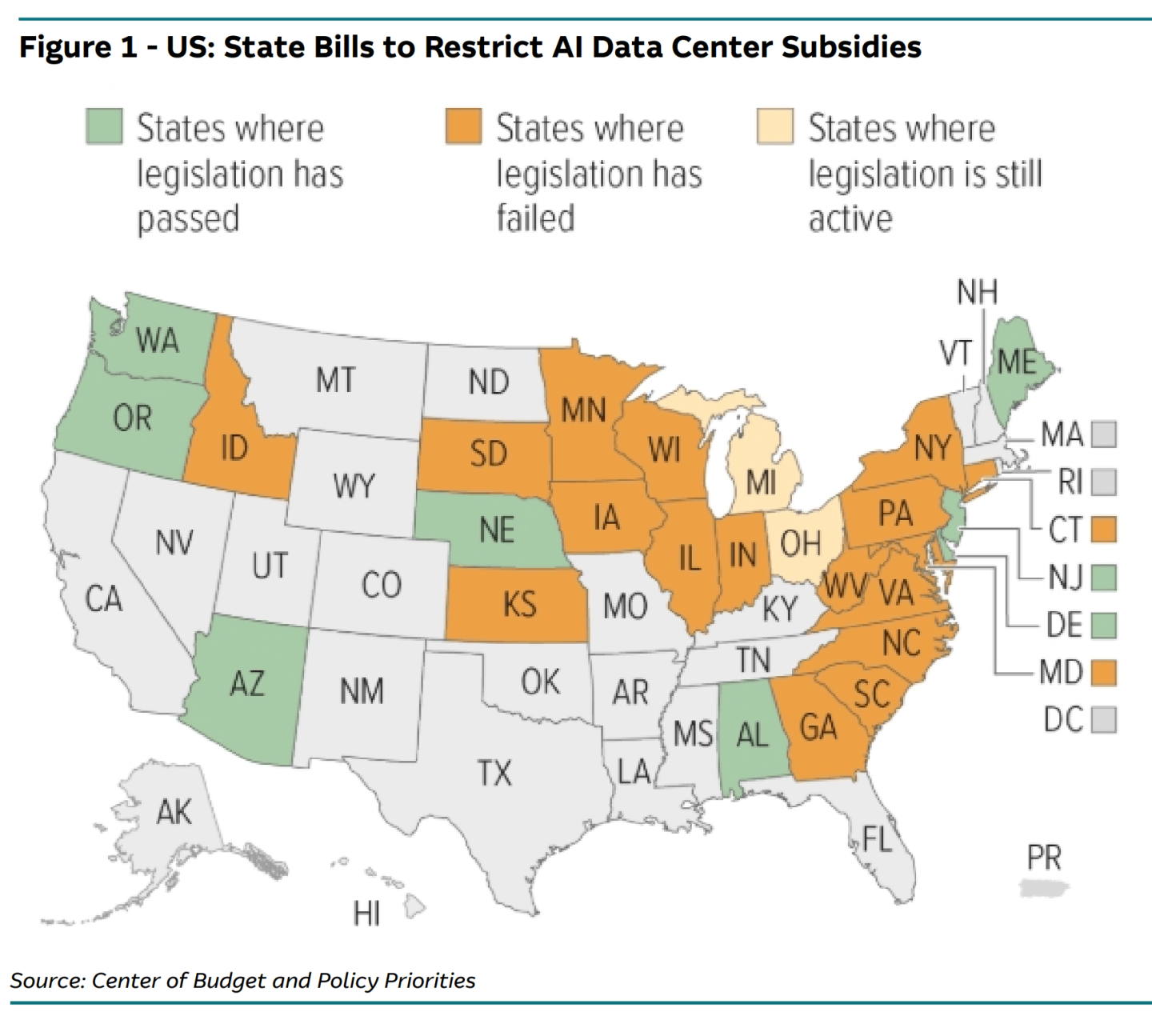
The collapse in the price of CoreWeave stock has dragged down the entire tech sector in the last couple of days, and focused investors’ minds on the risks attached to AI. And although the chatter has revolved around the “existential threat” of rogue AI agents, customers who aren’t seeing productivity gains, AI CEOs like Dario Amodei and Sam Altman urging a slowdown in development, and the widening spreads on debt issued by CoreWeave and Oracle, Macquarie’s Thierry Wizman and Gareth Berry point out that there’s another set of hurdles in the system: The number of U.S. states legislating against the development of AI.
The pair produced these maps of where states are restricting subsidies for data centers …
… And where states are banning data centers from being built:
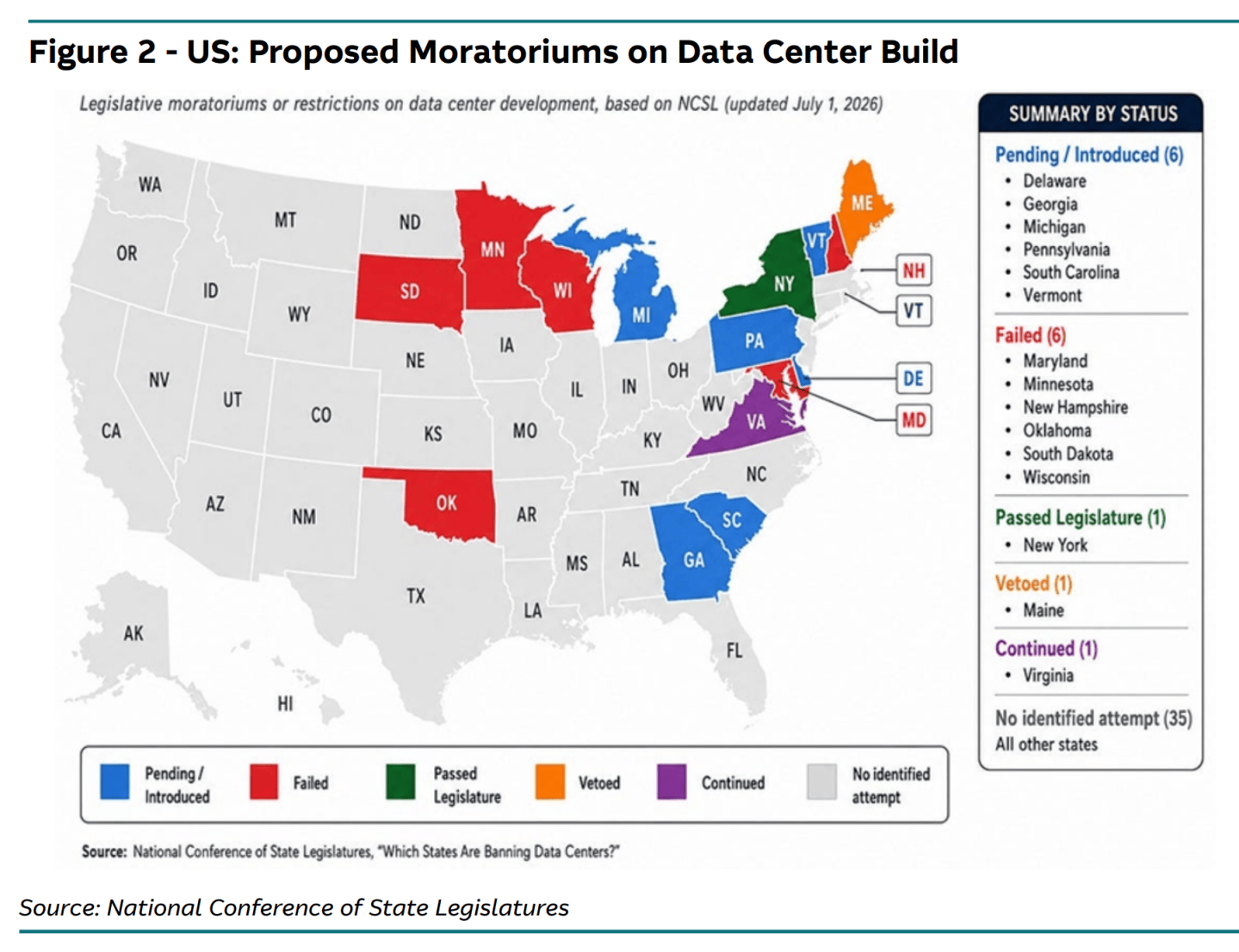
“The approach of the U.S. mid-term elections, with its prospect of a ‘blue wave,’ may be alerting investors to the possibility that new data-center ‘moratoriums’ may be enacted at various U.S. state legislatures once the Democrats have achieved new or larger majorities in those chambers. So far, anti-AI legislation has taken the form of blocking subsidies for AI data centers. Much of that legislation is already sitting at the legislatures and ready to be (re-)voted upon early next year,” they said in a note to clients.
CHART OF THE DAY
Fast, cheap, and (possibly) out of control
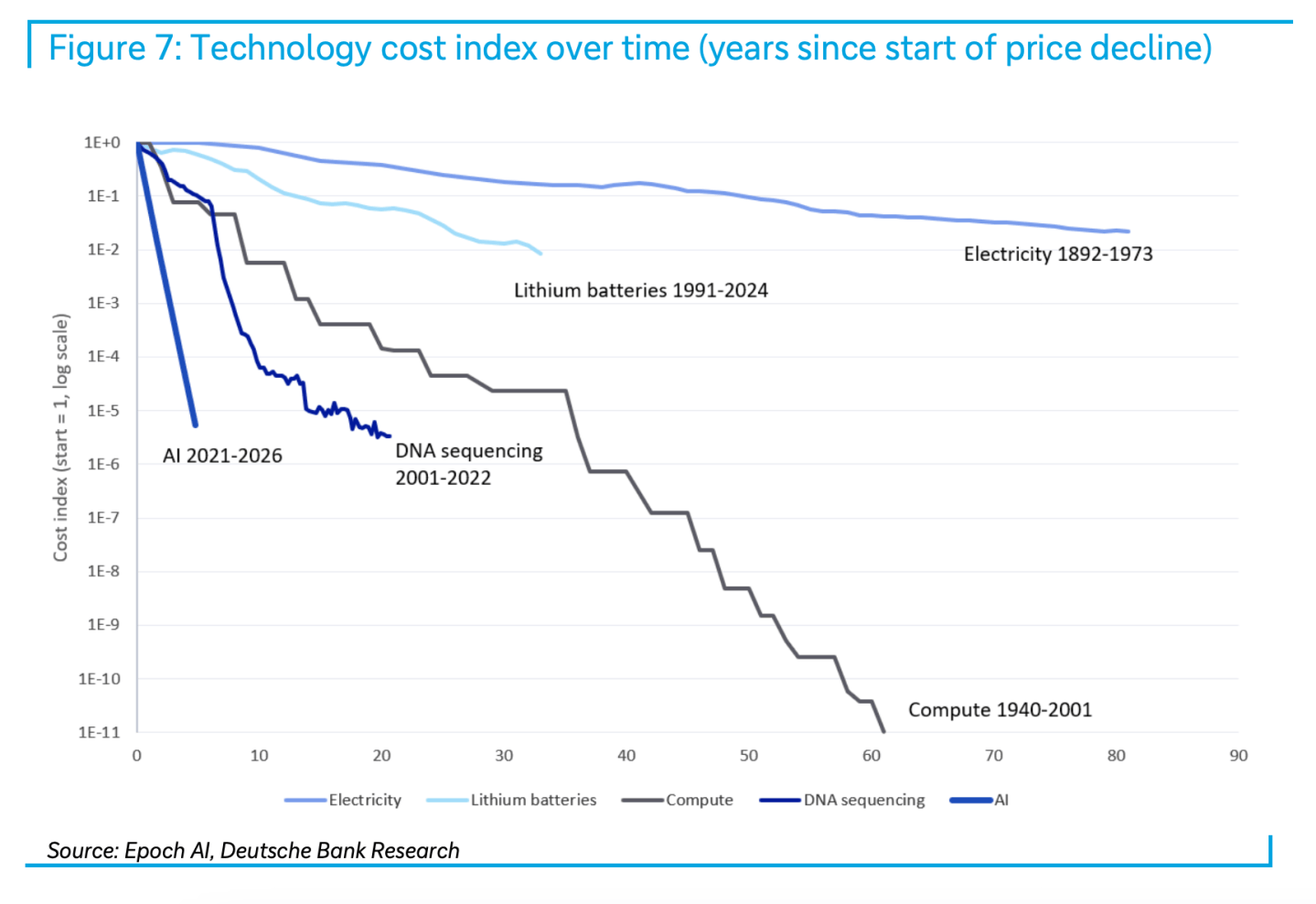
The cost of new technology tends to fall over time as companies become more expert at making it and improving it. But the cost of AI is falling so fast it’s almost charting a vertical drop, per this chart from Deutsche Bank comparing new tech pricing over time.
“The cost of achieving a given level of AI performance has tumbled about 47 percent a quarter, or 13 times a year, since 2023. That is four times faster than DNA sequencing, six times faster than compute, and 18 times faster than lithium batteries,” Deutsche’s Adrian Cox said in a recent note.
NUMBER OF THE DAY
0.2%
The growth of retail sales in the U.S. for September, if you exclude gasoline and automobiles. If, on the other hand, you include those categories, then sales were up 0.8%—demonstrating how the price of oil is driving up prices.
“CPI showed headline inflation accelerating to 3.7%, with gasoline accounting for more than half of the monthly increase,” according to Chris Osmond, chief investment officer for Fifth Third Wealth Advisors. That is feeding into everything else, he said: “Inflation is becoming increasingly difficult to dismiss as an energy-only story.”
THE FRONT PAGES TODAY
Trump weighs easing restrictions on Russian and Iranian ‘shadow fleet’ - FT
Trump names scapegoats as Republicans sweat in Texas - Axios
Tesla’s new roadster takes flight after nearly a decade of delays - WSJ
Warsh boosts market expectations of Fed rate hold in October - Bloomberg
Senators demand investigation into Ukraine satellite disruption - NYT
ONE MORE THING
This GOP billionaire's squirrel buffet is allegedly fueling a rat infestation in Chicago
Chicago officials are weighing legal action against Barre Seid, the 94-year-old industrialist behind the largest known political advocacy donation in U.S. history, over claims that workers he hires to scatter nuts in Lincoln Park are fueling a rat infestation, writes Fortune’s Catherina Gioino.
Alderman Timmy Knudsen said he is pushing the Chicago Park District to sue Seid for damage to the park, while Park District officials told the publication they are still weighing their options.
In an Aug. 25 letter to Seid, Knudsen called the matter a final warning and said city staff had received photos and video documenting Seid or his staff putting out food daily for squirrels and other wildlife, according to WGN. The letter said the feeding created a public health hazard because it drew in not only squirrels but also pigeons and rats.
- Would you like to sponsor this newsletter? Contact advertising@fortune.com for details.