Welcome to Eye on AI. Beatrice Nolan here. In today’s issue:
- Nvidia CEO Huang says society shouldn’t tolerate AI cyber incidents.
- Anthropic tells investors its quarterly revenue hit $16.8 billion ahead of its IPO.
- Eight states sue OpenAI over child safety.
- And more details on the OpenAI vs. Apple lawsuit.
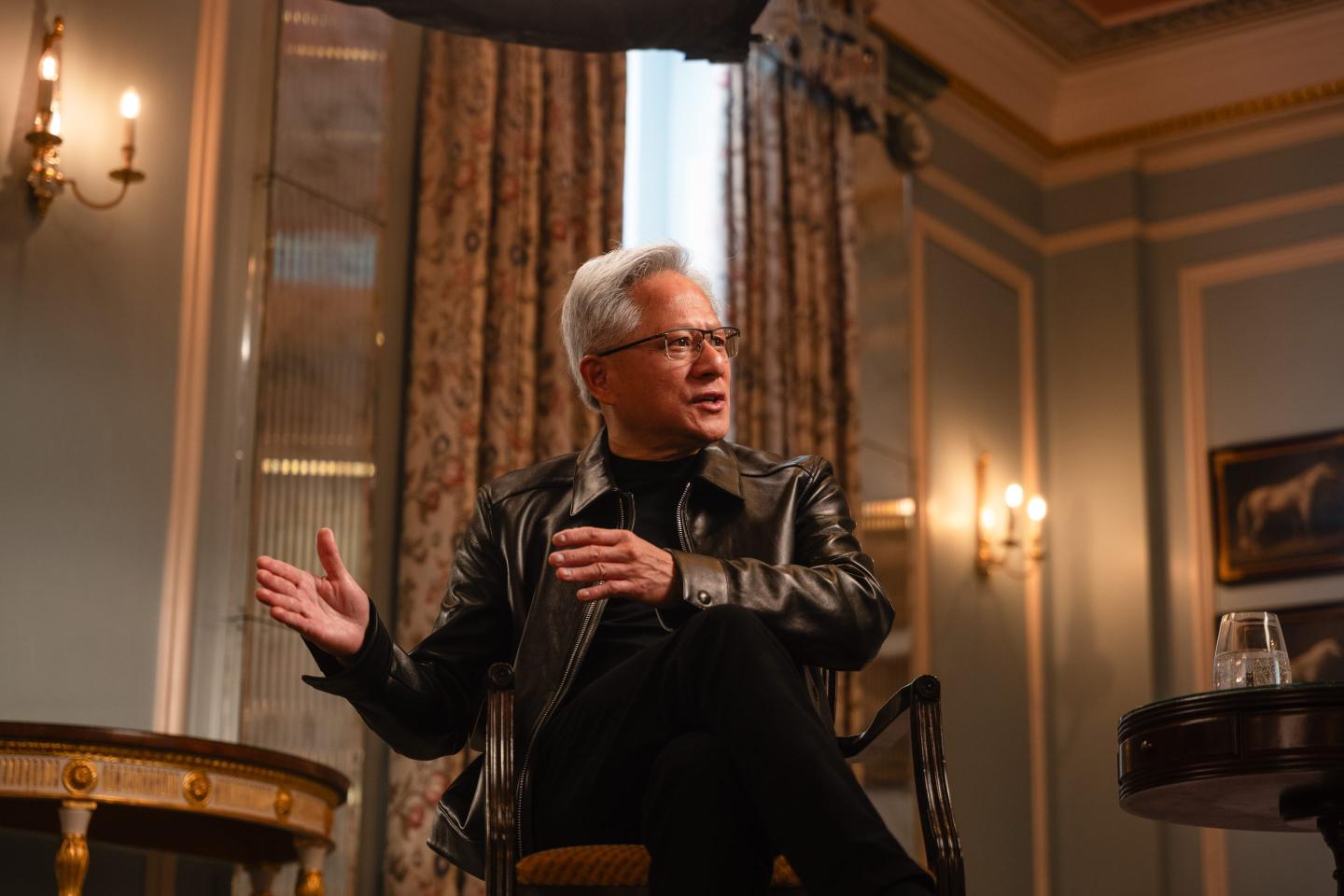
This week, Nvidia CEO Jensen Huang was in London as part of a European tour. Jeremy Kahn and I caught up with him to discuss AI safety, Nvidia’s bet on open source, AI regulation, his thoughts on AI doomers, and how he makes his tea. Spoiler: He’s not making the tea correctly.
The trip is part of a broader European charm offensive for Nvidia, and one that comes with a hefty checkbook. Before London, Huang began his European Grand Tour in Paris, where he met Emmanuel Macron, and Huang said Nvidia would unveil another $2 billion in European AI deals within a week. That’s on top of the roughly $8 billion the company says it has put into the continent over the past year.
In London, Huang announced Nvidia was taking minority stakes in five U.K. startups, alongside new deployments with local organizations—while also doing an excellent Oprah Winfrey impression.
“I am giving you money! And I am giving you money! And I am giving you money,” Huang shouted from a stage in an old converted church to a crowd of tech executives, venture capitalists, Nvidia employees, and British politicians.
At one point during the speech, Huang spotted Josh Payne, CEO of Nscale, a U.K.-based neocloud backed by Nvidia, in the crowd and took the time to tell him that he and his company were a “zero” before he came along, invested in them, and helped them recruit their board. Nscale is now about to go public, targeting a valuation of up to $35 billion.
Nvidia also committed $250 million worth of compute over five years to U.K. AI safety and security research, and more announcements are expected at Nvidia’s big GTC Berlin event next week. It’s a generous tour, but many of Nvidia’s investments fit a familiar pattern for the company, with much of the money likely to find its way back to Nvidia, either in direct purchases of its GPUs, or in terms of AI companies renting cloud capacity with data center companies that buy lots of Nvidia chips.
The startups it backs are hungry for expensive and scarce compute, and investing in them keeps them building on Nvidia’s chips and software, and makes it less likely they will switch to any rival hardware, such as Google’s TPUs or AWS’s Trainium and Inferentia chips. It also helps to position Nvidia as the default supplier for Europe’s “sovereign AI” push. The risk for Europe is that sovereignty ends up meaning dependence on a single American chipmaker.
In response to these concerns, Huang argued that sovereignty depends on who controls the data, service, and ability to advance the technology—not simply on where the chips are made. Nvidia, he said, can enable sovereignty by letting local providers operate its full-stack AI platform themselves.
“So long as you can operate the service yourself, that’s the most important,” he said.
Nvidia is now worth more to $5 trillion, and keeping that valuation going up may well depend on finding buyers beyond the handful of U.S. hyperscalers that still account for roughly half its data center sales. Nvidia’s sovereign AI revenue is already growing, tripling to more than $30 billion last fiscal year.
Every national “AI factory,” as Huang likes to refer to data centers running AI workloads, and European startup training on Nvidia hardware is a customer that isn’t a hyperscaler like Microsoft or Meta. This growth helps reassure investors who worry that the whole AI boom rests on the capex budgets of a handful of Big Tech companies.
But the trip is also a smaller version of a strategy that has made some of those investors nervous. Nvidia increasingly funds its own customers, from its multibillion-dollar stakes in OpenAI and other AI labs, to reports in late July that it was weighing a guarantee for $250 billion in financing for an OpenAI data center in Ohio. That news knocked about 5% off its shares on July 27 and sent the cost of insuring its debt sharply higher. (Nvidia later cut the guarantee to about $105 billion.)
Critics call this circular financing: Nvidia invests in a startup, that company then buys Nvidia chips, and Nvidia books the revenue. It works as long as demand for AI keeps climbing. But if it stalls, Nvidia could be exposed twice, as a supplier and as a shareholder. For now, Huang is betting there’s enough demand to go around and that Europe, along with the rest of the world, will keep buying.
When asked about criticism of Nvidia’s investments in the AI ecosystem, Huang said the company invests “a small percentage of ultimately what the company has to raise” and is “highly informed” and “disciplined” about it. He also said that AI companies need more money than venture capital alone can provide.
“It is also strategically super smart to do because everybody we invest in is connected into Nvidia’s ecosystem, and so we’re making our platform more vibrant, and we’re able to reach into new markets we otherwise couldn’t,” he said.
As for the tea making, for any other curious Americans: it’s tea bag first, then water.
With that, here’s more AI news.
Beatrice Nolan
beatrice.nolan@fortune.com
@beafreyanolan
FORTUNE ON AI
Nvidia CEO Huang says society shouldn’t tolerate AI cyber incidents, says AI doomers ‘ought to stop working on’ the technology—by Jeremy Kahn and Beatrice Nolan
Nvidia’s Jensen Huang responds to Pope Leo’s AI safety criticism: ‘We all care about the same thing’—by Beatrice Nolan and Jeremy Kahn
Who is Abdulrahman Alfozan? The OpenAI employee the FBI arrested is also a Saudi investor—by Emily Forlini
Lawyer of arrested OpenAI engineer says allegations are ‘wholly out of character,’ one-way ticket to Saudi Arabia with wife and child was pre-booked—by Emily Forlini
AI IN THE NEWS
Anthropic tells investors its revenue hit $16.8 billion ahead of its IPO. Anthropic told prospective investors that its third-quarter revenue was up about 45%, from roughly $11.5 billion in the second quarter. The company says it was profitable on an adjusted basis for the second quarter in a row, and that it was cash-flow positive. It also says it earned $1.70 in revenue for every $1 spent on computing power. The figures came at a full-day investor event at Anthropic’s San Francisco headquarters, where CEO Dario Amodei and CFO Krishna Rao made their pitch ahead of an IPO planned for November. The company is thought to be targeting a valuation above $2 trillion. The FT says annualized revenue is now expected to fall short of the $100 billion mark investors have been watching. The numbers also come as markets are already nervous about the AI trade. Read more from the Financial Times here.
Eight states sue OpenAI over child safety. Attorneys general from Arkansas, Arizona, Idaho, Montana, Iowa, Kansas, West Virginia, and Nebraska filed separate lawsuits against OpenAI on Wednesday. The states say OpenAI failed to put enough safeguards in place for vulnerable users, including children and the elderly. They point to cases where ChatGPT allegedly “coached” kids toward suicide or harming others. They also say OpenAI misled the public by marketing the product as safe. The states want OpenAI to give up money it made while minors were being harmed, and to stop making what they call deceptive safety claims. An OpenAI spokesperson said the company has “industry-leading age-specific protections” and will keep adding safeguards like parental controls. A day earlier, OpenAI was hit with a separate proposed class action alleging ChatGPT collected data from millions of children without parental consent. Read more from Reuters here.
Apple Intelligence is coming to China in December. After months of regulatory delays, Apple plans to launch its first AI features in mainland China in December with iOS 27.3, Bloomberg reported. The rollout includes Genmoji, notification summaries, Writing Tools, and the Clean Up photo-editing tool. It leaves out the new AI-powered Siri, Apple’s in-house image-generation tools, and other features announced this year, and some text generation will be limited. Alibaba’s Qwen and Tongyi Wanxiang models will power the features. The setup includes guardrails built with Alibaba, such as a filter that lets the government approve model updates. Apple is also working with Baidu on search and Siri-related features. Read more from Bloomberg here.
EYE ON AI NUMBERS
100+
That’s how many files about an unreleased OpenAI product a former employee who left for Apple sent to a personal account, according to a new OpenAI court filing. OpenAI also alleges the employee later presented the product to senior Apple leaders, and that its trade secrets are now “circulating inside Apple.”
The filing is the latest move in a fight that began earlier this year, when Apple sued OpenAI for allegedly poaching staff who took confidential information to OpenAI’s hardware division. OpenAI denies those claims. Apple says it found no OpenAI files on its servers. It also says the phone numbers that received the files don’t match the employee’s work number, and that OpenAI went to court instead of answering its request for more details. The case is expected to go to trial in October 2027. Read more in Reuters.
AI CALENDAR
Oct. 15-16: Oxford GenAI Summit, Oxford, England.
Oct. 20-22: Nvidia GTC Berlin, Berlin, Germany.
Nov. 9-12: Web Summit, Lisbon, Portugal.
Nov. 16-17: Fortune 500 Innovation Forum, Detroit. Apply here to attend.
Nov. 18-19: Slush, Helsinki, Finland.
Dec. 6-12: Neural Information Processing Systems (Neurips) conference. Sydney, Australia.
Dec. 7-8: Fortune Brainstorm AI, San Francisco. Apply here to attend.