
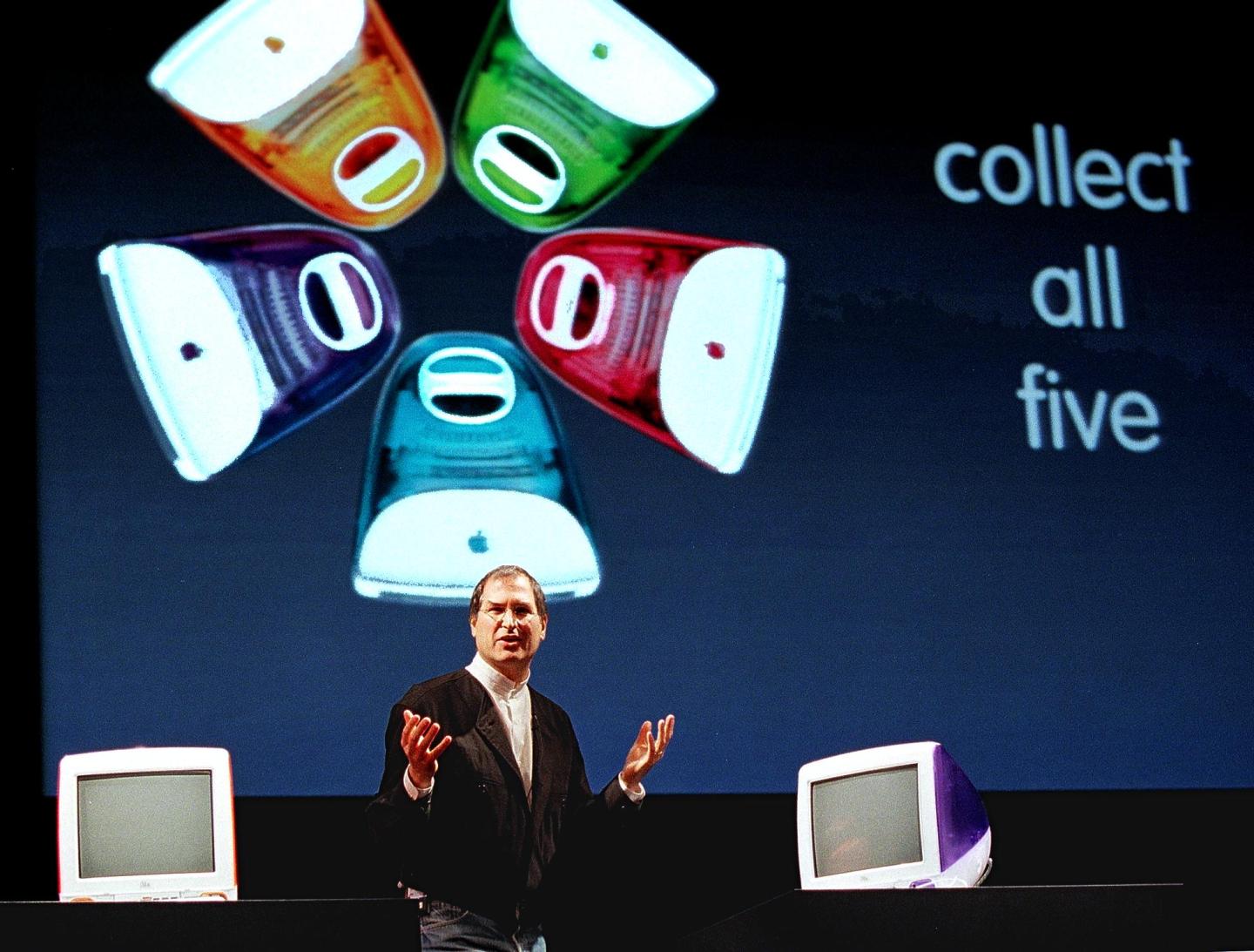
Scroll through Instagram and you’ll find them: translucent iMacs in Bondi blue, tangerine, and strawberry, glowing like hard candy. A generation too young to have used the original iMac is hunting them down on resale sites, while those of us who do remember them get misty-eyed in the comments.
Fortune immediately saw the appeal when the iMac debuted in 1998, calling it “a startling design alternative to the old beige box” and marveling that it “actually glows when you turn it on.” That November, Carol Vinzant declared the machine “Fast Like Cheetah, Cute Like Kitten.” Designer Jonathan Ive (now known widely as Jony), she reported, had consulted candy makers to get the see-through shell just right. Color expert Jill Morton argued that the original iMac’s Bondi blue, with its watery associations (it’s named after Australia’s Bondi Beach), would put technophobes at ease. Indeed, one study cited in the piece found 16% of buyers were first-time computer users and 28% were 50 or older.
The bold design choice paid off. By January 2000, Fortune’s Brent Schlender was describing “sleek, colorful iMacs and iBooks” that consumers were “buying hand over fist” in a Fortune cover story headlined “Steve Jobs’ Apple Gets Way Cooler.” Apple’s stock had hit an all-time high of $118 the month before.
Steve Jobs bristled at the idea that the magic was cosmetic. “In most people’s vocabularies, design means veneer,” he told Fortune. “It’s interior decorating.” The iMac, he insisted, was “not just the color or translucence or the shape of the shell. The essence of the iMac is to be the finest possible consumer computer in which each element plays together.”
A quarter-century later, the iMac’s color-saturated spirit lives on. “Dopamine decor” has become one of the internet’s favorite aesthetics: rooms built around bright colors, squishy textures, and objects that exist mainly to delight.
It may be that aesthetic that’s drawing Gen Z to a cute but bulky-by-today’s-standards computer. Or perhaps a fruit-colored iMac recalls a moment when the internet felt like a toy rather than a threat, when getting online meant possibility instead of doomscrolling. Or it could simply be nostalgia: In December 2021, Christie’s sold the Strawberry iMac that Jimmy Wales used to launch Wikipedia for $187,500.
Meanwhile, after years of sleek silver aluminum being its default, Apple has returned to its more colorful roots. Since its 2021 redesign, the 24-inch iMac has come in seven shades: green, yellow, orange, pink, purple, blue, and silver. An M6 model with a refreshed palette is reportedly due before the end of 2026. The beige box is dead. Again.