

• Home
  • Latest
  • Fortune 500
  • Finance
  • Tech
  • Leadership
  • Lifestyle
  • Rankings
  • Multimedia

Trendingnow

1

Jeff Bezos says a 3-day workweek and more single-income households are on the way thanks to AI: ‘It’s going to be difficult to hire people’

2

Palantir’s billionaire CEO says only two kinds of people will succeed in the AI era: trade workers—‘or you’re neurodivergent’

3

Nvidia built a $5 trillion company while making employees pay for their own lunch—but they get far more lucrative perks like stock discounts

1

Jeff Bezos says a 3-day workweek and more single-income households are on the way thanks to AI: ‘It’s going to be difficult to hire people’

2

Palantir’s billionaire CEO says only two kinds of people will succeed in the AI era: trade workers—‘or you’re neurodivergent’

3

Nvidia built a $5 trillion company while making employees pay for their own lunch—but they get far more lucrative perks like stock discounts
EconomyDebt

CBO chief warns it’s ‘probably not plausible’ that a strong economy alone can steady U.S. debt as 5%-6% growth is needed—more than Bessent’s 3% view

Jason Ma
By
Jason Ma
Jason Ma
Weekend Editor
Down Arrow Button Icon
Jason Ma
By
Jason Ma
Jason Ma
Weekend Editor
Down Arrow Button Icon
October 10, 2026, 6:54 PM ET
Treasury Secretary Scott Bessent in the Oval Office of the White House on October 7, 2026.
Treasury Secretary Scott Bessent in the Oval Office of the White House on October 7, 2026.Anna Moneymaker/Getty Images
Google source logo
Add Fortune on Google for similar content.

Congressional Budget Office Director Phillip Swagel said faster economic growth is unlikely to keep U.S. debt in check, even if GDP expands at more than double its current pace.

Recommended Video

Gross debt is now $40 trillion, and publicly held debt is 100% of GDP. Just keeping that ratio flat, let alone bringing it down, would require a massive, sustained boom. For now, CBO see the debt-to-GDP ratio soaring to 120% by 2036.

During a Minneapolis Fed conference on Thursday, Swagel said stronger economic growth will help by bringing in more revenue for the federal government, but it’s not that simple.

Federal spending also boosts growth, which lifts wages that in turn affect outlays on Social Security benefits, he pointed out. A robust economy also tends to send interest rates higher, which adds to debt interest costs.

“So growth will help, but it’s probably not plausible that growth alone will stabilize our fiscal trajectory,” Swagel added. “So then we’re left with changes in revenues and changes in spending, and those are inherently political choices.”

Minneapolis Fed President Neel Kashkari asked if AI can help supercharge economic growth, and he replied that CBO has detected an increase in total factor productivity, which measures the efficiency of labor, capital, and other inputs.

The CBO’s next batch of economic forecasts due early next year will incorporate its views on AI, Swagel said, adding that future growth will be stronger. Still, the budget deficit is so deep that even the extra AI-powered growth won’t be enough, he warned.

Kashkari then asked how much faster growth would have to be in order to stabilize the debt. Swagel cautioned against doing arithmetic on the fly but offered some back-of-the-envelope numbers.

Assuming interest rates of 4%-5%, he estimated that nominal GDP growth would have to reach 7%-8% and real GDP growth would have to hit 5%-6%.

That’s more than double the latest real GDP pace of 2.2% in the second quarter. Meanwhile, even bullish Wall Street forecasts put full-year GDP growth at 2.5%.

The rough numbers from the CBO chief also far exceed what Treasury Secretary Scott Bessent said would be needed to overcome the debt.

“With 3% growth, we grow our way out of this,” he said at Southern Methodist University last month. “We’ll get to the other side of this Iran conflict, and the underlying economy is very, very strong, and I think reaccelerating.”

Meanwhile, other estimates fall somewhere in between. According to the Penn Wharton Budget Model, growth would have to average 3.5%-4% over a decade to maintain the debt-to-GDP ratio.
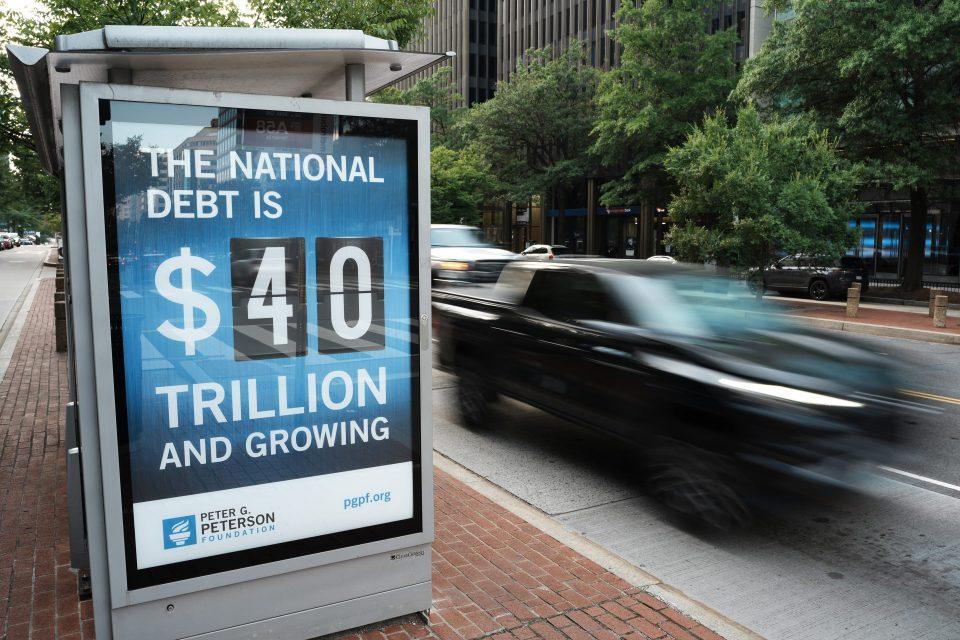
The current U.S. national debt on August 30, 2026 in Washington, DC.
Jemal Countess/Getty Images for the Peter G. Peterson Foundation

Swagel also noted that an economic shock that sends interest rates up suddenly would set off a vicious fiscal cycle.

“So there’s almost like a turbocharger,” he explained. “An interest rate shock feeds into the deficit, feeds into the debt, feeds back into interest rates.”

So far, the bond market is absorbing all the debt the U.S. Treasury is issuing to fund the budget deficit, but long-term yields have surged to the highest levels in 24 years.

Some of that is due to the strong economy, expectations for Fed rate hikes, high oil prices keeping inflation high, and the flood of AI hyperscaler debt competing for bond market demand.

But the enormous scale of U.S. debt is also a factor. Swagel said it’s small now, with a 1-percentage-point increase in the debt ratio leading to a 0.015-percentage-point hike on long-term interest rates.

“So it’s modest, but the fiscal trajectory is really quite challenging,” he added. “It adds up, and of course there’s that turbocharger type effect that I mentioned where it feeds back into deficits.”

Fortune Daily breaks the traditional barrier between audience and newsroom. The show transforms Fortune’s trusted reporting into actionable, conversational, and entertaining insights for an emerging class of business leaders. Watch here.
About the Author
Jason Ma
By Jason MaWeekend Editor

Jason Ma is the weekend editor at Fortune, where he covers markets, the economy, finance, and housing.

See full bioRight Arrow Button Icon
Google source logo
Add Fortune on Google for similar content.

Latest in Economy


Most Popular

Fortune Secondary Logo
Rankings
  • 100 Best Companies
  • Fortune 500
  • Global 500
  • Fortune 500 Europe
  • Most Powerful Women
  • World's Most Admired Companies
  • See All Rankings
  • Lists Calendar
Sections
  • Finance
  • Fortune Crypto
  • Features
  • Leadership
  • Health
  • Commentary
  • Success
  • Retail
  • Mpw
  • Tech
  • Lifestyle
  • CEO Initiative
  • Asia
  • Politics
  • Conferences
  • Europe
  • Newsletters
  • Personal Finance
  • Environment
  • Magazine
  • Education
Customer Support
  • Frequently Asked Questions
  • Customer Service Portal
  • Privacy Policy
  • Terms Of Use
  • Single Issues For Purchase
  • International Print
Commercial Services
  • Advertising
  • Fortune Brand Studio
  • Fortune Analytics
  • Fortune Conferences
  • Business Development
  • Group Subscriptions
About Us
  • About Us
  • Press Center
  • Work At Fortune
  • Terms And Conditions
  • Site Map
  • About Us
  • Press Center
  • Work At Fortune
  • Terms And Conditions
  • Site Map
  • Facebook icon
  • Twitter icon
  • LinkedIn icon
  • Instagram icon
  • TikTok icon
  • YouTube icon

    Latest in Economy


    Most Popular

    © 2026 Fortune Media IP Limited. All Rights Reserved. Use of this site constitutes acceptance of our Terms of Use and Privacy Policy | CA Notice at Collection and Privacy Notice | Do Not Sell/Share My Personal Information
    FORTUNE is a trademark of Fortune Media IP Limited, registered in the U.S. and other countries. FORTUNE may receive compensation for some links to products and services on this website. Offers may be subject to change without notice.