
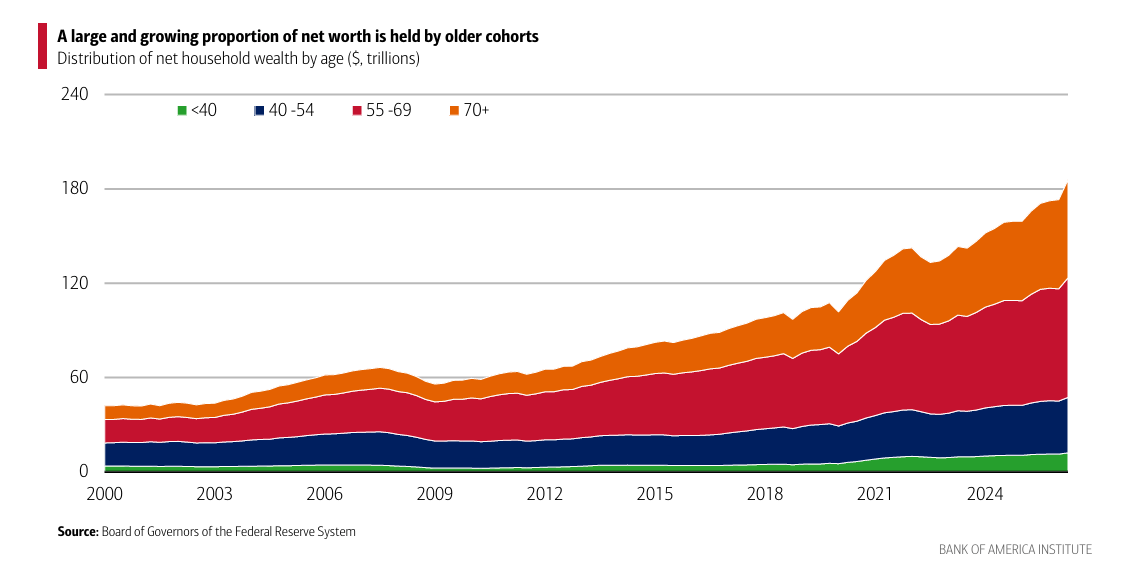
America’s older households sit on nearly $140 trillion in wealth, and much of it showed up recently.
Households age 55 and over held around three-quarters of the nation’s total net worth in the second quarter of 2026, according to an Oct. 1 report from Bank of America Institute, based on analysis of Federal Reserve data. “With equity markets rising strongly,” wrote senior economist David Michael Tinsley, those households have seen “a more than 20% increase in their net worth over the past two years.”
That rally has run on AI. The Magnificent Seven accounted for more than half of the S&P 500’s gains last year, Fortune reported in April, and Goldman Sachs strategists found technology stocks drove 85% of the index’s return through mid-May this year. “AI-driven return has been the single most important structural driver of equity performance,” Capgemini’s Luca Russignan told Yahoo Finance in June. Boomers own 54% of all U.S. stocks.
That’s a lopsided split. Americans 55 and over make up about 31% of the population, according to Census Bureau estimates, but control roughly 75% of its net worth.
The pile gives many older Americans what the institute calls “considerable capacity to spend on travel and other leisure categories.” Add their growing share of the population and their extra free time, and they become an increasingly influential market for businesses chasing consumer dollars. The BofA report focused mainly on the economic implications of a growing mass of older consumers, but the generational wealth composition was striking.
Most of this money belongs to boomers, whose members turn 62 through 80 this year. Census Bureau estimates put their number at about 68 million, which is roughly four in five Americans over 60 and about two-thirds of those 55 and over. They held $97.4 trillion in the second quarter, according to Federal Reserve data, about 52% of all U.S. household net worth and roughly 70% of the 55-plus total. They head only about 30% of households.
The G-shaped economy
The findings reinforce a divide Fortune has been tracking: Older Americans’ accumulated assets keep them spending after the paychecks stop, while younger households are still working to build wealth.
In March, Moody’s chief economists said that people over 50 were doing the “bulk of spending.” His summary: “They’re driving the train.”
Wall Street veteran Ed Yardeni has described the generational divide as a “G-shaped economy,” a variation on the familiar K-shaped economy that sorts by age rather than income. Yardeni argued that accumulated retirement wealth was an increasingly important source of spending power.
That makes the stock market an engine of consumer demand. Bank of America calls older households “some of the biggest beneficiaries of recent rises in equities.” A rally that pads a 401(k) shows up at the airline counter.
A windfall with a narrow landing zone
The gains haven’t spread evenly. Bank of America’s earlier research found the stock market’s wealth effects were concentrated among higher-income households. The wealthiest 10% of boomer households controlled 71% of the generation’s wealth in 2022, while nearly a third of Americans 55 and older had no retirement savings.
Across all ages, the split in stock ownership is sharper still. In the second quarter, the bottom half of U.S. households held $0.37 trillion in stocks and mutual funds, according to Federal Reserve data cited by Fortune. The top 0.1% held $16.15 trillion. Ray Dalio has called AI “a bubble that is going to have devastating effects on many people,” adding that “most people are not benefiting adequately.”
For older households without a cushion, the numbers look very different. Census Bureau research cited by the institute found that about 14% of Social Security recipients over 65 rely on it for more than 90% of their income. Without wealth to fall back on, rising costs such as gasoline “will likely have put them under more significant financial strain,” the report says, leaving them more dependent on Social Security’s annual cost-of-living adjustments. Health care also takes a much bigger share of older households’ budgets than those of younger ones.
The $140 trillion measures collective financial power. Plenty of people approaching or living in retirement will never touch much of it.
Money and time
The demographic shift has been building for decades. The share of Americans over 60 rose by almost 10 percentage points between 1995 and 2025, to 25%, according to the report. The Census Bureau projects it will climb another five points by 2055, to nearly 30% of the population.
Older consumers spend differently. Bank of America’s card data from January through July 2026 show older households put a bigger share of their spending toward groceries, and a smaller share toward restaurants, gasoline, general merchandise, and clothing. Households aged 61 to 75 also devote more to travel. Their share of spending on airlines has recovered faster since the pandemic than that of all households, though it remains below 2019 levels.
An aging America shifts the mix of demand, and some businesses are better positioned than others to catch it.
The market underneath this wealth is unusually top-heavy. Chief economist at Moody’s Analytics Mark Zandi flagged the tradeoff months ago. Older, wealthy consumers’ spending is “very positive and necessary in keeping us out of a near-term recession,” he told Fortune, “but [it’s] a very significant supply-side weight on the economy going forward.” His analysis of Fed data found 59% of all consumer spending now comes from the top 20% of earners.
Retirees have the least room to absorb a reversal. The 10 largest 401(k) mutual funds now average a 38% allocation to tech and communication services, according to Morningstar data cited by Fortune. As Fortune put it in April: “A sequence of returns shock in a tech-heavy portfolio at age 67 is not the same as a drawdown at 32.”
The damage wouldn’t stay with the people holding the stock. When a narrow slice of households drives this much of the country’s spending, a hit to their portfolios becomes a hit to the airlines, hotels, and grocers that depend on them, and to the workers those businesses employ. Dalio has been seeing “classic signs” of a bubble for months now, and he warned in August that “wealth is not the same as money … You see a lot of people getting wealthy, but you can’t spend the wealth. You have to sell the wealth to get money because you can only spend money.”
Generative AI was used for research assistance and/or transcription for this article. The reporter independently reported and verified the factual claims in this article, and a human editor reviewed it before publication.