
Cheating might seem like a simple concept to define. Not so in the competitive chaos of a gambling contest. What happens when you accidentally glimpse an opponent’s hand in poker? What about counting cards in blackjack? And what if a White House teleprompter operator uses prediction markets to bet on Presidential speeches he’s seen in advance?
History tells us that ethics and law are secondary concerns when there’s money on the table. Consider the case of Phil Ivey.
Ivey, a top poker professional, has won 11 World Series of Poker bracelets and shared a table with movie stars. He is also one of the few gamblers to have had a betting system dissected in a court of law.
On August 20, 2012, Ivey made £7.7 million pounds at the Crockfords Club in London with a technique called “edge sorting,” which he used to identify advantageous face-down cards in a baccarat spinoff called punto banco. The casino refused to pay, Ivey sued, and the two sides spent the next five years locked in a legal battle that went all the way to the UK Supreme Court.
The case was unusual because the judges had to consider questions of ethics and fairness, including the legal definition of cheating, as they pertained to a casino. Disagreements between gamblers and casinos are common, but they are rarely decided in public. Advantage players, who use science and technology to invent winning systems, tend to view taking legal action against the house as a waste of time and money. Casinos prefer to avoid the bad press that comes from dragging customers to court.
Exactly how Ivey achieved his edge is difficult to explain. Suffice it to say that there are certain high value cards in punto banco and it helps gamblers to know where they are. Ivey and his partner persuaded the Crockfords dealer to rotate the high-value cards 180 degrees before shuffling them back into the pack, citing some obscure superstition as justification. In reality, Ivey had noticed an asymmetric pattern on the reverse of the cards, which meant he could identify them from the back, even if their face value was hidden. That knowledge gave him a clear advantage.
Was Ivey cheating? The answer wasn’t immediately obvious. Ivey believed that what he was doing was “a legal way to beat the house.” Crockfords argued that the game had been “compromised” by his actions. Ivey countered that he’d never actually touched the deck. Both sides presented gambling experts at trial who touted opposing theories. One had carried out a survey of hundreds of people to get their opinions, which only added to the confusion. As the first-instance judge put it, “There is no commonly accepted view amongst those who play punto banco about whether edge-sorting does or does not amount to cheating.”
If you gamble for a living, blurred lines like these arise at every turn. Of course, there are also age-old hustles so evidently dishonest that there was a time when their exponents risked being hung or shot. In the 1800s, professional gamblers along the Mississippi River had a habit of marking cards that could help them win. It could be done by scraping a sliver of paint off the side of the aces and royal cards. It’s a simple trick, still effective today, and infuriating enough two centuries ago to have resulted in mass lynchings. A poker sharp called Gentleman Jack hid a tiny mirror on the inside of one finger so he could sneak a glimpse of his opponent’s cards. Jack called it his “light,” also known as a “glim” or “shiner.”
Advantage play, for the most part, doesn’t fall into this category. Those who define themselves as advantage players, as opposed to gamblers, argue that they’re simply using skill or knowledge to gain an edge; distinctly different from cheating.
There is no rule of blackjack, nor any law, that prohibits card counting (keeping track of dealt cards then betting big when the pack favors the player). But casinos are private property, and courts have upheld their right to bar whomever they wish. Those who refuse to leave can be arrested for trespassing. For practical purposes, the games belong to the house and the house gets to decide what’s cheating and what isn’t.
To the continued amazement of advantage players, casino operatives can argue with apparent conviction that card counting— essentially mental arithmetic—is a form of fraud. Andy Anderson, once a private detective for Griffin Investigations, demonstrated this remarkable feat of motivated reasoning in the 2004 documentary The Hot Shoe. He imagined a card counter playing at the same blackjack table as “Old Tommy over here from Kokomo, Indiana, [who] is coming to Vegas with his hundred-dollar bill.” The counter knows that aces are coming. Tommy, lacking the same skills, doesn’t. “Is it fair for Tom over here not to win, and you win?” he said. “I don’t think so. I think it should be a level playing field.”
Similarly, Steve Norton, a vice president at Resorts, the company that opened the first casino in Atlantic City, once told a reporter that the “law says that the casinos shall include games of chance. But when counters are allowed to play, it becomes a game of skill. There is no luck involved.” This assertion strains logic and factual reality to the breaking point. Even regular players are supposed to use their judgment in blackjack; dealers encourage them to do so. And even the best counters are vulnerable to runs of misfortune.
In the gray zone between card counting and hidden mirrors, there are several entirely legal and morally dubious advantage plays that can get you thrown out of a casino. Spooking, for example, involves stationing a partner near a dealer. When the dealer lifts the top card slightly to check for a blackjack, a partner with good eyesight can catch a glimpse and signal to the player. Advantage players are capable of doing mental gymnastics to justify such actions. After all, casinos don’t bother to make distinctions, labeling all winning systems as criminal. “Players on each side of this game often see the world with blinders on,” wrote Robert A. Nersesian, one of the few attorneys who specializes in representing gamblers.
Supposedly neutral arbiters, such as the Nevada Gaming Control Board, historically haven’t offered much help to the mistreated gambler. The control board is viewed as pro-industry and is reluctant to intervene on behalf of individuals. Bettors can file private lawsuits, since a wager is a contract between two parties. But such actions are expensive and unlikely to succeed. “The law is fickle, and especially mercurial, inconsistent, and unpredictable when it comes to gaming,” Nersesian observed.
Phil Ivey learned that, to his cost. In 2017, the UK Supreme Court ruled that edge sorting was cheating because it looked like cheating, in the same way that an animal with big ears and a trunk is an elephant because it looks like one. “Dishonesty is by no means a defined concept,” the judges wrote. “On the contrary, like the elephant, it is characterized more by recognition when encountered than by definition.”
Ivey never received his winnings and was left with a large legal bill. A Crockfords attorney called the Supreme Court decision one of the most important rulings in a generation. Nersesian’s partner in his Las Vegas law firm applies her own version of the criterion used by the British judges: If her grandma from Peoria can recognize an activity as cheating, it probably is.
The “smell test” approach to gambling ethics is a handy yardstick for casinos. However, it was of no use to advantage players exploring new technology in the early 1980s. Gambling computers hadn’t been around long enough to create legal precedents, let alone for the average person to form an opinion about their use. A grandmother in Peoria would likely have found it impossible to understand what the devices did, not to mention how they might be applied at the gambling table.
That put casinos into a difficult situation. Security guards would call the police whenever they frisked a player who was wired up like a suicide bomber. But they never managed to make charges stick. The law, written to punish confidence tricksters, had to be stretched thin to cover a wearable computer, and prosecutors knew it. Eventually, Nevada legislators passed an emergency statute banning any device that helped a gambler.
Advantage players, meanwhile, had no difficulty defending betting machines. Under their moral code, anything that didn’t physically interfere with the equipment or use information that was supposed to be hidden was fair game. Ultimately, though, questions of law and ethics were a secondary concern. They wanted victory and, almost as much, to see their adversaries humbled by defeat. The gambling industry’s protectors viewed advantage players the same way. It made little difference what judges or cops or casino regulators or Peorian grandmothers thought. Both sides were prepared to do whatever they could get away with. Whatever it took to win.
Like the technological battleground of the 1980s, prediction markets are so new that no one knows quite how to manage them. The Commodity Futures Trading Commission and state regulators are competing for that responsibility. Insider trading is against the rules of both major prediction markets, just like card counting at casinos. Kalshi and Polymarket have argued that trading the future provides a useful social function and isn’t really gambling at all.
In many ways, though, the new betting markets are just like the old ones. There are a lot of losers, and the few winners face a struggle to keep their profits. The White House teleprompter operator has been reported to the CFTC and may have to pay back whatever he earned. Prediction markets, like the house, get to make and enforce the rules, mainly for their own benefit.
In the words of President Trump: “The whole world, unfortunately, has become somewhat of a casino.”
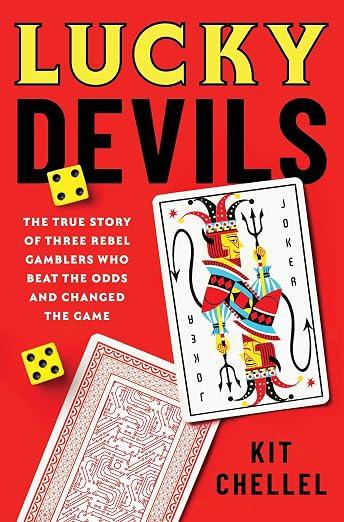
Reprinted from Lucky Devils: The True Story of Three Rebel Gamblers Who Beat the Odds and Changed the Game By Kit Chellel with permission from Atria Books.