
Donald Trump’s 2024 campaign promised not merely to improve on “Bidenomics,” but to replace it.
“On day one, we will throw out Bidenomics and we will reinstate MAGAnomics,” Trump said at a May 17, 2024 speech. He paired that with a promise to “stop the Biden stupid spending spree” and “end his inflation death spiral.”
“This is Biden-nomics,” he told the audience in St. Paul, Minnesota. “Inflation has eaten—you know, it’s a country-buster.” He then called Biden’s inflation “a colossal tax on American families” and concluded: “We will call it the Biden inflation tax.”
Twenty months into Trump’s second term, and with pivotal midterm elections approaching, his economic team is facing the political logic embedded in that indictment. Hiring has cooled, mortgage rates recently topped 7%, and inflation is still sufficiently elevated to make boasting about the economy treacherous. The administration’s top economic officials are now conceding that favorable aggregate indicators are no easy answer to public anxiety.
“If I say, ‘Oh, people are wrong, the economy’s great,’ then it looks like I’m insensitive,” Kevin Hassett, director of the National Economic Council, said Sunday on CNN’s State of the Union. “And if I then go into why the economy is great, then it looks like I’m insensitive.”
Just a few years ago, Biden officials pointed to low unemployment, payroll gains, rising wages, factory investment and economic growth. Trump’s campaign argued that none of those figures settled the matter if families still felt unable to afford groceries, rent, cars or homes.
Now Treasury Secretary Scott Bessent is making a version of the same concession. He told Axios that the administration would not imitate what he portrayed as the Biden team’s mistake: “What we’re not going to do is do what the Biden people did and tell the American people how good they had it.”
But Bessent also said that “any of the numbers are quite strong, other than headline inflation,” which he attributed in part to energy prices linked to war with Iran. He predicted the energy shock would “fade away.”
He did not use the word “transitory,” the term the Biden White House and Federal Reserve officials famously used for much of the 2021 inflation surge. But he did not have to.
His most important concession concerned the lasting effect of the earlier price shock. “Sometimes I feel like an emergency room doctor,” Bessent told Axios. “The American people were backed over by the inflation Mack Truck.”
Bessent’s point is economically sound: lower inflation does not mean lower prices. It means prices are rising more slowly from a higher base. Households that absorbed a multiyear jump in food, housing, energy and borrowing costs are not made whole even if wages now keep pace with that higher level of expenses.
It is also the premise Trump used against Biden. In that same Minnesota campaign speech, Trump argued that wage gains offered no meaningful answer to the cost-of-living shock: “Somebody got a little bit of a wage increase. It doesn’t matter because the prices have gone up so much.”
The present economic picture makes that reversal uncomfortable. On CNN, Jake Tapper cited second-quarter growth of 2.2%, headline inflation of 3.4%, a 0.4% August increase in consumer prices, 29,000 jobs added in September and unemployment of 4.2%. Those figures describe an economy that is still growing, but one that has neither eased price anxiety nor produced strong hiring.
And for all the promises about AI as a revolutionary technology, Apollo Global Management chief economist Torsten Slok noted today that there is simply zero trace of it making a dent in productivity data. The San Francisco Fed’s utilization-adjusted measure of total factor productivity is slightly below zero, he wrote in his Daily Spark blog, “with no sign of acceleration since the AI capex cycle began.” Output per hour, meanwhile, is growing at about 2.5%, comfortably above its post-2005 average, but Slok called that a signature of capital deepening, not a technology shock. This is just business as usual, he added, but after all, “electricity and IT both took a decade or more to show up in aggregate numbers.”
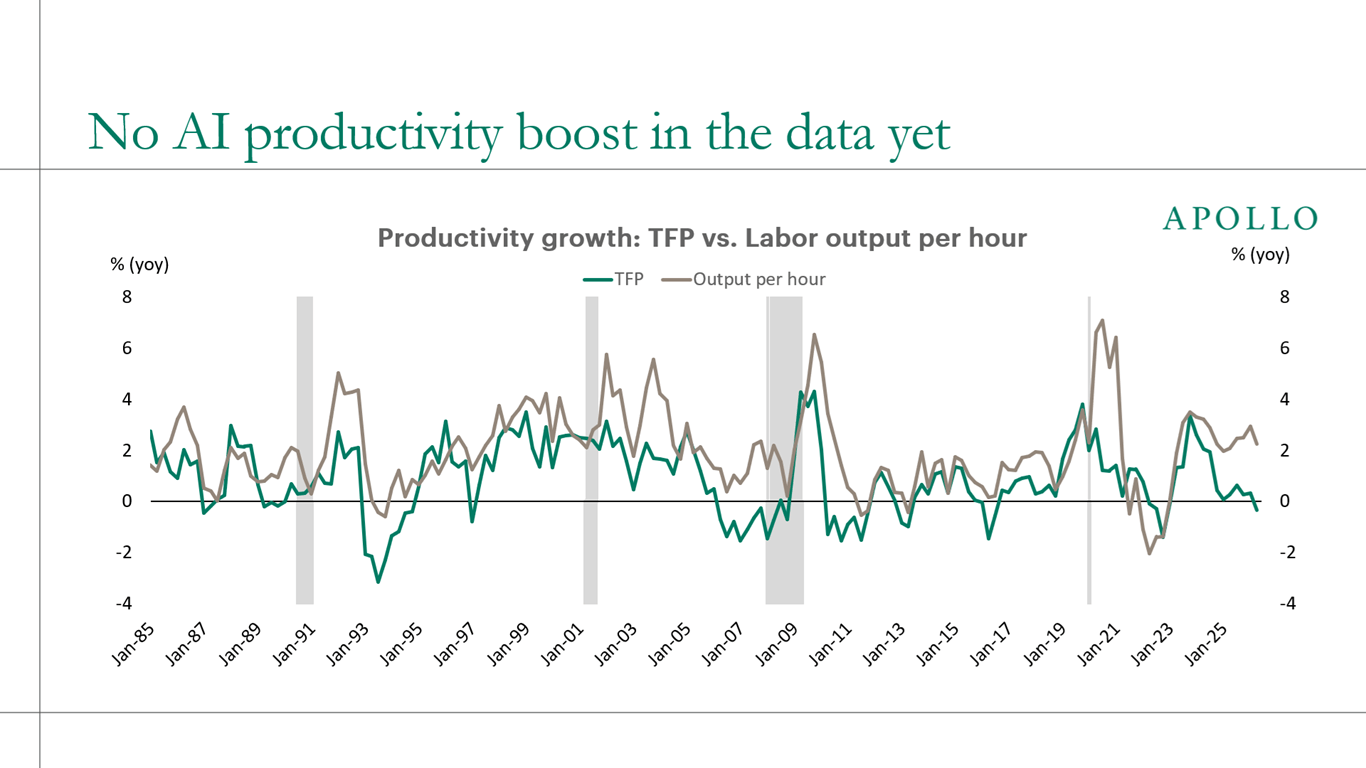
That matters because the administration made AI central to it economic case: rapid future productivity growth would help validate present investment, support higher real incomes and make daunting debt arithmetic easier to manage. Slok’s conclusion is more restrained: the AI boom is “clearly visible in investment data and in equity valuations,” but the productivity payoff remains “a forecast rather than an observation.”
Ruchir Sharma, chair of Rockefeller International and contributing editor for the Financial Times, recently argued that it actually cuts a bit deeper: the AI economy is creating a “reverse Robin Hood effect” that benefits mainly the wealthiest 0.1%, then followed by the top 1%, then the top 10%, then everyone else. It’s an awkward fit for Trump, who, in Sharma’s words, “rebuilt the GOP as a vessel of anti-incumbent anger” but his incumbent economy has a top-heavy, anti-populist flavor. He trained his own voters to be upset at the results his economy is producing, in other words.
The administration has substantial counterarguments. Hassett said the three-month annualized PCE measure showed core inflation at 2%, the Fed’s target, and headline inflation at 1%, helped by falling food and gasoline prices. He also pointed to consumer spending, low initial jobless claims and an Atlanta Fed GDPNow estimate of 4% to 5% growth in the third quarter.
But these are the kind of arguments that Bidenomics boosters were making in 2023 and 2024—about trajectory and underlying economic strength. The problem is that Trump’s 2024 campaign made a different political standard central to its case: no administration deserved to call the economy successful while families still felt that inflation had hollowed out their purchasing power.
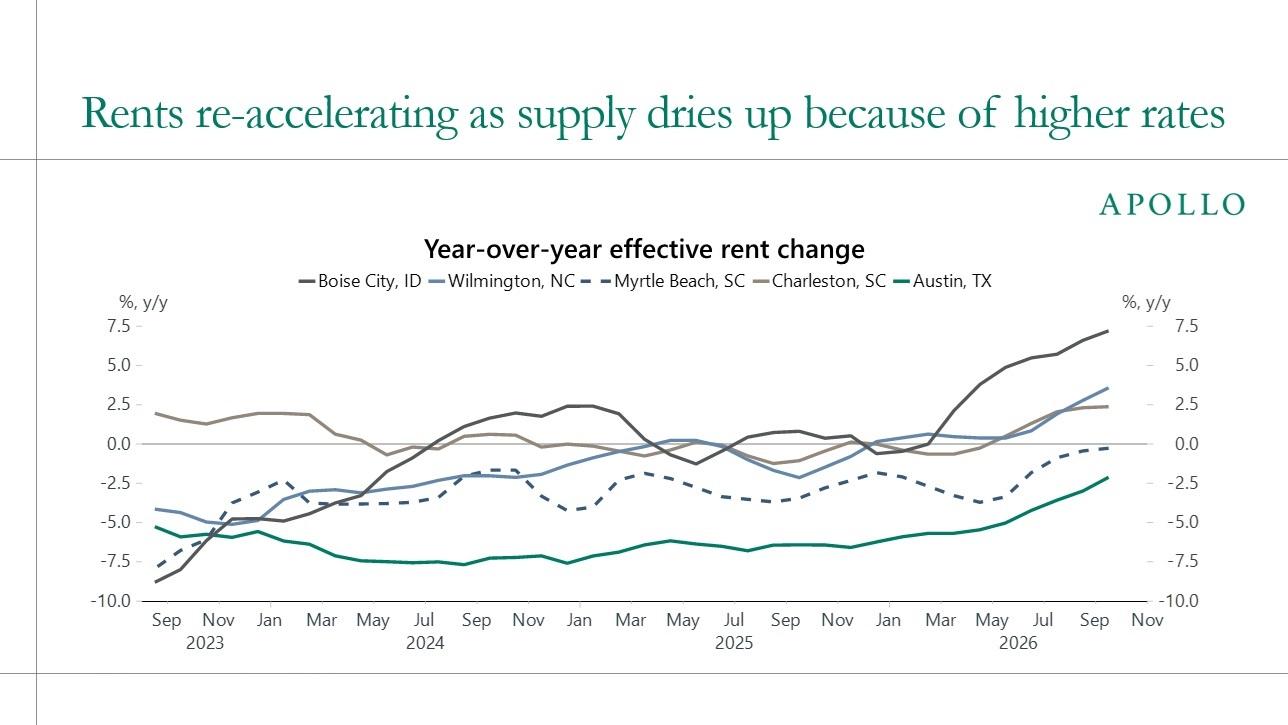
In Minnesota in 2024, Trump argued that Biden-era inflation had made it “impossible for millions of Americans, especially young Americans to buy a home, a car, or even make their rent.” Existing-home sales fell to a 3.98 million annual rate in August, the first reading below 4 million since June 2025, even as inventory reached its highest level since 2019, according to NAR. The price of cars has climbed as well. Slok noted on Sunday that a “higher rates, higher rent doom loop” at work where high interest rates prevent builders from building, forcing rents and inflation up higher.
That is the standard now haunting MAGAnomics. Hassett says the White House cannot safely tell people that the economy is great; Bessent says households have not been made whole by merely keeping pace with inflation. The administration may have a distinct explanation for the current inflation problem and a different program for resolving it. But it is increasingly caught in the same political bind it said had discredited Bidenomics: the gap between an economy that looks defensible in aggregate and one that still feels unaffordable in daily life.
Generative AI was used for research assistance and/or transcription of this article. The reporter independently reported and verified the factual claims in this article, and a human editor reviewed it before publication.