As chairman of the 1998 Blue-Ribbon Commission on CEO Succession of the National Association of Corporate Directors, I vividly remember the enthusiastic and unanimous discussions among my fellow commissioners. We advised that good boards must, among other things:
1) conduct ongoing reviews of internal and candidates for the top job and not wait to act only if there is performance or health crisis
2) be sure to evaluate internal and external candidates as heirs apparent and to consider what trial assignments would be valuable developmental roles for such candidates
3) never make promises of the CEO position to top candidates, such as through a stacking of sequential job title commitments
4) consider incumbents term of office based upon the merits, character and their performance; and not arbitrary timelines or age grading
5) work in partnership with the incumbent CEO for collaborative rather than adversarial transitions unless there is a performance failure
Just this week, each of these key principles were forgotten by eager gossip-seekers in the business media as they giggled over solid reporting that soon turned to misguided rumors about Goldman Sachs, focused on the supposed “news” that longtime David Solomon protégé and loyalist John Waldron is the heir apparent at the company, coinciding with Solomon’s eighth anniversary as the CEO of Goldman.
In fact, the Goldman Sachs board, long admired for its grooming of successors, has done just what all good boards are supposed to do as diligent directors: which is to always be updating succession plans for various possibilities to assure competent leadership and a smooth transfer of power at the right time.
That a reporter or two heard of this normal process led to the erroneous inference that a change of leadership is imminent. It is not – and for very good reason. Goldman is being led by a widely admired, top-performing CEO in Solomon, with Waldron a very possible but not designated future heir apparent. That his name was leaked as a prospective future CEO to drama-seeking observers only set off erroneous ripple effects of speculation that Solomon was headed out the door.
These are the exact succession principles that have been followed by the Goldman Sachs board – as they have done over many decades. The headlines that the board was thinking of Waldron as heir apparent could just as accurately read the Goldman board was considering one or two alternative candidates from inside of Goldman or even considering one or two candidates from outside Goldman. So what? Where is the news here? These considerations are what a board is supposed to do on an ongoing basis.
Such misguided reporting can have a deleterious impact on all parties, undermining the incumbent CEO by implying they are a lame duck running out of time, disparaging an heir apparent as they are presented as ambitiously trying to dispatch their mentor in an underhanded, disloyal way, as Brutus did to Caesar; and the company itself as it sparks distracting jockeying for position around possible new power centers that cascade down the firm.
I have studied leadership succession for five decades. My bestselling 1988 book, The Hero’s Farewell (Oxford) was the first systematic study of CEO exits, and I researched the conditions of 100 prominent transitions and discovered many such instances.
For example, in 1983, a prominent but erroneous front page article in The Wall Street Journal triggered generational tensions at Corning Glass between Amory (Amo) Houghton, the CEO of this 175-year-old pillar of American industry and his brother and successor James (Jamie), suggesting that Amo was a clubby, polo-playing legacy executive on cruise control while his ambitious brother was presented as the driving force for new technological transformations of the company from glassware into new businesses such as fiber-optics and health equipment. The inference was that Jamie had planted a disparaging story about his older brother to hasten his exit. The conflict had to be resolved by bringing in their elderly mother to mediate (Corning was then a family-owned concern).
Similarly, just as the legendary Reginald Jones of General Electric and his board were working on his succession plan in 1979, the Wall Street Journal came out with a piece anointing Tom Vanderslice, the president, as the heir apparent and the transformational wizard of the future. As Vanderslice unwittingly contributed to the story with some quotes, not realizing the tone and direction of the article, his candidacy was derailed and his credibility ruined. A major new horserace took place which eventually led to the much younger Jack Welch winning in an upset. Vanderslice went on to run nearby General Telephone (GTE) and launched a wistful but obtuse ad campaign for GTE service with the tag line chanting on each commercial “No, not GE, GTE!” This message confused all except GE insiders.
Boards would be well served to keep the succession yardsticks focused on genuine performance metrics rather than fact-free dogma related to CEO age, longevity or tenure. Indeed, certain misguided governistas hold a longstanding, fact-free superstition against long-tenured CEOs, apparently favoring a revolving-door-like CEO structure, demanding CEO changes as frequent as a subway turnstile and airport departure lounge exit. Case in point, one prominent commentator even declared, referring to Solomon, “It’s just very hard for a person like that to decide they are really going to retire.”
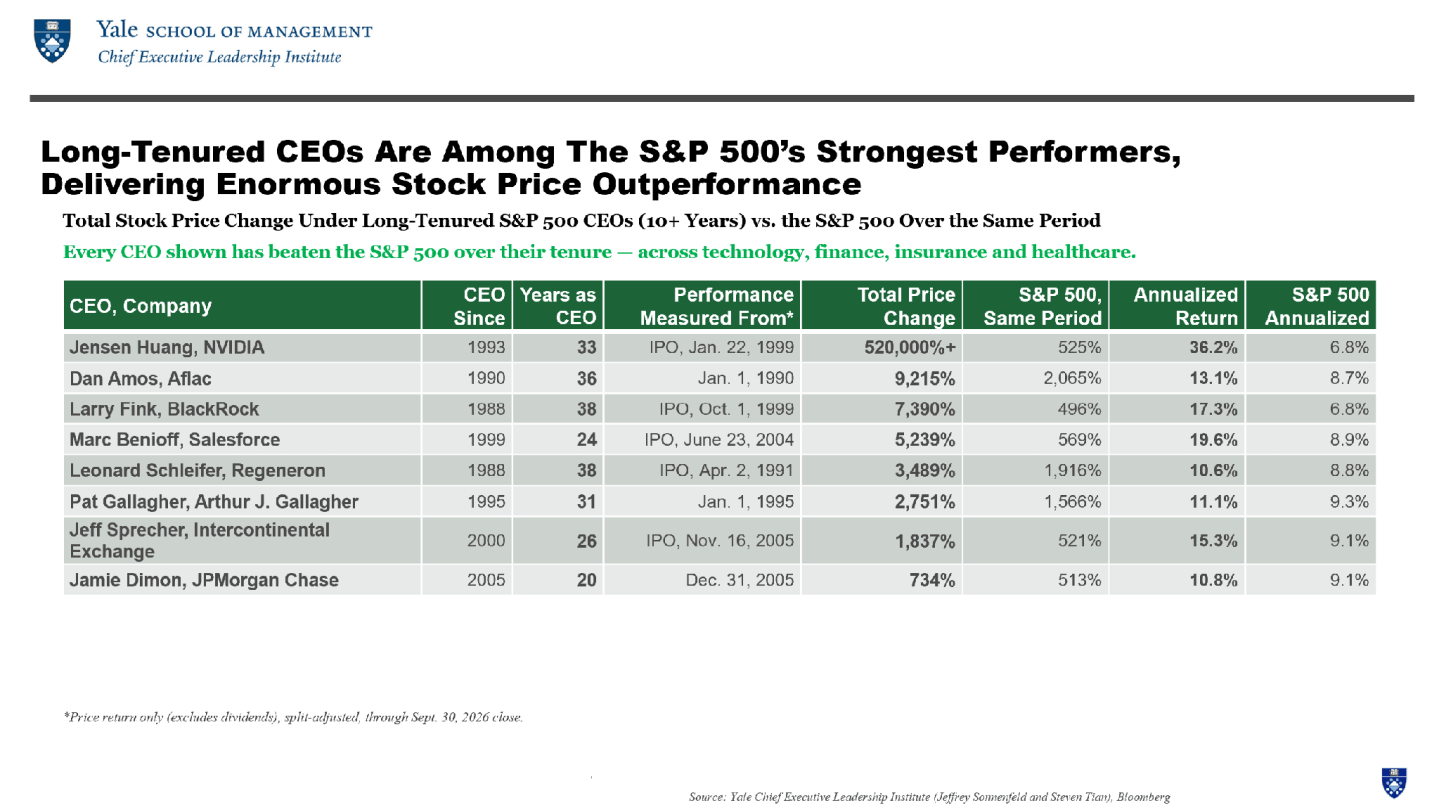
What all these cynics miss is that long tenured CEOs tend to have some of the strongest financial performance, and their longevity is an asset rather than a hindrance for their companies. Indeed, in taking a look at CEO tenure in the S&P 500, we see that the longest-tenured CEOs are among the strongest performers, delivering enormous stock price outperformance, ranging from Jensen Huang of NVIDIA to Larry Fink of BlackRock or Marc Benioff of Salesforce or Len Schleifer of Regeneron, to name a few of many.
The simple fact of the matter is that David Solomon remains firmly in charge of Goldman Sachs and will for the foreseeable future. That is a good thing, for Goldman Sachs, the financial industry, and the business community are all stronger with the widely revered CEO continuing at the helm. David Solomon’s results speak more loudly than any manufactured story – even if many in the press seem to have missed it entirely, focusing on idle gossip and unsubstantiated personal innuendo instead of the genuinely triumphant transformation taking place at Goldman Sachs.
Indeed, the real story about Solomon’s leadership of Goldman Sachs they ought to have covered, but missed, is that Solomon has turned Goldman Sachs back into a ‘growth’ company, driving the stock to record heights in the process.
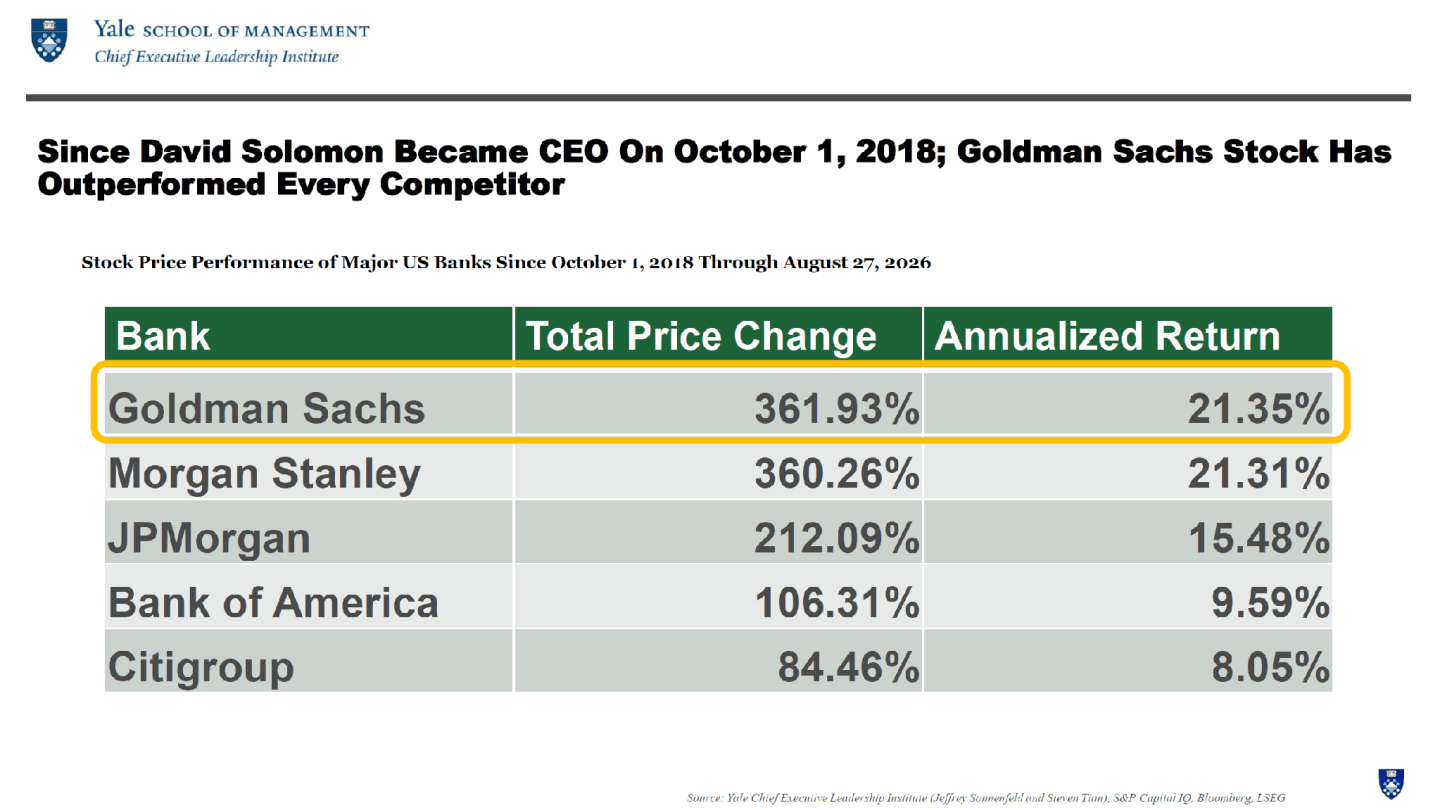
Consider just some of these remarkable data points: since David Solomon became CEO in 2018, Goldman Sachs Stock has significantly outperformed every major competitor, including JPMorgan, Morgan Stanley, Bank of America and Citigroup, by a healthy margin.
That is remarkable, because for many years, JPMorgan traded at a premium multiple to Goldman Sachs, driven by the fact that as recently as 2023, JPMorgan had a return on equity (ROE) that was 2x that of Goldman. But Solomon has closed that gap entirely, with Goldman Sachs stock now trading at a higher price-to-book than JPMorgan, with virtually equivalent ROEs.
But all this tremendous success reflects not overnight deliverance, but rather the fruits of years of sustained hard work, and tough choices by David Solomon during his tenure – indeed, it is the product of several years of successful strategic and cultural transformation as well as focused capital allocation priorities which were a dramatic departure from Goldman’s history.
Investing in growth, as Solomon has done, hasn’t always been the Goldman way, despite Goldman’s historical successes and strong prior leadership, through no fault of their own. When Goldman was a private partnership for approximately 100 years, the primary goal of the firm was to make money for its partners. Any growth initiatives had to be funded through partners’ capital – hardly an appealing prospect for those same partners – which resulted in a long period of low growth into new business lines. That is no knock on Goldman’s prior legendary leaders – for example, former CEO Lloyd Blankfein skillfully navigated the instability and aftermath of the Great Financial Crisis and reestablished its preeminence as the elite investment banking pillar as detailed in his best-selling memoir Streetwise; rather, that was the way things always were.
But under Solomon; growth, and investing back into the firm, have become genuine capital allocation priorities. During his tenure as CEO, Solomon has grown the firm into new business lines, positioning Goldman to reap more resilient, non-cyclical revenues, including lucrative recurring, durable fee revenues from Goldman’s burgeoning asset management franchise.
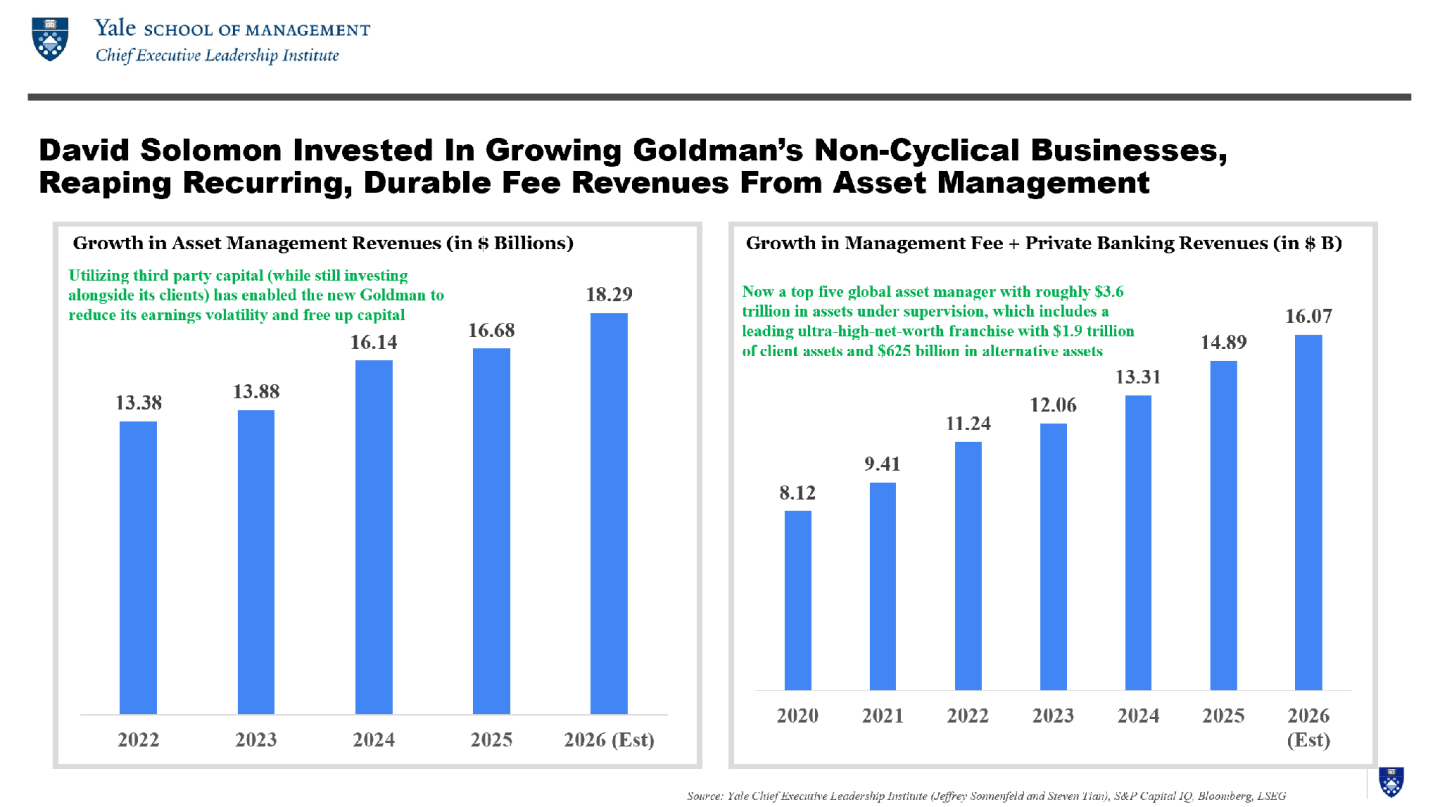
That, alongside Goldman’s continued dominance in its investment banking and capital markets business lines, has allowed Goldman to deliver return on assets and return on equity which are some of the strongest amongst its peer banks – all while buying back more stock than any peer. In fact, since Solomon became CEO, Goldman has retired over 21% of its total share count, significantly more than its competitors.
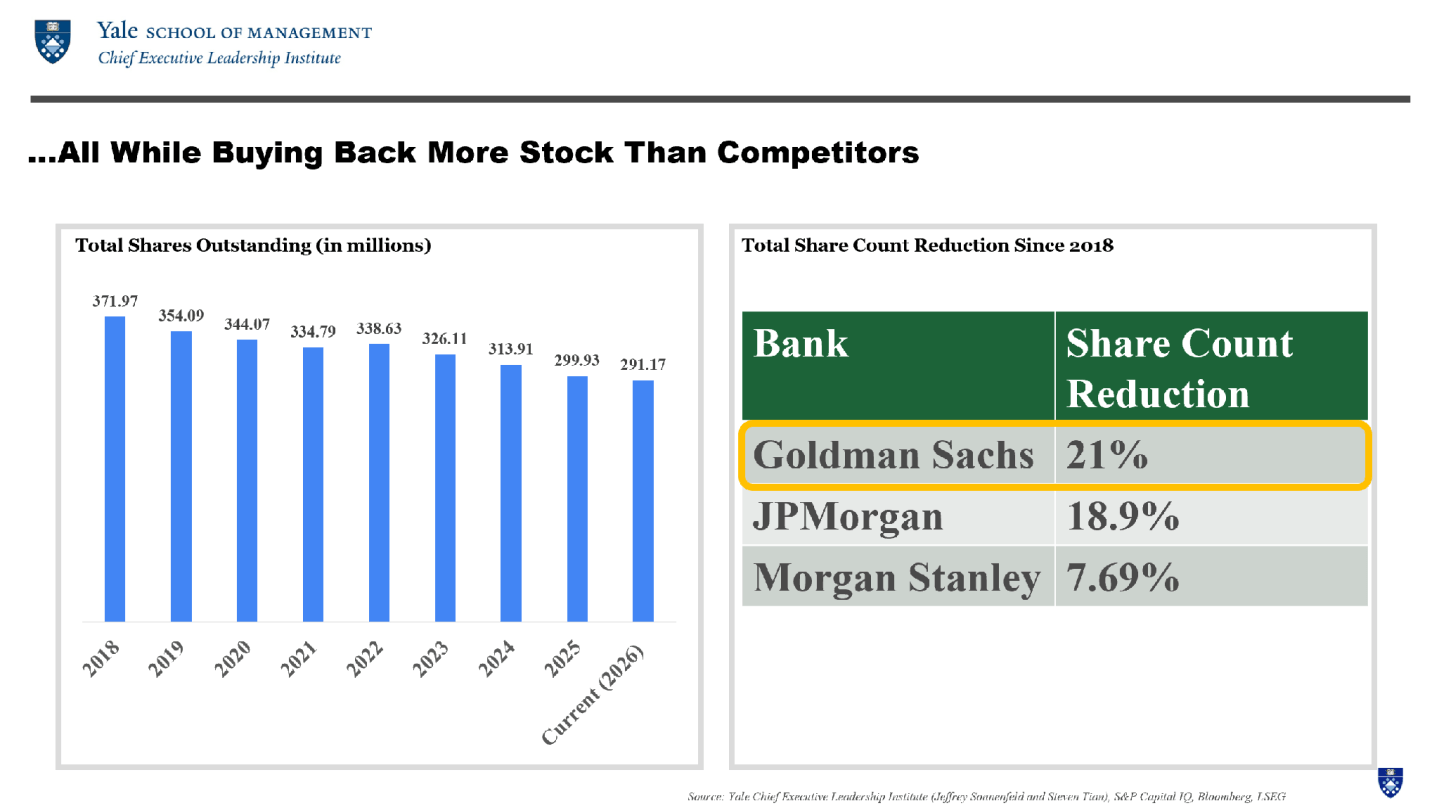
Coincidentally, today marks exactly eight years since David Solomon took the helm at Goldman Sachs. In that time, he has roughly quadrupled the stock, closed a valuation gap with JPMorgan that once seemed permanent, and turned a cyclical, partnership-era trading house into a genuine growth company. Rather than scripting the final act of a Shakespearean tragedy that exists only in their imagination, skeptics might try covering the story unfolding in front of them – one of the most successful transformations on Wall Street playing out today.
Indeed, the irony is that the very reporting billed as palace intrigue describes the opposite: an orderly, long-telegraphed succession, authored by Solomon himself, with a hand-picked protégé waiting patiently in the wings. That is not Brutus sharpening his dagger on the Senate steps – that is what good governance looks like, and by any rule of good governance, Goldman Sachs is lucky to have David Solomon continuing at the helm.
Boards and CEOs perform best when looking upwards with vision instead of being distracted by the gossip on the street. As Winston Churchill once said, “The nation will find it very hard to look up to the leaders who are keeping their ears to the ground.”
The opinions expressed in Fortune.com commentary pieces are solely the views of their authors and do not necessarily reflect the opinions and beliefs of Fortune.