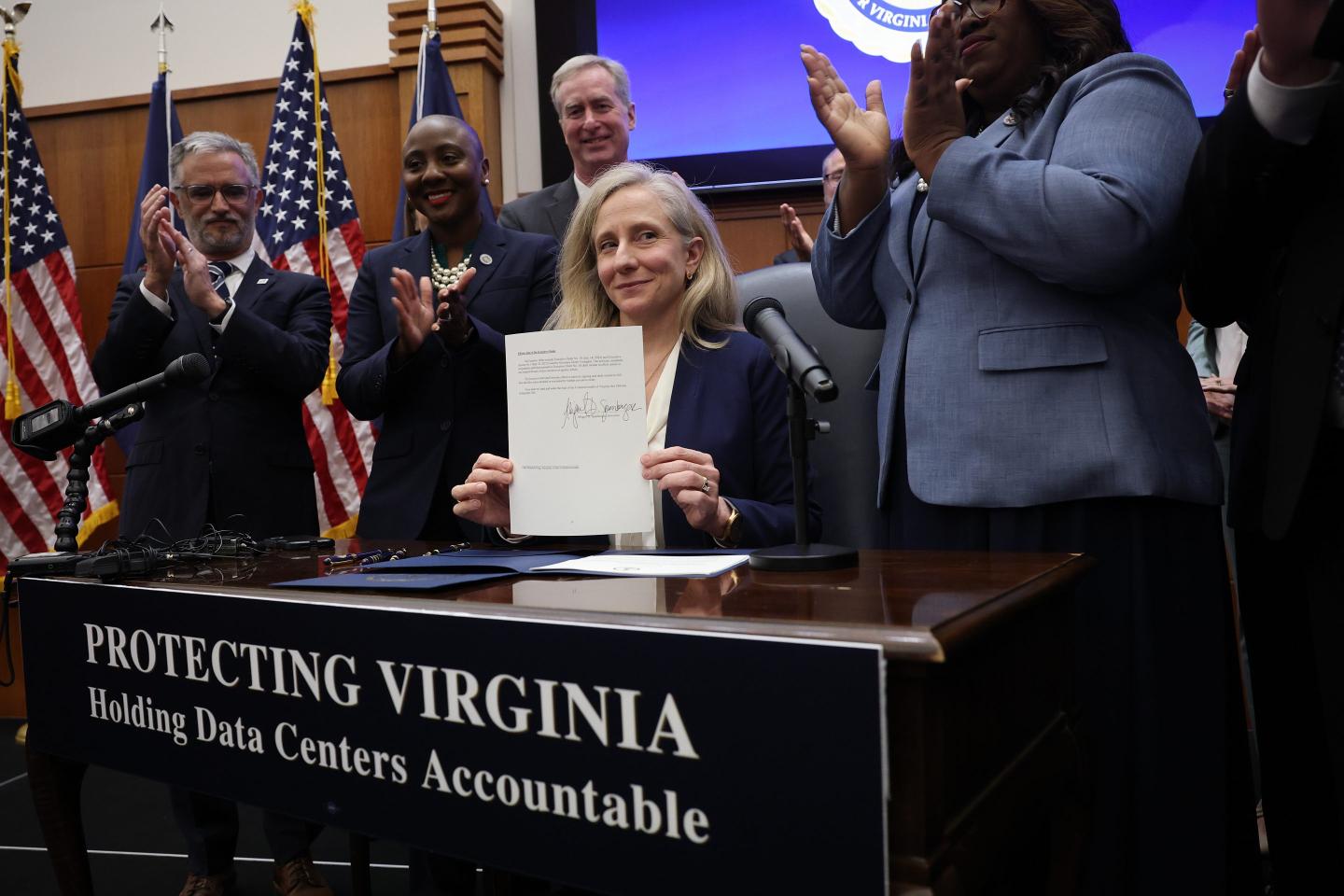
The people of northern Virginia have been living with data centers for many years. The area is home to the world’s largest concentration of data centers. In a survey we conducted, we found northern Virginians support development restrictions that could make data centers more transparent and accountable to the public. But they care about some types of regulations more than others.
As public concerns about data centers’ electricity demand and effects on the environmental and surrounding communities have grown around the nation, organized opposition to their construction is also on the rise – not only around the country but also at the epicenter of data centers.
In northern Virginia, public protest and legal action led developers to withdraw a proposal for an 2,100-acre campus for as many as 37 data centers in Prince William County in early July 2026. A week later, county officials cited that opposition when rejecting a proposal that would have rezoned another 2,000-acre area elsewhere in the county to allow more data centers.
Our research explored Virginians’ views on living near and among data centers, identifying what they think about their experiences and how they want to shape future data center development projects that might come to their communities. In the fall of 2025, we surveyed 1,004 residents of northern Virginia and the Richmond metropolitan area – homes of the two largest data center clusters in Virginia.
What we asked
Rather than asking whether they supported or opposed specific policies, we presented survey respondents with pairs of policy combinations that combined different policy measures to regulate data centers and asked them which combinations they preferred. Those measures included locations of the centers, placement of power lines, electricity rates, environmental effects, reporting of energy and water usage and requirements for public review before approval.

For instance, a respondent might choose between two combinations. One combination might include power lines being placed underground and data centers being allowed near homes and parks, but environmental impact assessments not being required. The other combination might include above-ground power lines, restrictions on data centers near homes and parks, and a required environmental impact assessment before approval.
Each respondent compared five pairs of combinations. Because the policy measures were varied across combinations, the same option appeared for different respondents alongside many combinations of other policies. This allowed us to statistically separate the influence of each individual option from the rest of the combination. In effect, we could see whether including a particular policy measure made people more or less likely to choose a combination, while averaging across the many combinations of other policies respondents saw. In this way, even though respondents evaluated complete policy combinations rather than individual measures in isolation, we could determine the independent influence of each policy option on their choices.
Visible and immediate impacts matter
Our analysis shows that residents most strongly supported policies addressing visible, immediate and tangible results, including requiring new electricity transmission lines to be built underground and restrictions on building data centers near homes, schools and parks. They also strongly support regular reporting of energy and water use.
Our findings also underscore the importance that residents place on having a voice before data center projects are approved. Public participation is ranked second among the six policy provisions in shaping residents’ preferences.
For many years, many jurisdictions in Virginia have allowed developers to build data centers without public review, so long as the buildings meet existing zoning requirements. The public has often found itself asking questions only after major decisions have been made.
For instance, in July 2024, residents of Fairfax County’s Bren Mar neighborhood raised concerns about a proposed 466,000-square-foot data center, only to find that local zoning laws allowed the developer to build it without a public hearing or much review or oversight.
In early 2025, Loudoun County, nicknamed “Data Center Alley,” ended automatic zoning approval for new data centers and required public hearings before local officials decided on the proposals.
By contrast, the U.S. Environmental Protection Agency under the Trump administration has moved to reduce requirements for public hearings for air-pollution permits from data center projects.
Complex issues need clearer explanations
Our research found less public support for policy provisions governing more complex issues related to data centers. In particular, respondents were ambivalent about whether data centers should be charged higher electricity rates than other customers.
Infrastructure costs incurred to support data centers can ultimately pass down to other customers. According to a Bloomberg analysis, wholesale electricity prices near data centers more than tripled between 2020 and 2025.
As for retail price, in August 2026, Reuters reported that rapid data center growth in Virginia has forced local power company Dominion Energy to rely more on costly wholesale power, contributing to a proposed rate adjustment that could raise a typical residential bill by about $20 per month.
We believe that members of the public can come to informed decisions about complex issues. But before they can do so, they may need help from technical experts like those who work for local and state governments to clearly communicate what’s involved and the trade-offs at stake.

Growth and oversight can coexist
Given their support for regulations on data centers, it’s tempting to assume that the respondents to our survey simply don’t want data centers in their communities. But, in fact, about 47% of respondents told us they support data center development in their area, while 25% are neutral and 27% oppose it.
These respondents were not simply saying “yes” or “no” to data centers. They have opinions about how data centers should be developed and which regulatory controls and safeguards should be in place.
Their views indicate that supporting data center growth and strengthening oversight are not competing goals. Residents may welcome development while expecting governments to address negative effects, provide opportunities for public input and establish safeguards to protect communities. The challenge for communities and their leaders is not simply deciding whether to allow data centers, but determining how to govern their growth.
Fengxiu Zhang, Associate Professor of Policy and Government, George Mason University and Saba Siddiki, Professor of Citizenship and Democracy, Syracuse University
This article is republished from The Conversation under a Creative Commons license. Read the original article.
