

Ask U.S. Bank’s wealth executives whether Gen Z has thrown in the towel on traditional wealth-building, and the answer is a firm no. Ask them about the “Bank of Mom and Dad,” and the answer gets more complicated — and more emotional.
Both questions came from the floor during a briefing on U.S. Bank’s newly released 2026 Wealth Report, addressed to Scott Ford, the bank’s president of Wealth Management; Ryan Nelson, president of Emerging Affluent Wealth Management; and Beth Lawlor, president of Private Wealth Management, who moderated the session.
Is financial nihilism real?
By the time the floor opened for questions, the panel had spent the better part of an hour walking through U.S. Bank’s 2026 Wealth Report — data showing Gen Z and Millennials starting to build wealth earlier than prior generations, leaning on the stock market over homeownership, and turning to social media and AI for financial guidance before ever sitting down with an advisor. Two-thirds of them, the panel noted, are still starting that journey with a conventional brokerage account, not a crypto wallet.
I raised my hand and asked about the meme that’s been circulating in finance coverage all year: “financial nihilism” — the idea that Gen Z has quietly given up on traditional paths to wealth and is chasing more exotic, alternative assets instead, like crypto, prediction markets and meme stocks. Is it true?
The answer came back fast, an unequivocal no. Nelson said he knows about the meme and finds it fascinating, in theory. But in practice, he’s just “not finding that” to be true. “By and large, I would say the answer is no. It is still a pretty traditional path. And if anything, it surprises me how conservative this generation is.”
The bank’s own numbers back that up. Despite nearly half of Gen Z and Millennials saying newer investments like cryptocurrency are appealing, only 12% of Gen Z and 14% of Millennials actually hold it, and 76% of Gen Z and 79% of Millennials still say traditional investing is the best way to achieve long-term financial goals. The real nihilism, the panel argued, has to do with every generation’s view on building wealth in the 2020s.
The Bank of Mom and Dad, reconsidered
My second question pushed further: it sounds from the data like a big part of building wealth is the “Bank of Mom and Dad,” or young people turning to their parents early in their careers, sometimes even leaning on them for help with big purchases like a down payment for a house.
Lawlor said the survey hadn’t isolated hard numbers on the phenomenon specifically, but that the underlying housing-affordability math left little mystery about why it’s happening: with median home prices around $430,000 and required incomes of $130,000 to $150,000 against a median household income closer to $85,000, “the question is how many young people” have that kind of money on their own, she said.
What struck Lawlor was the emotional register around this transition. Parents used to treat a grown child asking for money as an awkward, even resented request, but now there’s a feeling of “guilt” at the economy that’s being handed over.
“It didn’t come out necessarily in those words in the survey,” Lawlor said, but it seems like the parents felt “I’ve got to help them because it is so much harder than it was 30 years ago.” In the past, she said, parents were feeling more like their kids were a “barnacle” looking for a handout, but that stigma is fading more and more in the 21st century.
Nelson pointed to the reordering of priorities directly, telling the room that two-thirds of Millennials and Gen Z are now starting their wealth-building journey with a brokerage account rather than a home down payment, with parents and grandparents increasingly stepping in to help on the housing side — a dynamic he attributed to older homeowners sitting on refinanced, low-rate mortgages and years of price appreciation.
Lawlor added her own math to the affordability picture, noting that a home she and her husband bought in Maplewood, New Jersey, for $253,000 in their 20s is worth $2.1 million today — “the house didn’t change,” she said, “so it’s like how does somebody in their 20s start out with a $2.1 million house? How does somebody in their 20s start out with a $2.5 or $2.1 million house? It’s crazy.”
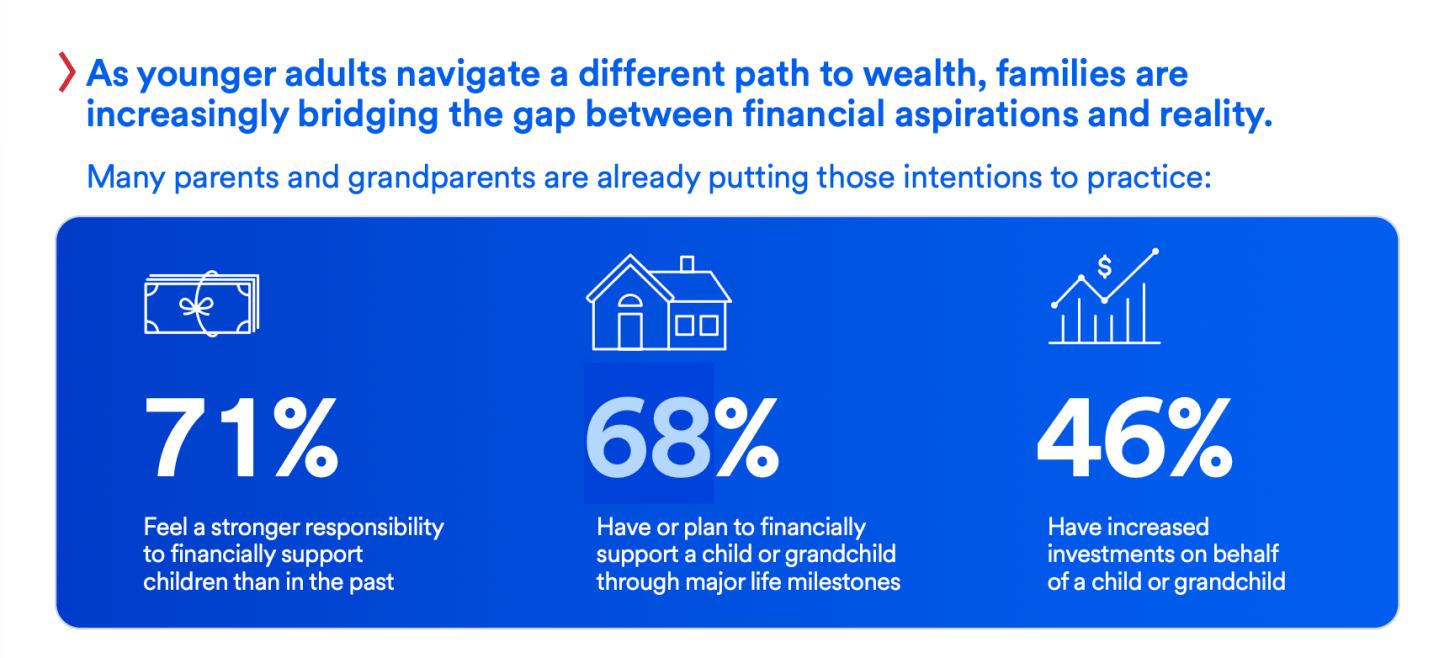
While the survey didn’t produce a single “Bank of Mom and Dad” statistic, its published findings support the guilt-driven framing Lawlor described in the room. Seventy-one percent of parents say they feel more responsible for supporting their children financially than parents did in the past, and 68% have already provided or plan to provide financial support for major milestones like a home purchase. That sense of obligation is heavily concentrated among younger parents themselves: 83% of Gen Z parents and 84% of Millennial parents report feeling this heightened responsibility, compared with just 52% of Boomer parents.
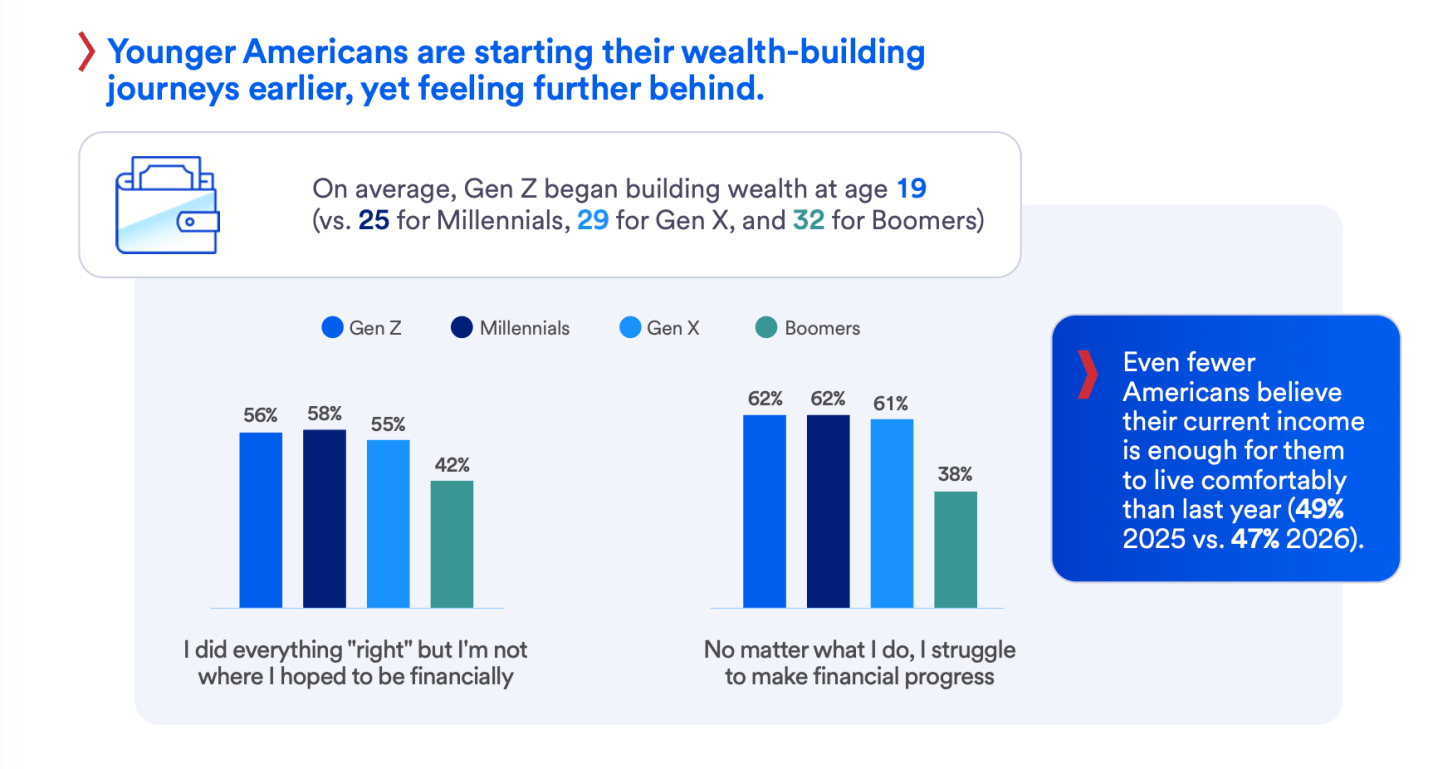
The pressure driving that guilt is documented elsewhere in the report. Fifty-six percent of Gen Z say they “did everything right” financially but aren’t where they expected to be, and 62% say they struggle to make financial progress no matter what they do. Homeownership hasn’t lost any of its symbolic pull — 86% of Americans across every generation still call it a marker of financial success — but only 22% of Gen Z non-homeowners who want a home think they’ll actually get one within five years, and 29% say they’ve already given up on the goal entirely, more than double the 12% of Boomers who’ve done the same.
The nihilism emerges in the report as a rational reaction to facts on the ground: 86% of Americans across every generation still call homeownership a marker of financial success, but 62% of Gen Z and 61% of Millennials say the stock market has become a more realistic path to wealth than buying a home.
The evolving American wealth equation
The questions landed at the end of a discussion that had already laid out a broader picture of how Americans are adjusting their approach to wealth. Ford opened by noting that the financial markers of success — buying a home, building a career, educating children — have stayed remarkably constant across generations, even as the path to reach them has changed considerably, particularly for Gen Z.
The panel also spent significant time on the gender gap in wealth-building. They found that women begin building wealth slightly earlier than men, at 27 versus 28, but only 26% felt confident and prepared when they started, compared with 41% of men. Nelson called this a paradox: women want more guidance — 80% say so — but are less likely than men to actually work with a financial advisor, a pattern he attributed to discomfort with financial jargon. Lawlor noted a generational silver lining, pointing out that 31% of Gen Z women now say they felt prepared when they began building wealth, the highest share of any female cohort surveyed, which she credited to rising financial literacy and enrollment gains for women in business schools.
Ford also highlighted what the survey calls “First Generation Wealth Builders” — the 44% of Americans without a family financial role model or expectation of inheritance — describing them as prioritizing fundamentals like saving, budgeting and debt paydown before taking on investment risk. He connected that group directly to the parental-obligation theme, noting that 71% of parents now say they feel more responsible for helping their children get ahead than parents did in the past.
Taken together, the panel’s answers to every reporter’s floor questions told a coherent story: Gen Z isn’t abandoning the traditional wealth-building script, as the “financial nihilism” narrative suggests — it’s leaning harder on family to stay in it. Parents aren’t stepping in because their kids gave up; they’re stepping in because, as Lawlor put it, the math changed and the sense of obligation followed. Nelson’s data-driven pushback on nihilism and Lawlor’s read on parental obligation describe the same generation from two directions — one still playing by the old rules, the other unable to do so without help nobody expected to need this much.
For this story, Fortune journalists used generative AI as a research tool. An editor verified the accuracy of the information before publishing.