
• Home
  • Latest
  • Fortune 500
  • Finance
  • Tech
  • Leadership
  • Lifestyle
  • Rankings
  • Multimedia

Trendingnow

1

Jamie Dimon says the American Dream is slipping away. The dysfunctional baby boomer retirement wave is a major part of the problem

2

Amazon workers on food stamps have tripled despite its record revenue—and it’s just the latest evidence of the new economy of shrinking labor shares

3

Billionaire Mike Bloomberg was fired after dedicating 15 years of his career to Salomon Brothers—the next morning, he founded his media empire

1

Jamie Dimon says the American Dream is slipping away. The dysfunctional baby boomer retirement wave is a major part of the problem

2

Amazon workers on food stamps have tripled despite its record revenue—and it’s just the latest evidence of the new economy of shrinking labor shares

3

Billionaire Mike Bloomberg was fired after dedicating 15 years of his career to Salomon Brothers—the next morning, he founded his media empire
Economynational debt

As 10-year Treasury yield hits 5%, debt hawks are eyeing a national debt spiral: ‘If this isn’t a wake-up call, I don’t know what will be’

Eleanor Pringle
By
Eleanor Pringle
Eleanor Pringle
Senior Reporter, Economics and Markets
Down Arrow Button Icon
Eleanor Pringle
By
Eleanor Pringle
Eleanor Pringle
Senior Reporter, Economics and Markets
Down Arrow Button Icon
September 15, 2026, 6:48 AM ET
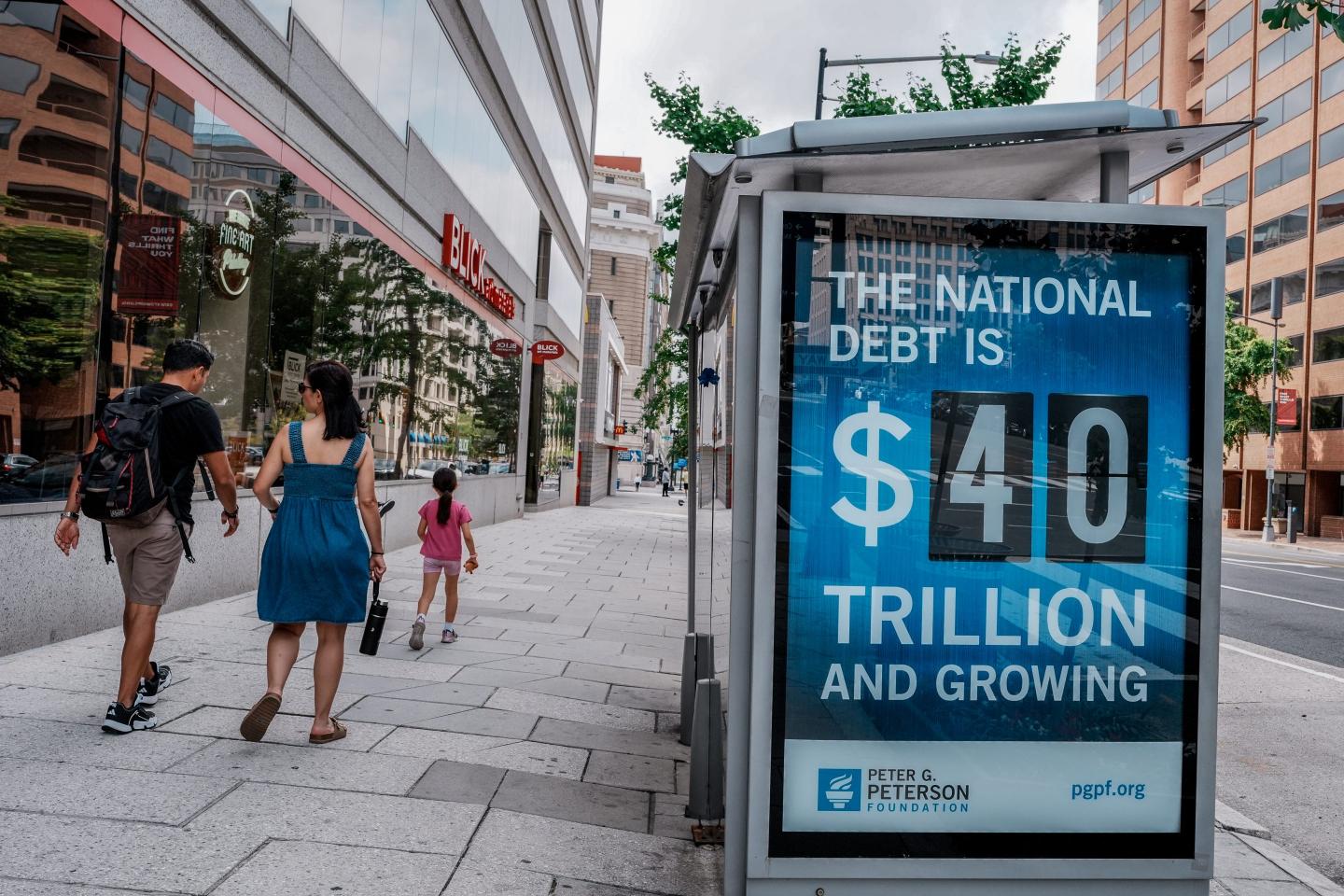
A view of a bus shelter at 13th and I St's NW where an electronic billboard and a poster display the current U.S. National debt per person and as a nation at 40 Trillion Dollars on August 30, 2026 in Washington, DC.
A view of a bus shelter at 13th and I St's NW where an electronic billboard and a poster display the current U.S. National debt per person and as a nation at 40 Trillion Dollars on August 30, 2026 in Washington, DC.Jemal Countess - Getty Images for the Peter G. Peterson Foundation
Google source logo
Add Fortune on Google for similar content.

Budget watchdogs have been given fresh cause for concern this week as the rate on 10-year Treasuries has tipped over 5%—a symbolic benchmark for investors and economists.

At the time of writing, yields on the 10-year note sat at 5.027%, having climbed steadily since February of this year.

The 52-week high came after the U.S. Treasury intervened in the bond market, with a multi-billion-dollar buyback scheme last month in an attempt to improve market liquidity.

Recommended Video

But after a brief drop, yields resumed their march higher ahead of this week’s Federal Open Market Committee (FOMC) meeting, and ongoing tensions in the Middle East contributing to inflationary fears.

With yields now notching over 5%, longer-term interest rates across the economy are increasing, pushing up borrowing costs on the national debt as a result. Budget hawks have long worried that the U.S. might enter a debt spiral—a cycle where interest payments cause debt to grow because more borrowing is needed to finance that debt.

As Maya MacGuineas, president of the Committee for a Responsible Federal Budget, said in a statement last night: “If rates remain 80 basis points-plus above projections over the next decade, we’re on course to spend an annual $2.7 trillion on interest payments at the end of the decade. We’ll be spending more on interest than Medicare or Social Security retirement benefits.”

“High interest rates also increase cost-of-living for ordinary Americans. New homebuyers are paying 7% on their mortgages, and other loans are even more expensive. For businesses, the high cost of borrowing may stifle investment, slowing economic growth and leaving Americans poorer than they otherwise would be.”

The “real threat” is a debt spiral, MacGuineas added, saying: “A fiscal crisis, once unthinkable, is now a distinct possibility … If 5% interest rates aren’t a wake-up call, I don’t know what will be.”

Those on the bullish end of the debt debate would point out that, although yields are relatively elevated, the factors driving the rise at present don’t necessarily stem from fiscal concerns. Rather, they may reflect growth or inflation expectations over time, as opposed to demand for higher returns due to perceived risk in holding U.S. debt.

Bulls also argue that the U.S. economy could grow its way out of any fiscal concerns—increased productivity from the AI boom could propel the country out of danger, for instance.

The 5% benchmark

While debt hawks and doves might debate the importance of the 5% threshold being hit, UBS’s Paul Donovan points out that the number actually means very little in a real economic sense.

He told clients this morning: “Economically, there is no significant difference between a 4.9% yield and a 5.0% yield. Politically, 5.0% has more impact, as does the direction of travel. U.S. Treasury Secretary ‘House’ Bessent’s attempts to steer the market have not been crowned in glory, and U.S. fiscal policy has very limited credibility at the moment.”

Likewise, Roman Ziruk, lead FX strategist at global financial services firm Ebury, pointed out that while the U.S. is an outlier with its debt at over $40 trillion, rising Treasury yields are not limited to a single nation.

“The ongoing Iran war has fuelled a surge in oil prices, reviving inflation fears and adding a fresh layer of uncertainty as to the path for long-term central bank rates,” Ziruk noted to clients last night. “This is clearly not just a U.S. phenomenon, but a global one. Yields across the major economic areas have all risen in tandem with U.S. Treasuries in recent weeks, pointing to a shared, geopolitically driven pressure on bond markets that is not confined to the U.S. alone.”

Exclusive: In a new sit-down interview with Fortune, OpenAI CEO Sam Altman explains safety standards are "not at a place" to push AI capabilities much further and warns AI beyond human control is "absolutely" possible. Watch or listen here.
About the Author
Eleanor Pringle
By Eleanor PringleSenior Reporter, Economics and Markets
LinkedIn icon

Eleanor Pringle is an award-winning senior reporter at Fortune covering news, the economy, and personal finance. Eleanor previously worked as a business correspondent and news editor in regional news in the U.K. She completed her journalism training with the Press Association after earning a degree from the University of East Anglia.

See full bioRight Arrow Button Icon
Google source logo
Add Fortune on Google for similar content.

Latest in Economy


Most Popular

Fortune Secondary Logo
Rankings
  • 100 Best Companies
  • Fortune 500
  • Global 500
  • Fortune 500 Europe
  • Most Powerful Women
  • World's Most Admired Companies
  • See All Rankings
  • Lists Calendar
Sections
  • Finance
  • Fortune Crypto
  • Features
  • Leadership
  • Health
  • Commentary
  • Success
  • Retail
  • Mpw
  • Tech
  • Lifestyle
  • CEO Initiative
  • Asia
  • Politics
  • Conferences
  • Europe
  • Newsletters
  • Personal Finance
  • Environment
  • Magazine
  • Education
Customer Support
  • Frequently Asked Questions
  • Customer Service Portal
  • Privacy Policy
  • Terms Of Use
  • Single Issues For Purchase
  • International Print
Commercial Services
  • Advertising
  • Fortune Brand Studio
  • Fortune Analytics
  • Fortune Conferences
  • Business Development
  • Group Subscriptions
About Us
  • About Us
  • Press Center
  • Work At Fortune
  • Terms And Conditions
  • Site Map
  • About Us
  • Press Center
  • Work At Fortune
  • Terms And Conditions
  • Site Map
  • Facebook icon
  • Twitter icon
  • LinkedIn icon
  • Instagram icon
  • TikTok icon
  • YouTube icon

    Latest in Economy


    Most Popular

    © 2026 Fortune Media IP Limited. All Rights Reserved. Use of this site constitutes acceptance of our Terms of Use and Privacy Policy | CA Notice at Collection and Privacy Notice | Do Not Sell/Share My Personal Information
    FORTUNE is a trademark of Fortune Media IP Limited, registered in the U.S. and other countries. FORTUNE may receive compensation for some links to products and services on this website. Offers may be subject to change without notice.