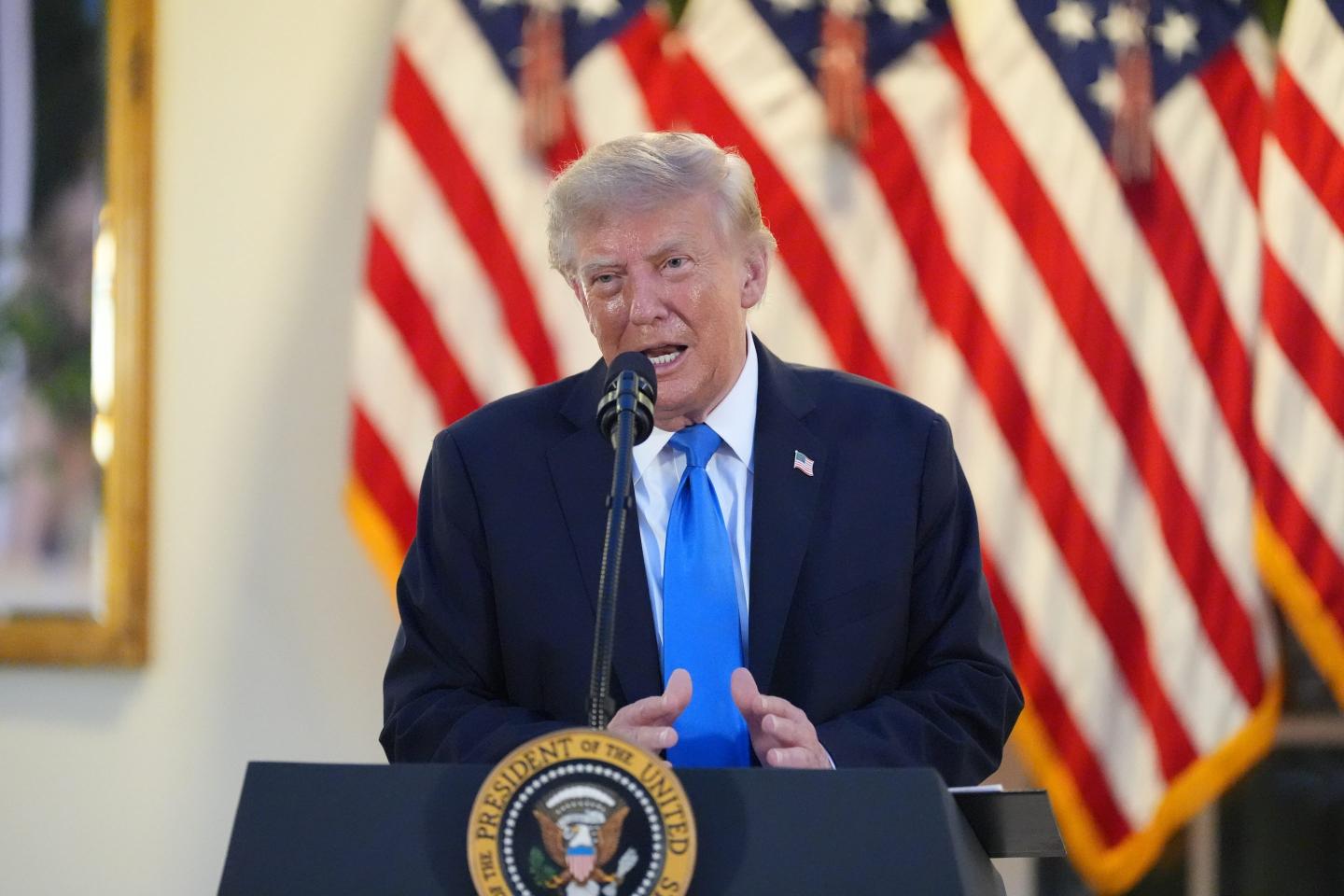
Working to keep the majority in Congress, Republicans at the midterm convention in Dallas are showcasing their chief legislative accomplishment — the sweeping package of tax breaks, social service cuts and immigration enforcement that President Donald Trump signed into law.
A year on, what’s known as the One Big Beautiful Bill — or, the “Big Ugly Bill,” as Democrats call it — has produced mixed results. Millions of people have received enhanced tax breaks, while millions are also losing access to federal food aid and health care. More immigrants are being arrested, many deported, some dying during the process.
House Speaker Mike Johnson calls it the kind of “common sense” governing that Republicans plan to do more of, if voters return them to power.
“Shamefully, not one Democrat voted for it,” Rep. Derrick Van Orden, R-Wis., said Wednesday during the convention’s opening night.
Here’s a look at what the big bill has accomplished, over the objections of Democrats.
Tax breaks for millions
Millions of taxpayers enjoyed tax benefits this year they might not even realize they received — the continuation of policies from Trump’s first term, in 2017, that were set to expire at the end of 2025 if Congress had failed to act.
The legislation extended those Trump tax breaks and added new ones, including no taxes on tips, overtime pay and certain auto loan interest payments. There’s a larger standard deduction, a bigger child tax credit and an extra deduction for many seniors, as well as new Trump accounts for children.
“Let me hear you if you’re benefiting from those tax cuts President Trump fought for,” Majority Leader Steve Scalise, R-La., said at the convention.
Cheers rippled through the audience.
All told, some 7.5 million filers claimed no tax on tipped income, 29 million people claimed no tax on overtime and 35 million took the enhanced senior deduction, the Treasury Department said. Nearly 40 million families claimed the bigger child tax credit.
But the flow of the tax breaks has been uneven, with larger gains at the upper incomes.
Garrett Watson, vice president of federal tax policy at the nonpartisan Tax Foundation, said people may not feel the tax cuts, which averaged $2,300, “because it’s just continuing what was already the case.”
Actual refunds were up by about $350 on average, the foundation said, about an 11% increase.
“It was avoiding a tax hike,” he said, which is different from “here’s additional relief.”
Those gains have been largely offset by costs from Trump’s tariffs and other policies, he said.
Cuts to SNAP food aid and healthcare
A centerpiece of the bill brought substantive changes to the nation’s federal food assistance and healthcare programs, with stricter new work requirements for many people who receive aid.
The shifts are set to chisel more than $1 trillion from the programs as fewer people are enrolled, according to the nonpartisan Congressional Budget Office.
So far, 4 million fewer people are receiving food aid through the Supplemental Nutrition Assistance Program, known as SNAP, according to federal data compiled by the Center on Budget and Policy Priorities, a think tank in Washington.
SNAP participation rates have dropped in every state, and more than 800,000 children are no longer receiving the aid in at least 13 states with publicly accessible data, according to the think tank.
While SNAP has always required certain people to work as part of receiving the aid, the Republicans extended the requirement to more people, including older Americans through age 64 who are able-bodied and without young children.
The Medicaid health program has not had such a work requirement, and will soon face one as part of the big bill.
While a few states have begun imposing the Medicaid work requirement this year, most will launch in 2027. The CBO has estimated more than 7 million people will be without health insurance from the Medicaid changes. The bill adds a $50 billion fund to help rural hospitals handle the cuts.
Republicans said their goal has been to root out what they call waste, fraud and abuse in the food aid and healthcare programs and get people back to work. Recipients are required to work, do community service or enroll in education programs for 80 hours a month.
Advocates for the programs say many of those who can work already do, relying on the aid to help make ends meet.
All told, the tax breaks and program cuts add up to fewer resources for poorer people — and more for those in the upper incomes.
“Resources will decrease for households toward the bottom of the income distribution,” the budget office said, “whereas resources will increase for households in the middle and toward the top of the income distribution.”
There’s more money for the Pentagon and deportations
The package provided some $350 billion for the Defense and Homeland Security departments, supercharging agency budgets.
The Pentagon’s $150 billion boost is funding a range of projects, though Defense Secretary Pete Hegseth returned to Capitol Hill this summer seeking additional money to help pay for the war against Iran.
Homeland Security was given some $175 billion in the big bill, largely to support Trump’s immigration enforcement and deportation agenda.
Immigration arrests surged to a high of nearly 50,000 in July, as Homeland Security redoubled its efforts following a slowdown in the aftermath of the deaths of two Americans, Renee Good and Alex Pretti, who were killed by law enforcement while protesting the federal enforcement actions in Minneapolis.
Then in August, Homeland Security said it set another record, nearly 51,000 immigration arrests.
Immigration and Customs Enforcement has been on a hiring spree, while state and local police departments are also tapping additional funds to partner with ICE.
Deficits rise and debt hits a milestone
The big bill is expected to increase the nation’s deficit by $3.4 trillion over the decade, according to a CBO analysis.
Tax revenues are projected to fall by $4.5 trillion, thanks to the tax breaks, offset partly by a $1.1 trillion reduction in spending, largely to the food and healthcare programs.
The nation’s annual deficits are hovering at nearly $2 trillion, and the accumulated U.S. debt now stands at $40 trillion, a milestone.