The ancient Greeks had a word for an object that is a remedy in one hand and poison in the other, depending on how it’s administered: pharmakon. Socrates used it in Plato’s Phaedrus, more than two millennia before Claude, Perplexity, or the AI-detection tool Pangram existed, to describe writing itself.
Plato recounts an Egyptian myth in which the god Theuth presents writing to King Thamus as a pharmakon — an “elixir,” or remedy, for memory (mnēmē) and wisdom (sophia). Thamus is not persuaded. Writing, he answers, will instead produce forgetfulness: by relying on external marks, people will neglect their own memory. It is, he says, a pharmakon not of mnēmē but of hypomnēsis — not memory itself, but only an aid to recollection — and one that may furnish the appearance of wisdom without genuine understanding.
The French philosopher Jacques Derrida returned to that passage in his 1968 essay Plato’s Pharmacy, arguing that pharmakon cannot be fixed as either remedy or poison: the same tool that preserves and extends thought can also displace the faculty it is meant to support. That is generative AI’s dilemma, revived. Used by someone with knowledge and judgment, it can help retrieve, organize, test, and revise ideas; used as a substitute for those capacities, it can produce fluent prose without understanding.
The remedy and the poison are one and the same. The debate over AI writing, in other words, is not a 2026 conundrum. It is the oldest argument about writing, wearing a new face.
The strait every desk now faces
Greek myth also offers a parable for a threat that can only be managed, not avoided: Circe’s warning to Odysseus to steer between Scylla and Charybdis, a calculus of survivable loss versus total destruction. Together they name, almost too closely, the two live questions in every newsroom’s, law firm’s, and research desk’s relationship to generative AI: how visible the intervention is, and what you’re actually willing to give up to use it responsibly.
Circe’s counsel to Odysseus is among the least comforting pieces of advice in ancient literature, precisely because it is sound. Ahead lies a strait: on one side, Scylla, a six-headed creature that snatches sailors from the deck; on the other, Charybdis, a whirlpool that swallows the entire ship. Steer nearer Scylla, Circe advises — better to lose six men than all, and the vessel besides.
Media institutions, research desks, law firms, and other entities producing content or ideas are quietly weighing Circe’s counsel: what can be surrendered without diminishing the work itself, or the broader mission of truth it serves. The question is no longer whether to make a sacrifice, but how to calculate the precise formula of survivable loss.
Charybdis is the old economics: insist on the unassisted workflow and risk becoming a “media Pharisee,” while a competitor’s earnings note lands an hour sooner, a memo arrives overnight instead of in a week, a research desk publishes at half the cost. The precedents are not hypothetical. The Associated Press made the trade in 2014, automating corporate earnings stories and expanding coverage from roughly 300 companies per quarter to 4,400, on the logic that a formulaic scoreboard story was worth ceding for reporting time that requires judgment and better sourcing. Bloomberg made the same bet around the same time, publishing headlines with the help of machine learning starting in 2015 and using automated technology to assist with roughly a third of its content as far back as 2019, per The New York Times.
When investor Stanley Druckenmiller published a Wall Street Journal op-ed on the bond market this August, readers running it through the detection tool Pangram got a 100% AI-generated verdict. Druckenmiller confirmed it within hours, without shame. The piece carried no disclosure, and WSJ editorial page editor Paul Gigot defended the silence rather than demand it be broken. More than a decade before “AI writing” became a newsroom-wide reckoning, it had already redefined much of the job — for people willing to look honestly. Noteworthy figures in business and technology consistently insist on and defend the use of the tool.
Scylla is the toll those efficiencies exact: the byline’s claim to have thought the thought, the analyst’s to have read the filing, the student’s to have made the argument — each quietly severed from the work that once made it theirs. It is the Odyssean bargain: accept a sufferable loss in pursuit of a larger goal, but know exactly what you are giving up.
The god from the machine
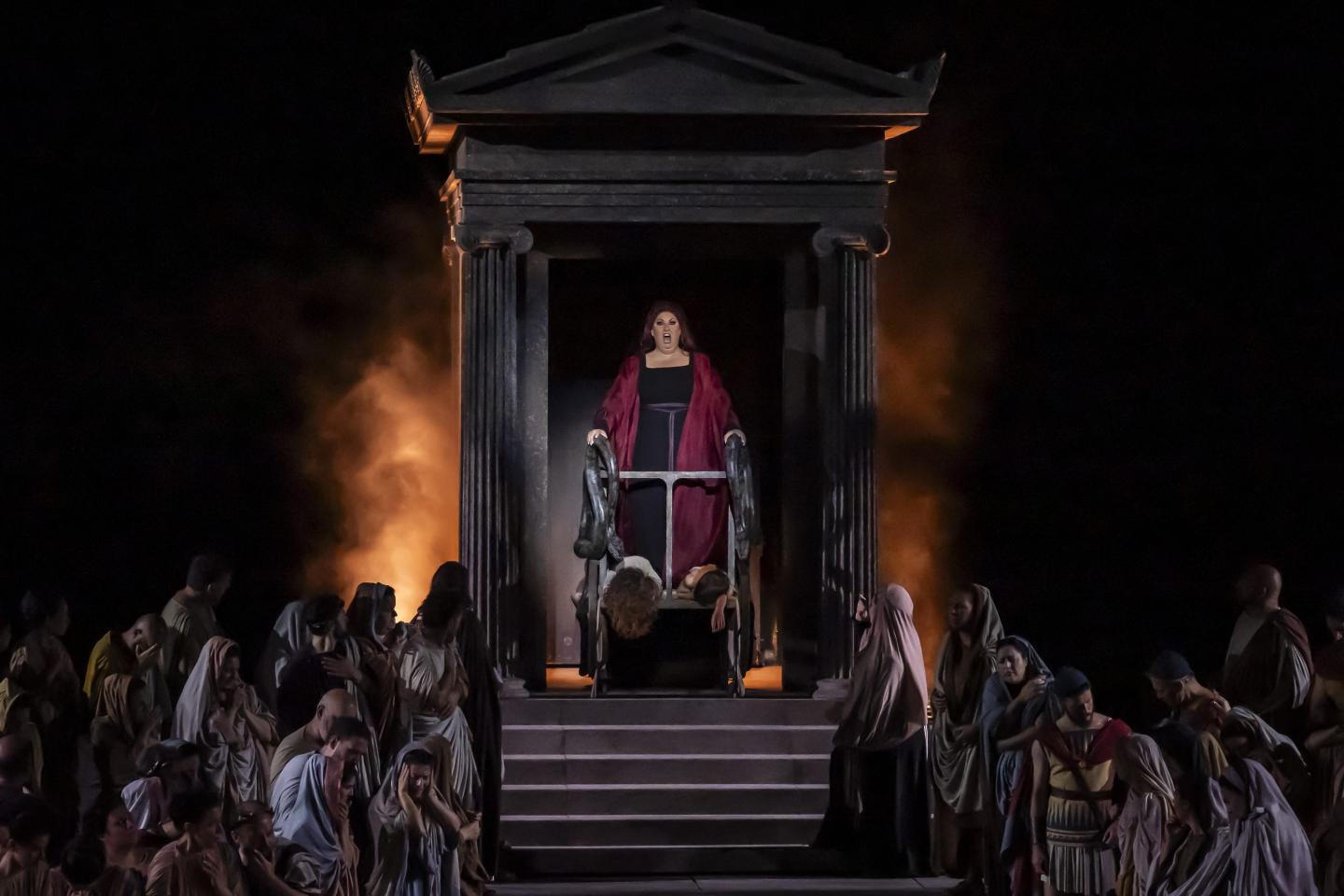
If the AI-writing crisis is older than most people know, the face it’s wearing is older still—borrowed from the Greek stage. The deus ex machina was a device where an actor playing a god was lowered to the stage by crane to solve what no character in the narrative could. The crane itself had a name: the mēchanē, the actual piece of stage technology that delivered the deus — and it was introduced by the great playwright Aeschylus before becoming the signature of Euripides, particularly at the end of Medea, when a dragon-drawn chariot from Helios lifts the murderous heroine out of a plot that had run out of road.
Just as with today’s innovation, the mēchanē drew criticism. Aristotle was unimpressed, arguing in his Poetics that a resolution imported from outside the story’s own causal logic might satisfy an audience, but cheapens the tale it claims to finish. A deus ex machina, as it came to be called in Latin, is defensible for events “outside the play,” Aristotle allowed — past events beyond human knowledge, or future ones only a god could foresee — but not for solving a plot a human character should have solved.
According to Drew Lichtenberg, the Yale-trained dramaturg and artistic producer at Washington, DC’s Shakespeare Theatre Company (and the twin brother of one of the authors), the critique was both more and less fitting for the age of AI than people think. “Aristotle was speaking specifically about Euripides,” Lichtenberg told Fortune. “He had a problem with [Euripides] cheapening or corrupting the poetics.” Aristotle was describing writers in the late part of the 5th century who started to “abuse this device” of the deus ex machina — particularly how Euripides pushed past its limits by having “the gods come down and interfere” in plots that, in Aristotle’s view, should have resolved themselves through human action alone.
In chapter 15 of the Poetics, Aristotle writes that “The supernatural should be used only in connection with events that lie outside the play itself, things that have happened long ago beyond the knowledge of men, or future events which need to be foretold and revealed, for we attribute to the gods the power of seeing all things.”
Lichtenberg said he saw a parallel — though one that inverts the ancient device in a telling way. “AI is the deus coming out of the machina, more than the machina,” he said — because in AI writing and AI creating, it is taking on an active role in a play that was formerly reserved for human characters. “That’s where it’s a really suggestive comparison,” he said. Film critics today sometimes accuse a lame act III of having a deus ex machina problem, and it names the crisis at the heart of AI writing: a machine wedged between a person’s idea and its expression, blurring how much of the finished piece is the person’s and how much the machine’s.
Lichtenberg calls Euripides “an unorthodox and experimental writer who was interested in new forms and sensations,” fascinated with the idea of the witch character Medea becoming a deus. More broadly, he was “fascinated with people becoming gods,” a fascination “which people found creepy and scary, the way people do with AI.” (It appeared again in Euripides’ later work, The Bacchae.) At the same time, Lichtenberg says, he went on to become “very influential on the generation that came after” — a writer blamed, even then, “for ending the golden age, for his excesses.”
Euripides’ late career overlapped with, in Lichtenberg’s words, “the decline and fall of self-rule” in Athens — the Peloponnesian War, the oligarchic coup of 411 B.C., and the slow exhaustion of Athenian democracy in which his final plays were written. What followed compounded the shift in dramatic taste. After Euripides, he explained, Alexander the Great came to power and changed culture: “Alexander goes around the ancient world and builds all these massive theaters,” Lichtenberg says, and “the style of theaters becomes more bombastic” in the Hellenistic period that followed — venues built to seat 10,000 or more, architecture and performance scaling up in grandeur even as the tightly self-governing city-state that had produced Sophocles receded into memory. “When we talk about the fear of AI,” Lichtenberg argues, “we are talking about this Euripidean decline and fall.”
At the same time, Lichtenberg allows, “now we read [Euripides] and he seems to be the most modern” of the three tragedians, with characters that are “the most complex.” What once got Euripides docked points with his judges is exactly what unsettled his contemporaries: “the irregularity of his dramaturgy,” Lichtenberg says, made his plays seem “disunified or incomplete, distorted,” producing what he calls “grotesque variations” on the form Aeschylus and Sophocles had established.
The Nietzsche question
No critic made a harsher case against Euripides — and perhaps his modern counterparts in the AI media crisis — than Friedrich Nietzsche, who devoted much of The Birth of Tragedy to the argument that Euripides had killed the art form. “Tragedy died,” in Nietzsche’s argument, “because the Dionysian rites, the ritual origin of tragedy, was lost,” Lichtenberg says, “replaced by a more psychological, scientific, questioning mode.” Nietzsche argued that “tragedy should be about mysteries and ritual essences,” not the interrogative, rationalizing sensibility that Euripides brought to the stage.
Addressing “sacrilegious Euripides” in Chapter 10 of The Birth of Tragedy, Nietzsche levels an accusation about tragedy: “It died under your violent hands … you plundered all the gardens of music, you still managed only copied, masked music. And because you had abandoned Dionysus, Apollo abandoned you: rouse all the passions from their resting places and conjure them into your circle, sharpen and whet a sophistical dialectic for the speeches of your heroes–your heroes, too, have only copied, masked passions and speak only copied, masked speeches.”
Ancient critics could never quite agree on the direction of causality between Euripides’ formal excesses and the political decay of Athens around him — and Lichtenberg thinks that same ambiguity now surrounds AI. “There’s an interesting chicken-or-the-egg problem with Euripides, he says: “Is he writing this way because society is falling apart? Or is society falling apart because artists are doing these damaging things?” Indeed, in Chapter 11 of The Birth of Tragedy, Nietzsche argued that “Euripides brought the spectator onto the stage” and “made the New Comedy possible.” As a result, “Civic mediocrity, on which Euripides built all his poetical hopes, was now given a voice.” The AI question, to Lichtenberg, conjures similar questions to the ones Aristotle and Nietzsche asked: “Is AI a sign of decline, or a symptom of disease?” he asked rhetorically. “Have we opened Pandora’s box?”
Nietzsche is not just a long-dead German philosopher: tech titans and AI thought leaders still use his language to describe their creation. Nietzsche’s concept of the Übermensch, or “superman,” is one that tech boosters have repeatedly reached for to describe AI’s potential. Mark Zuckerberg calls his own AI lab Superintelligence, and released a 6,000-plus-word essay on his dreams of achieving “personal superintelligence.” SoftBank’s Masayoshi Son told shareholders in 2023 that ChatGPT had brought him to tears over the meaning of life before he committed his company to “design the future of humanity”; by June 2026, Son was telling CNBC that AI models were approaching “superintelligence… exponentially smarter than all of us,” language lifted almost directly from Nietzsche’s own vision of a being that “overcomes” ordinary human limits.
Lichtenberg argued that Nietzsche meant something different in preaching about the superman: he was the latest apparition of the Dionysian, not a triumph of engineered reason. To Nietzsche, Lichtenberg explained, Dionysus was a “mask” or “metaphor” for something profound in human nature — an argument that “we should embrace the things that make us like beasts, seeing through the illusory nature of existence and exerting selfhood.”
That, in Lichtenberg’s telling, is the deeper misreading built into AI hype: not just that executives have seized on the Übermensch as a marketing metaphor, but that they’ve located the god in the wrong place. “AI could be the deus ex machina, but who’s the person who’s wielding it?” he asked. The artist used to be society’s transgressor; now “politicians and the tech overlords are the real transgressors” — casting their machines as gods to obscure their own hand on the lever. Modern society may have lost the Apollonian and the Dionysian altogether, leaving only the rationalizing, “Euripidean” half of human experience—just as a new machine intelligence arrives to do the questioning for us.
“What tradition does AI actually fall into?” Lichtenberg asks. “What’s so anxiety-producing, maybe, is there’s no clear precedent. It combines all these forms in a new and somewhat frightening way.”
“What tradition does AI actually fall into?” Lichtenberg asks. “What’s so anxiety-producing, maybe, is there’s no clear precedent. It combines all these forms in a new and somewhat frightening way.”
Writing was offered as remedy; Thamus called it poison; the pharmakon refuses to resolve. The same tool that extends thought can displace it; the same machine that speeds the work can sever the author from it. All Circe’s counsel makes clear is that there is no passage without loss; only the question of which loss you can survive.
The opinions expressed in Fortune.com commentary pieces are solely the views of their authors and do not necessarily reflect the opinions and beliefs of Fortune.