
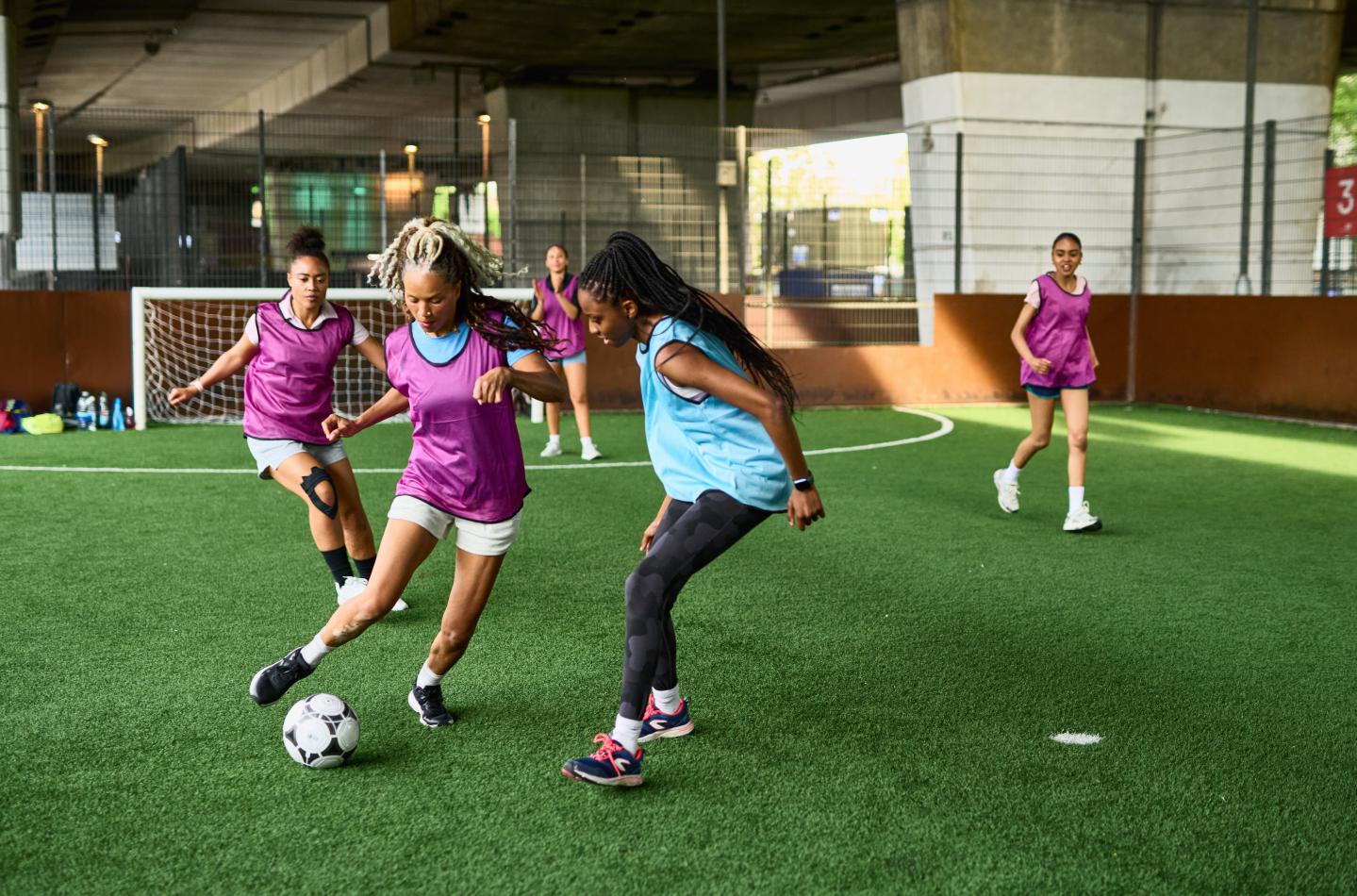
We know that girls who play sports grow up to be leaders. It’s a fun fact repeated often by women at the top of the business world, from Deloitte to the WNBA. Usually, these reports reveal that something like 94% of women in C-suite roles played sports growing up.
A new report from elf Beauty provides some more context on exactly how that happens. The beauty brand partnered with the women’s sports consultancy Parity to survey 9,500 women across the U.S., Canada, Germany, and the U.K. (The billion-dollar beauty business has a growing sponsorship portfolio in women’s sports, from the NWSL to the Professional Women’s Hockey League to a partnership with Billie Jean King.) Just over 5,000 of those women identified as “everyday athletes,” which means they played sports for at least three years before the end of high school or within the past five years. Under 4,000 women never played sports or played less than that; and only 328 women surveyed were pros.
The survey found that everyday athletes share certain qualities compared to the broader population of women in the workforce. Everyday athletes are 37% more likely to aspire to top leadership roles. They’re a whopping 50% more likely to actually hold those leadership roles. And they’re 25% more likely to have negotiated their salaries.
The skills that girls learn while playing sports lead to these numbers: teamwork, performing under pressure, communication, discipline, perseverance, and adaptability.
Interestingly, the top way that sports influences women later in their lives differs by region. In the U.S., sports teaches girls to speak up for themselves—leading many athletes to a path of advocacy, whether for a cause, for others, or for themselves at work. In Canada, playing sports correlates most with ambition. In Germany, it’s advancement to the top; athletes are 45% more likely to have been promoted multiple times. And in the U.K., athletes vs. non-athletes see the biggest gap in salary negotiation.
Elf is tying this research into its Change the Board Game campaign, which works to elevate more diverse women to board roles. For the women who already sit in those seats, we’ve long been able to see, looking back, that sports helped them get there. Now, for girls and women still coming up, we can better understand how sports could influence their path in decades ahead.
Emma Hinchliffe
emma.hinchliffe@fortune.com
The Most Powerful Women Daily newsletter is Fortune’s daily briefing for and about the women leading the business world. Subscribe here.
ALSO IN THE HEADLINES
Unrivaled is valued at $650 million. The women's basketball league cofounded by WNBA players Napheesa Collier and Breanna Stewart raised more than $100 million in a Series C. That doubles its valuation from its last fundraise in fall 2025.
A new exec to watch at OpenAI. Even as OpenAI has been losing many of its top female execs, there are some new ones coming onboard (if not in as prominent positions). Sandhya Devanathan will be leading Southeast Asia and Australia for the AI giant; she's been on Fortune's Most Powerful Women Asia ranking in the past in her role as VP and head of India for Meta.
Why Gap tapped Hailey Bieber. "She's a Gap girl," CEO Richard Dickson tells my colleague Phil Wahba in a new episode of Fortune's Behind the Business. But the ultimate purpose of Gap's pursuit of cultural relevance is "to drive revenues, and also drive prices."
The Victoria Beckham turnaround. For the first time since it launched in 2008, the Victoria Beckham business turned a profit in 2025. The addition of Victoria Beckham Beauty alongside the fashion line is helping drive that profit—and so did Netflix's Victoria Beckham documentary.
ON MY RADAR
The right's woman problem NY Mag
The abject hell of the Lindsay Clancy trial Washington Post
Mark Zuckerberg's social reckoning New Yorker
PARTING WORDS
"I'm really lucky that I'm interested in a field where women excel so that my only limitation on my success was my own imagination."
— Ina Garten, in her latest New York Times interview