
Good morning. Tomorrow, John Ternus officially takes the reins as Apple CEO.
Today, Fortune’s Sebastian Herrera asks whether the man can help Apple win the AI race.
The answer, naturally, lies here. Give it a read.
Today’s tech news follows. Have a productive day. —Andrew Nusca
Want to send thoughts or suggestions to Fortune Tech? Drop a line here.
The AI boom hasn’t stopped U.S. companies from hiring cheap offshore labor

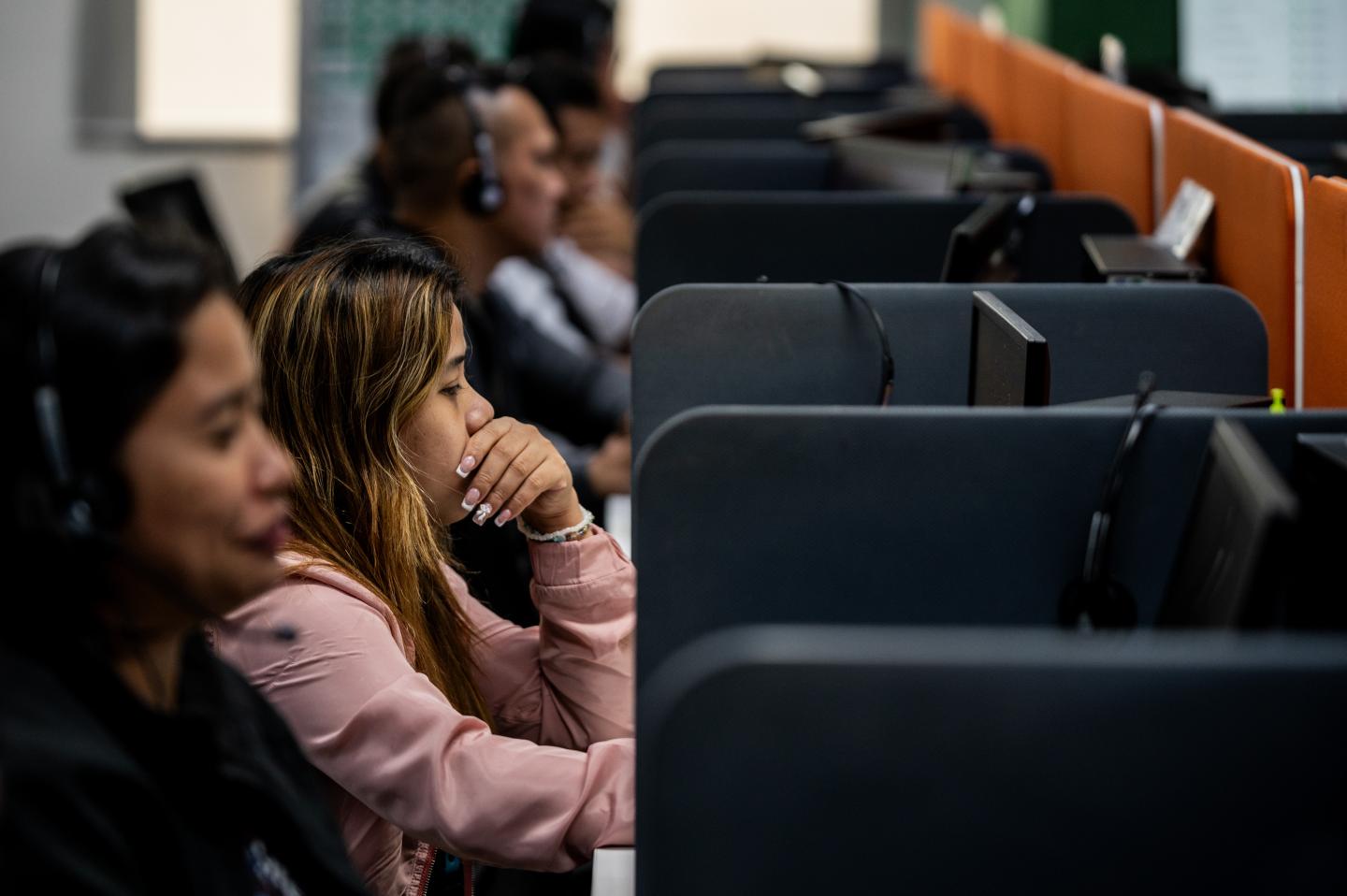
As more companies adopt agentic AI in hopes of replacing or making human workers more efficient, one top economist has noted customer service roles—particularly those overseas—are only growing.
Apollo chief economist Torsten Slok noted in a recent blog post that from 2016 through 2025, call center employment in the Philippines has risen each year, nearly doubling to 2 million over the 10-year span.
He also found from 2021 to July 2026, unemployment rates in the Philippines have decreased from 9% to about 5%, and in India decreased from around 7% to 6%, suggesting AI has not displaced offshore workers.
“If AI were displacing white-collar work at scale, you would expect to see it first in the Philippines and India, where business process outsourcing (call centers, IT support, back-office processing) accounts for a large share of employment,” Slok wrote last week. “Instead, the unemployment rate in both countries has continued to trend lower.”
Offshore call center jobs began booming in the late 1990s and early 2000s as a cost-cutting measure. The labor is considerably cheaper overseas than in the U.S. The Philippines dethroned India as the largest call center employer about 15 years ago.
But these jobs are also among the most susceptible to AI displacement. The Brookings Institution estimated 86% of customer service representative tasks had high automation potential.
The apparent contradiction of the job’s potential to be automated alongside rising employment points to a centuries-old economic paradox reflected across labor more broadly, according to Slok.
“This is Jevons paradox in action,” he wrote. “As AI makes call center work cheaper and faster, companies are buying more of it, not less.” —Sasha Rogelberg
Flock becomes a bipartisan target
Last Wednesday, blue-leaning Tempe, Ariz. turned off its Flock automated license plate readers and said the city would not seek another company to replace the system, citing “risk of misuse.”
Three hours later, the nearby red-leaning town of Cave Creek did the same.
The same day in Washington, D.C., Senator Josh Hawley, a Missouri Republican, opened a formal investigation into the company, while independent Vermont Senator Bernie Sanders posted a lengthy statement pledging to introduce legislation against it.
The lawmakers sit at opposite ends of the Senate’s ideological spectrum, but Flock’s rapid expansion, and the scrutiny now following it, has captured their attention.
In his letter, Hawley wrote that Flock has built an “unprecedented national surveillance network” of more than 120,000 cameras across 49 states, scanning more than 20 billion vehicles a month, and that “Congress never authorized the network your industry has built.”
By its own account, Flock’s cameras have helped close roughly a million police investigations and locate about 10,000 missing people over the past year.
But an August Washington Post investigation found more than 50 law enforcement officers had been accused, charged with, or convicted of misusing automated license plate readers, including cases where officers used the systems to track former partners.
As of Wednesday, the anti-surveillance group DeFlock says more than 90 cities have moved to cancel or reject Flock contracts.
The company has since reduced its default data retention window from 30 days to seven and now requires officers to enter a case code before accessing stored data. But Flock CEO Garrett Langley told Fox News the country needs “compromise” between privacy and safety concerns.
Whether that arrives before more policymakers take action remains to be seen.—Catherina Gioino
Shein raised $1.7 billion in its Hong Kong IPO
Shein, the Chinese-turned-Singaporean fast-fashion retailer, has completed its initial public offering—with a few caveats.
Set for a market debut tomorrow, Shein raised $1.7 billion at a valuation of $26 billion. That’s 15 times forward earnings (and double the ratio of rival Temu’s parent company), according to Bloomberg, but a fraction of the $100 billion valuation it commanded in 2022.
Growth is slowing (in part from competition by Temu) and tariffs continue to bedevil the company. Both are tough prospects for new investors.
Shein generated $41.9 billion in full-year revenue for 2025—a significant jump from 2023’s $32.1 billion, but a modest uptick from 2024’s $38.8 billion, thanks to higher costs from those pesky tariffs.
The going question is whether Shein’s adjusted business model will prove as effective as its nimble, data-driven supply chain. The company has moved to diversify suppliers (to reduce import duties), raise prices (to absorb tariffs), and sell its logistics network as a service to other brands (to increase revenues from other retailers feeling the pinch).
It’s been a long road for Shein. The company originally wanted to list in New York in 2022, but legislative pushback led the company to pivot to London the following year. Shein soon again found itself in geopolitical crosshairs, leading to an eventual listing in Hong Kong. —AN
More tech
—Taiwan authorities raid Unimicron. The Nvidia and Intel supplier is accused of labeling China-made parts as made in Taiwan.
—Lake America! Lake Ontario! In the wake of Trump’s name change, Google Maps makes updates, Apple Maps doesn’t, and this author has thrown himself into a lake.
—California passes bill exempting Linux and other open-source operating systems from a 2025 age verification law.
—SoftBank's SB Energy may file for an IPO this week. It hopes to raise up to $7 billion.
—Grindr’s path forward: Premium paid services for well-heeled, time-strapped users.
—Sony Music, Warner Chappell sue Anthropic. Tens of thousands of copyrighted songs were allegedly used to train Claude's LLMs.
—The older you are, the more likely you are to be positive about your employer’s AI use.