In March, I wrote in Fortune that the shadow fleet exists because the rules of the sea are fundamentally voluntary. Ships can opt out. They can switch off transponders, fly flags bought from registries that never inspected anything, and hold insurance nobody can trace. I noted that when one of them has an accident, there may be no one standing behind the policy.
Which is happening right now off the coast of Oman.
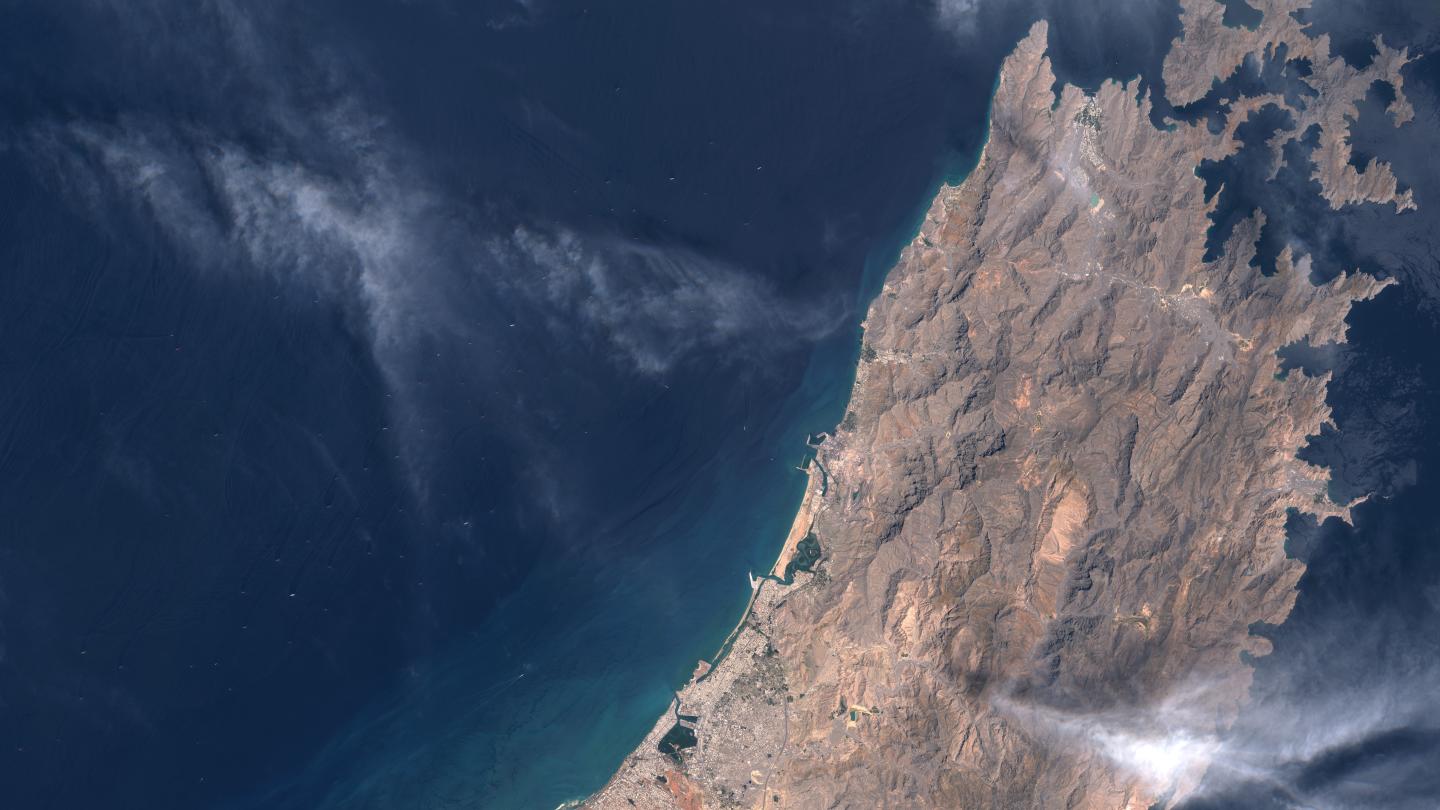
The dark fleet vessel in question is the Caroline Bezengi: a Suezmax built in 2001 carrying roughly 800,000 barrels of Russian Urals crude. The ship loaded at Novorossiysk on May 11 and was destined for Sikka, in Gujarat. On June 8 an explosion flooded her engine room off southern Yemen and left her adrift. No group has yet claimed responsibility and no government has stated a conclusion about the cause. Security sources and Greenpeace have both pointed to a limpet mine, but that is not yet confirmed. Her crew abandoned ship three days later, and on June 30 she hit the rocks of Al Qibliyah, in the Hallaniyat archipelago, and grounded. Adding insult to injury, she now sits — leaking oil — inside a 667-square-kilometer marine reserve Sultan Haitham had created by royal decree nearly eight months before, to protect an endangered population of Arabian Sea humpbacks.
Oil reached the mainland at Ras Madrakah. Oman’s Environment Authority assessed the affected area at 390 square kilometers on August 10; satellite analysis by SkyTruth’s John Amos suggested a figure of more than 2,000 square kilometers two days later. Dimitris Maniatis, who runs the maritime risk firm Marisks, told Bloomberg Television that cleanup alone could run $200 million to $500 million.
Nobody is going to pay it.
The Caroline Bezengi’s last registered owner of record is Rentoor Shipmanagement Ltd, a Marshall Islands company dissolved on February 24. Its Shanghai correspondence address is, Maritime Executive reports, a dead-letter box in a residential block. The ship claimed Cameroonian registry, but Cameroon suspended its international register on February 6 after discovering its flag was being issued through two fraudulent websites. In June Cameroon told the IMO it had struck 39 ships off its registry. No International Group club (whose members insure roughly 87% of oceangoing tonnage) is likely to insure a ship without any approved classification. The ship had no publicly identified insurer. That isn’t supposed to be possible.
So, no insurer is going to pay. Fortunately, there is a longstanding international safety net. It isn’t going to help. Oman is a party to the 1992 Civil Liability Convention and the 1992 Fund Convention. It sits comfortably inside the compensation architecture the world built after Exxon Valdez and rebuilt after Prestige: strict liability on the registered owner, compulsory insurance certificates, and to back it all up the International Oil Pollution Compensation Fund, which can pay up to about $279 million per incident. The Fund is financed by levies on any company receiving more than 150,000 tonnes of oil a year in a member state.
That worked for three decades. The Fund paid €147.9 million after the Prestige. It paid South Korea after the Hebei Spirit. In 2000, when a small tanker carrying no liability insurance and no class certificate sank off Abu Dhabi, the Funds paid claimants in the United Arab Emirates anyway.
It’s not going to pay Oman. A spokesperson for the Fund told Reuters in August that it would not be involved in cleanup costs because the incident “was being treated as an act of war,” a category the convention excludes. No reasoned determination has been published. The Fund’s governing bodies have not yet met on the incident. Under the convention the burden of proving that exclusion falls on the Fund, not the claimant, and Oman has three years to force the question in court.
Meanwhile, Oman is running the shoreline response on its own dime: booms, dispersants, and crews hand-clearing some twelve kilometers of oil-sodden beach at the height of the Khareef monsoon.
So, what will governments, especially those allied to the United States, actually conclude? The shadow fleet just showcased its capacity to inflict real and unmitigated consequences on a bystander nation. But enforcement isn’t politically cheap. The most likely answer is that pollution will quietly replace sanctions as the legal basis for stopping shadow fleet vessels.
Europe spent two years interdicting on sanctions grounds and found the tool blunt. Estonia and Finland challenged more than two thousand tankers for insurance documents by radio between 2024 and mid-2025; better than nine in ten produce a certificate, roughly a third of them from sanctioned Russian or Russian-linked insurers. Increasingly they produce certificates from Russian insurers nobody has sanctioned at all. No government has publicly disclosed how many were judged genuine. And the escalation risk is real. After Russia scrambled a Su-35 to shield a tanker Estonia tried to stop, Estonia’s navy commander told Reuters in April that the risk was “just too high” to detain shadow vessels. Two exceptions he did name were an imminent oil spill, and damage to undersea infrastructure.
This is becoming the doctrine. Ireland passed a bill to let its Naval Service board ships and order them to cease activities threatening “the marine environment.” RUSI recommends the environmental framing explicitly, because flag states respond better to marine-ecosystem arguments than to sanctions enforcement. To comply with sanctions is to pick a side. Enforcing environmental regulations is entirely defensible self-interest.
Environmental regulations at sea are about to get stronger, or at least more stringently enforced. Oman will be the example that gets pointed at. A nature reserve covered in floating crude oil, a bill somewhere north of $200 million, and a legal architecture that said no to helping. Oman will serve as a call to action for new efforts that have very little to do with saving the earth. The point is to fight the shadow fleet without publicly picking a side.
The opinions expressed in Fortune.com commentary pieces are solely the views of their authors and do not necessarily reflect the opinions and beliefs of Fortune.