
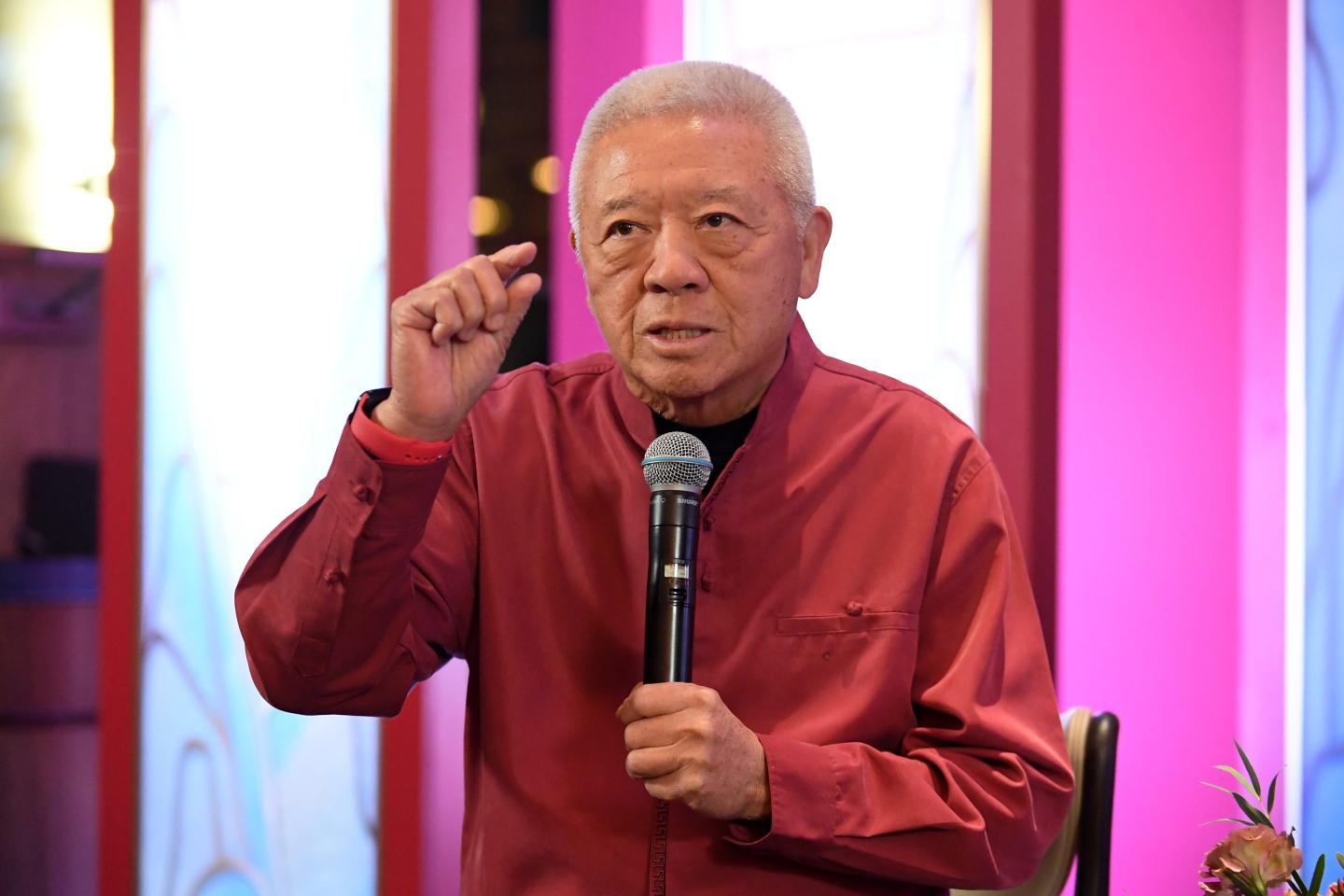
Work-life balance has become a major priority for Gen Z, with young workers increasingly placing a premium on maximizing time away from their jobs—even ranking it above pay in some surveys. But work-life balance has never been much of a priority for Panda Express cofounder Andrew Cherng.
Even at 78, the self-made billionaire restaurateur has long embraced the demanding schedules and relentless work ethic that helped him build the largest Asian-American restaurant chain in the U.S.
“It was hard when I had no business, there was no income,” he said after recently being asked by NBC News on how to avoid burnout. “But even then, I wasn’t burned out because, you just work, go to work, and [if] you have a like a 12-hour day, you go home, you sleep well—I mean that’s life.”
And that mindset helped him and his wife, Peggy, turn a single family-run restaurant into a nearly $7 billion-a-year global chain over five decades. It has also helped propel their net worths to an estimated $6.6 billion collectively.
How two immigrants turned $60,000 into an empire serving 148 million pounds of orange chicken a year
Andrew Cherng was born in Yangzhou, China, in 1948. When he was 5, his family fled to Taiwan, and eight years later, they moved again, this time to Japan.
He eventually made his way to the U.S., enrolling at Baker University in Kansas to study mathematics. There, he met his future wife, Peggy, who was Burmese-born and would go on to become his business partner and now serves as Panda Express’ co-CEO. The couple later earned master’s degrees from the University of Missouri.
“Every holiday I had, I worked in New York, waiting tables in a restaurant,” Andrew recalled to Fortune in 2013. “My father was a chef but hadn’t owned his own business. I didn’t like that. In my heart of hearts, I knew I wanted to be in business.”
Peggy went on to pursue her PhD and work a brief career as an engineer for McDonnell Douglas and Comtal (acquired by 3M), while Andrew began pursuing his own path in the restaurant industry. He moved to California to work for his cousin, putting in seven days a week at the restaurant for $800 a month.
After a year, Andrew decided to strike out on his own with his parents. Together, the family scraped together $60,000 from savings and a Small Business Administration loan and opened Panda Inn in Pasadena, California, in 1973.
“The whole family—my parents, a brother and sister—all worked at the restaurant for free,” he recalled. “We lived in a two-bedroom apartment in San Gabriel and didn’t have any money. Peggy would come to visit, and we got married in 1975.”
The restaurant’s expansion was slow at first, but by 1983, the first Panda Express was opened in a shopping male in Glendale, California, and the concept gradually exploded. In 1985, Panda grew from five locations to nine in a single year.

Today, Panda has more than 2,600 locations around the world and employs over 55,000 people. In 2025 alone, the chain served up 148 million pounds of its signature orange chicken. But perhaps more remarkably, the Cherngs built the empire without ever taking money from outside investors.
Work-life balance is rejected by many of the world’s top founders
The Cherngs aren’t the only business leaders who have embraced an all-consuming approach to work—and credited that commitment with helping fuel their success.
Nvidia co-founder and CEO Jensen Huang has similarly said that work-life balance is essentially nonexistent for him. Huang is constantly thinking about his chip-making business.
“I work from the moment I wake up to the moment I go to sleep. I work seven days a week,” Huang said in a 2024 interview with Stripe CEO Patrick Collison.
That relentless focus has helped transform Nvidia from a computer graphics company first conceived at a Denny’s into one of the world’s most valuable companies, with a market capitalization of more than $5.5 trillion. Huang’s personal net worth is estimated at nearly $190 billion.
Huffington Post founder Arianna Huffington recently echoed that sentiment to Fortune, saying that she doesn’t believe people with truly engaging jobs can simply shut their laptops at 5 p.m.
“I don’t think there is anybody with an interesting job who can do that,” Huffington said. “For you, or me, or most people with interesting jobs, there is never a time when you have a natural ending to the day.”
The same idea extends beyond core business. Will.i.am, the Grammy Award-winning music artist previously shared with Fortune that if Gen Z want to aspire for success, they should forget about work-life balance.
“If you’re trying to build something that doesn’t exist, it’s about dream-reality balance,” he said. “Work-life balance means that you’re working for somebody else’s dream. You just have a job supporting somebody else’s dream, and you want to balance your work and your life.
“But if it’s dream-reality balance, then it’s not work,” Will.i.am added. “It’s a dream that you’re trying to put into reality, and you’re ignoring your current reality.”