
The U.S. national debt has hit $40 trillion, and the Trump administration is facing questions about its budget plans as a result. The good news is, there has one: The American economy will apparently grow its way out of any fiscal crisis.
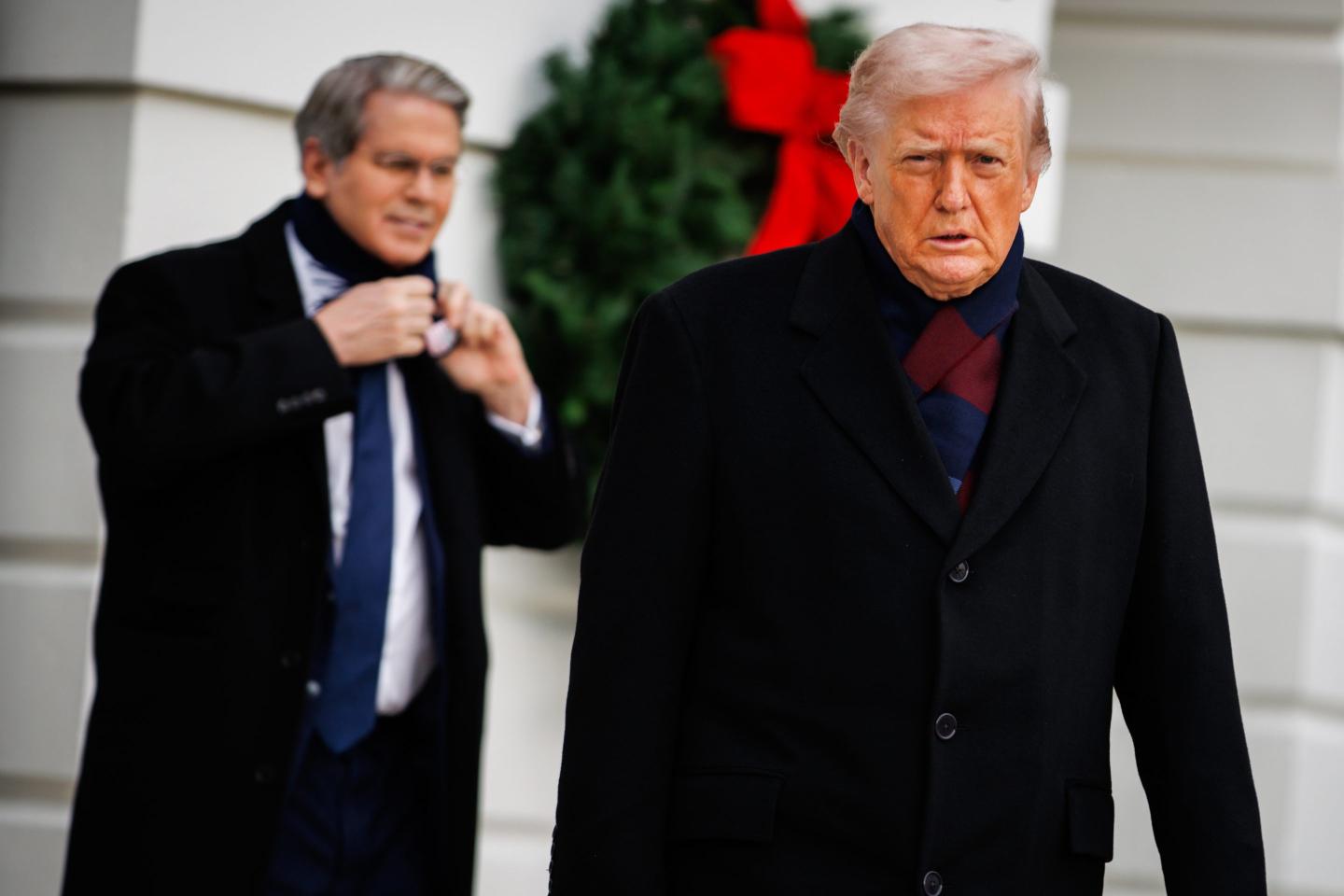
“It’s been a problem for 35 years,” Trump told reporters Friday. “And what we have now … is we have tremendous growth. And the way you take care of debt is with growth, and we have tremendous growth. We’ve never had growth like we have right now.”
“There’s nothing magic about the $40 trillion number,” Treasury Secretary Scott Bessent said on CNBC last week, “And we can grow our way out of that.”
Economists would be inclined to agree with Bessent: The value of the debt, while an extraordinary milestone, doesn’t hold much relative weight. What economists (and more importantly, the bond market) is watching is the debt-to-GDP ratio: This demonstrates the level of borrowing by a country against its economic capacity to repay and service it.
Currently, the U.S. ratio stands at 122%. To bring it back into a lower balance, an economy could cut its borrowing or—as Bessent suggests—increase its growth.
When the alternative is cutting borrowing and, as a result, government spending, the growth plan is a more optimistic and politically palatable route.
It’s also the latest in a series of solutions proposed by the White House: Originally, President Trump had suggested that tariffs would pay down the national debt (the plan was quickly nixed by a Supreme Court ruling ordering the administration to repay approximately $100 billion in revenues that the justices deemed illegal).
Trump later suggested a “golden visa” strategy—selling rich immigrants visas at $5 million each—could pay down the national debt. The policies were novel, but economists broadly welcomed action by the Trump Administration on the fiscal picture.
But now there a bond market reckoning looming. The risk premium demanded by investors for holding the 30-year Treasury rose to over 5.3% in recent days, prompting U.S. Treasury Secretary Scott Bessent to deploy $4 billion or more in unscheduled buybacks. If the U.S. can’t pay its debt, the worst-case scenario is a default crisis.
So, can the U.S. grow its way out of debt? It’s a “fantastic story,” says Kent Smetters, Boettner Professor of economics and public policy at the Wharton School at the University of Pennsylvania.
Unfortunately, Professor Smetters—the faculty director of a fiscal analysis tool called the Penn Wharton Budget Model—says the plan is also “pretty clearly” not feasible. He explained in an interview with Fortune: “People often get the causality kind of opposite. They think more growth, less of a debt problem, and in reality, it’s just the opposite … We deal with the debt issue in order to try to aid economic growth, not vice versa.”
In a perfect policy world, borrowed funds would be deployed to expand the macroeconomy—infrastructure around the AI boom could be one example; skills and training another. In reality, huge drawdowns on the budget come in the form of Social Security, Medicare and Medicaid, which present unique cost problems.
He explained: “A lot of people don’t realize this … the initial calculation of benefits actually includes productivity growth on top of inflation. So what happens is that hypothetically, even if we double the impact of, say, AI on productivity, it barely moves the balance because the initial benefits go up.”
The unique makeup of the labor market in healthcare also presents a snag: “If you want doctors to take Medicaid, Medicare patients … and you’re not increasing spending with the fact that the rest of the economy suddenly is growing really large, doctors could get good payments from servicing non-Medicare and Medicaid payments because wages are going up very well.”
Smetters suggests the government would ultimately spend more to retain healthcare professionals in roles that benefit public services.
Despite the flaws in the growth plan, policymakers will be aware they need some response on debt questions in the run-up to midterms.
Indeed, new research from the nonpartisan budget think tank the Peterson Foundation, conducted by the Democratic firm Global Strategy Group and the Republican firm North Star Opinion Research, found that only 10% of voters said the debt issue will not impact their ballot decision later this year.
“With the midterm elections approaching, voters are making it clear that they want candidates with a decisive plan to address our unsustainable budget and debt,” Michael Peterson, CEO of the Peterson Foundation, said in a statement.
Part of the plan
It’s worth noting that while Bessent has mentioned growth as a tool against a debt reckoning, he hasn’t said it’s the only route the administration is looking at.
Some debt-hawk camps are lobbying to cut federal deficits to 3% of GDP—about half their current levels—while others want to form a committee (similar to President Obama’s Bowles-Simpson Commission) to examine budget options. These options haven’t been ruled out by the current administration.
Confidence in U.S. economic expansion stems primarily from the artificial intelligence boom, whose capital expenditures have already become the chief driver of growth. But—as Tesla CEO Elon Musk pointed out in an X post last week—the timing of efficiencies coming to fruition, and a debt reckoning, will be close.
“We are going through a big investment boom right now, it’s transitory, it probably lasts three to five-ish years,” Smetters said. “You could still get lots of enhancements throughout the rest of the economy, but nothing that comes close, even remotely close to, dealing with the debt issue.”
With the debt compiled across both Republican and Democratic administrations, the ultimate outcome of the budget question will come down to the credibility of U.S. policymakers on both sides of the divide.
“Credibility is really important,” Smetters said. “They discount a lot—but if you tell the debt markets: ‘Hey, we think we’re gonna be able to grow our way out of this,’ and then a year later they’re not seeing any improvements from that, then it’s a credibility issue.”
He added: “There’s lots of clickbait trying to create panic, and panic creates panic. It’s a bank run issue, and we don’t want that. What we do want, though, is a serious discussion about forward-lookingness; we actually do have time to have rational discussions about this.”