
Learning to read and write cursive was once a rite of passage for practically every American schoolchild.
Until the early 20th century, children in the U.S. were generally taught to write in cursive or script, rather than the print writing typically taught to young children today. Some people at the time thought a person’s character could be evaluated based on the quality of their cursive.
In the first half of the 20th century, penmanship was often taught as a distinct subject in American elementary schools, where children could spend as much as 45 minutes a day on handwriting instruction and practice.
Students during these years generally learned print in kindergarten, first and second grade. Cursive was typically introduced in third or a later grade, in part because some child development researchers at the time believed that writing in print was easier for young children to learn and aligned with the fonts they found when reading.
I am a product of this system, learning cursive in third grade and winning awards for my excellent cursive penmanship from the retired nuns who once worked in my Catholic school. Now, I am a clinical professor of literacy studies and a teacher-educator, who researches reading and writing.
My experience is no longer typical, though, as cursive instruction has become less popular over the past few decades. Some states and schools, though, are reconsidering the value of cursive for today’s students.

A shift away from cursive
By the 1980s, the instructional time dedicated to cursive instruction in some schools had been reduced from 45 minutes a day to 30-60 minutes per week.
And the time allotted kept falling, in part because of the 1990s standards-based movement, which created school curricula overcrowded with content.
The new math standards called for data analysis and probability to be incorporated into mathematics education beginning in the early grades, including kindergarten. The social studies standards, meanwhile, reflected a broader approach to history that brought greater attention to figures such as Mansa Musa, the leader of the Mali empire in the early 1300s.
At the same time, computers became more widely available in schools and in homes, making the ability to type on keyboards seem like a necessary skill.
Cursive began to seem antiquated.
The Common Core state standards, a nationwide set of academic learning standards for K–12 students, were adopted in some fashion by 45 states between 2009 and 2014. These standards called for kids to learn how to type on keyboards, ensuring that whatever valuable teaching time was left for transcription would be spent on learning how to type.
A return to cursive?
It did not take long for the pendulum to begin to swing back in favor of cursive in the early 2010s.
Framed as a back-to-basics issue, North Carolina passed the first cursive law in 2013. It required students to read and write in cursive by the end of fifth grade.
The law also required children to memorize their multiplication tables.
By 2015, 14 other states had some kind of cursive instruction requirement on the books.
As of 2026, more than 25 states, including Pennsylvania, Florida, California and Michigan, require cursive instruction.
Lawmakers cite several reasons for mandating cursive in schools.
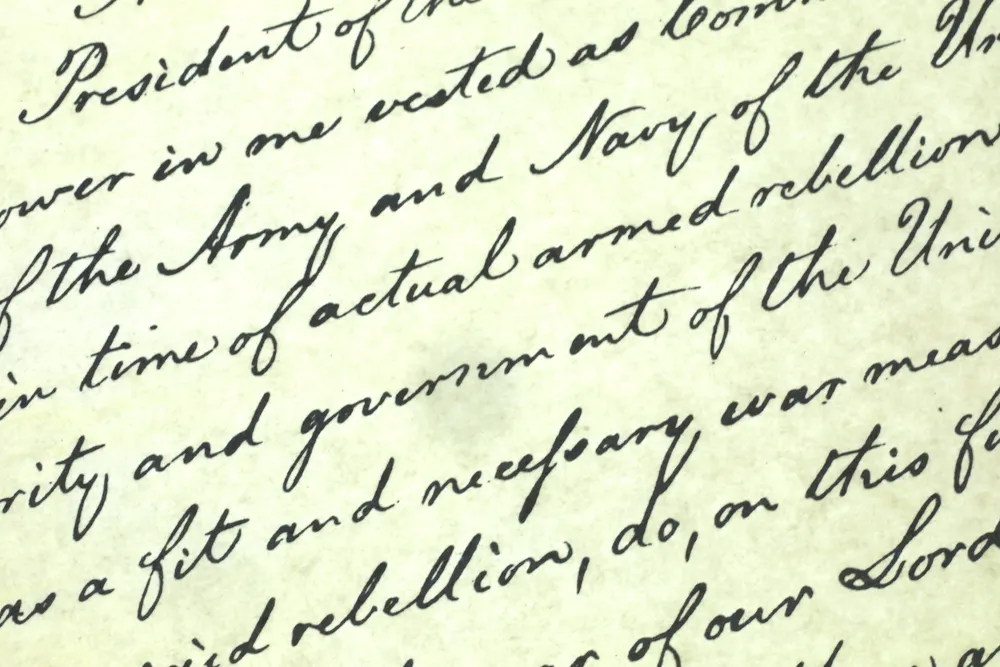
Pennsylvania and Florida legislators argue, for example, that an informed citizenry needs to be able to read historical documents, which are often written in cursive script.
In 2025, a Michigan representative suggested that reading cursive was also essential to preserving family history. Her granddaughter was able to read a letter that her deceased father, the lawmaker’s son, had written in cursive only because her school still chose to teach the skill.
A California assembly member had more modern realities in mind, suggesting that cursive could be used to ensure students aren’t using artificial intelligence to complete their schoolwork.
Benefits of cursive
Being able to write in cursive can have benefits for learners.
A 2020 study conducted in Norway hooked up 12 adults and 12 preteens to brain-imaging devices while they wrote in cursive, drew and typed.
They found that writing in cursive activates the brain waves and neural pathways used for learning and for memory. Learning to write in cursive is also associated with better outcomes for learners with dyslexia and dysgraphia, a neurological learning disability that makes writing difficult.
Other studies have shown cursive’s impact on writing fluency and quality. Some studies show that cursive can help people write faster, while other studies have found that children writing in cursive may not have a speed advantage.
First graders in Portugal who were taught cursive wrote in longer “bursts,” which the researchers attributed to the unbroken flow of cursive writing.
There’s even research suggesting that cursive gives an early boost to students’ reading skills, not just their composition skills. A 2019 study of 141 first graders found that children taught cursive read better by the end of the school year than classmates who weren’t.
One theory is that learning cursive trains the brain to process letters more effectively.
Cursive in today’s world
Not everyone is convinced cursive deserves a comeback tour.
For starters, the science is shakier than cursive’s champions let on. There’s solid evidence that handwriting beats typing for learning and memory. What’s much less clear is whether cursive specifically has an edge over ordinary print.
It is possible that much of the recent brain research getting cited in statehouses from Pennsylvania to California was done on kids printing their letters, not looping them together.
Still, teaching cursive in today’s schools is not necessarily simple.
Many of today’s teachers, and many of tomorrow’s, never learned cursive themselves, which means states are now asking educators to teach a skill they don’t have. Then there’s the question of time. Teaching cursive properly can eat up roughly 70 minutes a week, as children learn to master the skill. How does this fit into busy school days? Also, not every kid is going to love learning cursive.
Just ask any teacher who’s tried to get a room full of 7-year-olds excited about learning how to properly form a capital G in cursive.
Mary Jean Tecce DeCarlo, Clinical Professor of Literacy Studies, Drexel University
This article is republished from The Conversation under a Creative Commons license. Read the original article.
