
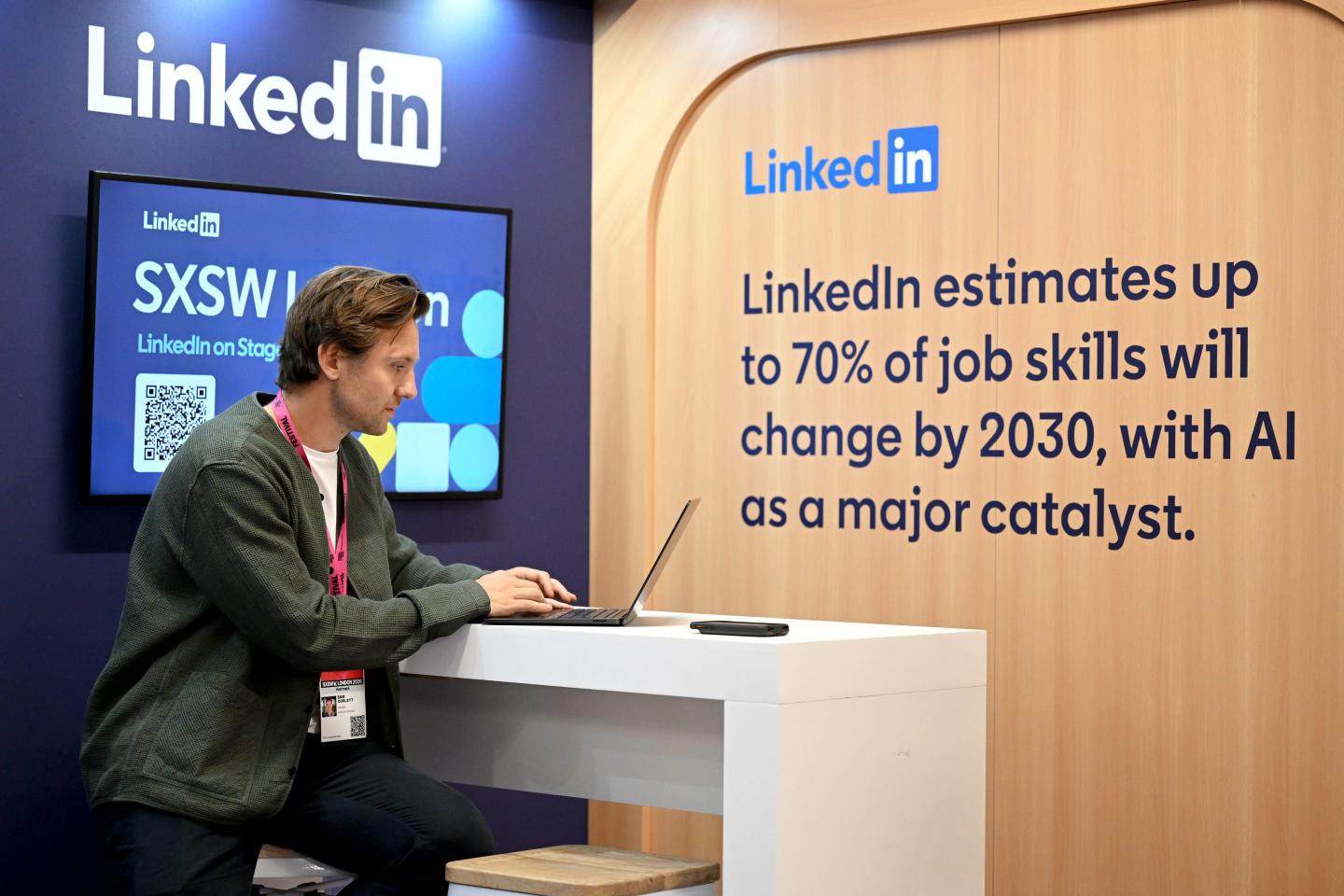
Years after the “dead internet theory” became popular to describe the apparent takeover of online spaces by AI, LinkedIn is taking steps to avoid an early grave by slopification.
Last month, LinkedIn chief product officer Hari Srinivasan announced in a post on the platform that in an effort to improve the quality of users’ experience, the company would add a new feature, a “seems like AI slop” button, to allow users to flag posts that appear to be AI-generated.
In the first two weeks of the feature’s launch, more than 1 million people have clicked the “seems like AI slop” button, Srinivasan wrote last week. He noted that overall, members are experiencing 40% fewer views on what the platform classified as AI slop compared to a few weeks prior.
“Despite the progress, we know we have more to do to ensure LinkedIn remains a place where you can find real people and real perspectives,” he said. “This all remains very top of mind.”
While the dead internet theory began in the late 2010s as a fringe belief in tech circles in response to the internet no longer appearing as genuine or lively as it once did in the age of blogs and forums, the conjecture has gone mainstream as agentic AI and bots flood online spaces—and it turns out it’s accurate.
“There’s a lot of missing pieces of information, but a lot of the observed data suggests the same thing, which is there is more bot activity,” Rudy Yang, PitchBook’s enterprise and retail fintech analyst, told Fortune. “Agentic AI activity is driving a lot of the browser activity you’re seeing.”
Cloud platform Cloudflare noted in April that for the first time, web traffic from AI surpassed that from human users, and as of Tuesday, bots accounted for 61.9% of search requests, compared to 38.1% of requests from humans. A Pew Research Center study published last week found that of 10,000 web pages collected in July 2026, 10% showed significant signs of AI authorship, compared with about 2% five years ago. Evidence of AI authorship has been present in more than one-third of all web pages published after ChatGPT was released in late 2022.
By some counts, LinkedIn—where its more than 1.3 billion registered users look for news and facts about employers—struggled more with AI-generated content compared to other text-based social media sites like Medium, X, and Substack. AI detection startup Pangram found in a July analysis that LinkedIn was “the most AI-saturated platform,” with more than 40% of its long-form posts being flagged as completely AI-generated, and its posts accounting for nearly two-thirds of the total content the startup flagged as AI.
Reversing the dead internet theory
Tech companies that opened up the door to AI are now reckoning with the flood of AI-generated content they initially permitted, scrambling to remove the slop from their platforms.
That includes Spotify, which said in July it removed 75 million bulk uploads and duplicate songs over the last 12 months—a massive chunk of the 100 million estimated uploads on its platform. Last month, Substack announced a partnership with Pangram, launching an AI-detection feature allowing users to scan posts and comments to estimate how much was created with the assistance of AI.
LinkedIn, for its part, will also expand profile and page verification and remove the “enhance your post” feature that allows users to edit a post with AI, opting instead for a feature that proofreads text, according to Srinivasan.
These companies have everything to lose if they fail to address the onslaught of AI-generated content. In March, link-sharing site Digg shut down its app and laid off staff members. Digg CEO Justin Mezzell said that while the app—which is now an aggregator of AI news—would not shutter, it would need time to combat bot spam that has become out of control.
“When the Digg beta launched, we immediately noticed posts from SEO spammers noting that Digg still carried meaningful Google link authority,” said a blog post about the layoffs. “Within hours, we got a taste of what we’d only heard rumors about. The internet is now populated, in meaningful part, by sophisticated AI agents and automated accounts. We knew bots were part of the landscape, but we didn’t appreciate the scale, sophistication, or speed at which they’d find us.”