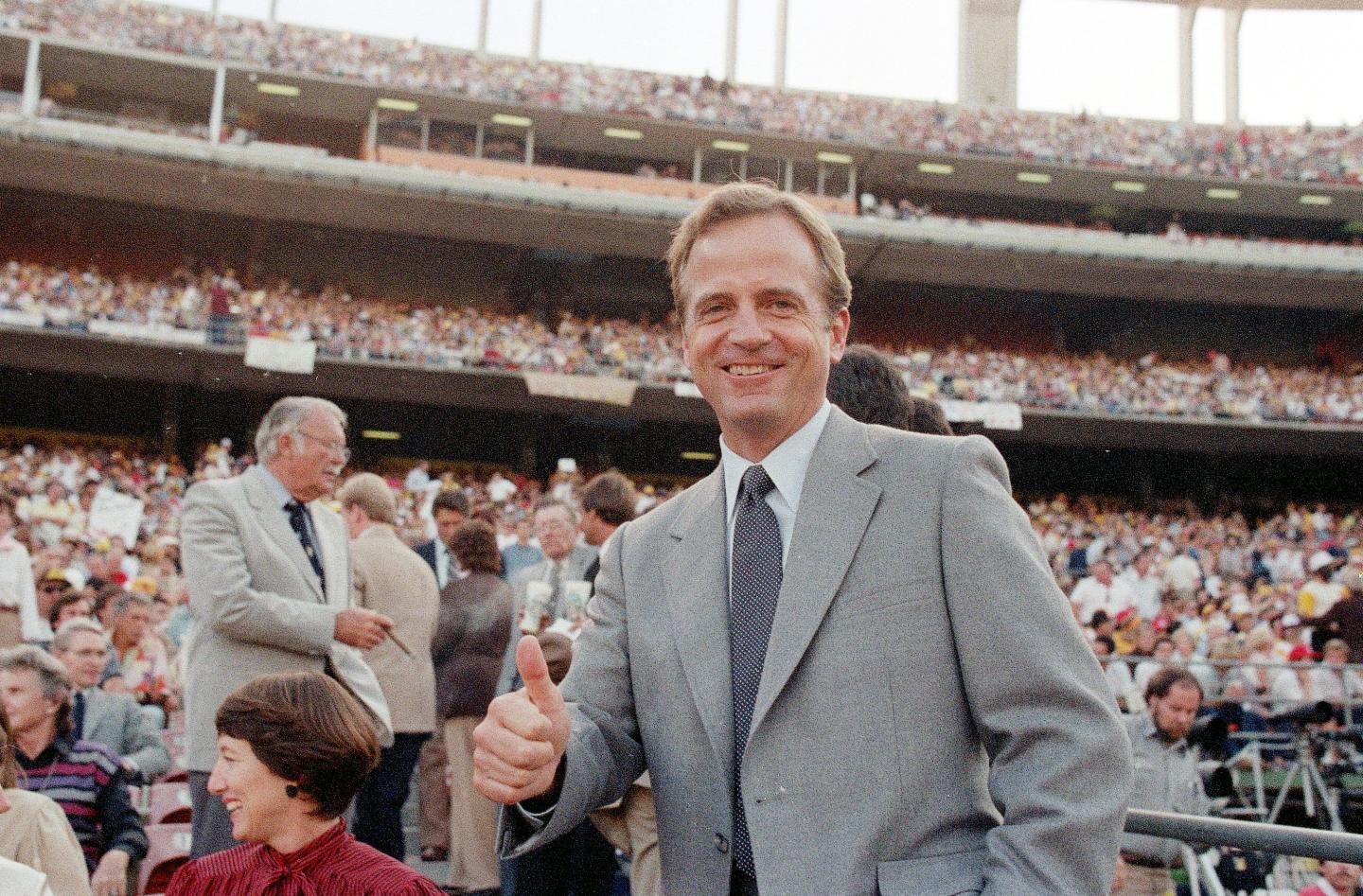
When Peter Ueberroth took over as Major League Baseball commissioner in 1984, he inherited a problem that still hangs over baseball four decades later: a widening financial disparity between its teams.
Player salaries were a part of that. With the introduction of free agency in the mid 1970s, the average of players’ earnings jumped from $51,000 in 1976 to $329,000 in 1984, and 37 players were making more than $1 million in 1985, Fortune reported that year. At the same time, local TV money was expanding the gap between teams in big cities and those in smaller markets: Fortune reported that the Chicago Cubs could make about as much from one weekend game as the Milwaukee Brewers made from the local television rights to 16 games.
Fortune writer Thomas Moore identified a salary cap for teams as one possible answer to baseball’s worsening financial imbalance, but the league never adopted one. Instead, it preserved free agency and later created the Competitive Balance Tax, or luxury tax, which makes high payrolls more expensive but does not stop teams from spending.
Four decades later, with the MLB’s average salary hitting $5.34 million, that same argument is threatening to disrupt the sport. MLB’s collective bargaining agreement expires Dec. 1, and the prospect of a lockout looms as owners push for a hard salary cap—reportedly $245.3 million in 2027—paired with a $171.2 million payroll floor and changes to revenue sharing. The players’ union has long opposed a cap, regarding it as a restraint on earnings. It’s a stance that evokes the 1994–95 labor fight, when the last serious push for a cap ended with a midseason strike and the cancellation of the 1994 World Series.
Today, the Dodgers boast MLB’s largest payroll—about $430 million, nearly $70 million more than the second-place Mets—thanks to a lucrative local TV deal, a massive fan base, and deep-pocketed ownership. In recent years, the team has used those financial advantages to repeatedly land marquee free agents on massive contracts, while its recent trade for Tarik Skubal, a two-time American League Cy Young Award winner, has become a useful exhibit in the owners’ case. Los Angeles acquired the frontline pitcher from the Detroit Tigers for three prospects, including two ranked among MLB’s Top 100, rather than subtracting from its major league roster coming off back-to-back World Series wins. The Dodgers assumed the roughly $9 million remaining on Skubal’s $32 million 2026 salary—a record for an arbitration-eligible pitcher—demonstrating the advantage of having both enormous revenues and an ownership group willing to deploy them.
The MLB’s competitive-balance problem goes far beyond the Dodgers. For fans of smaller-market and lower-spending teams, the frustration is not simply that Los Angeles can load up on stars—but that other owners may be spending too frugally. The Cleveland Guardians, owned by the billionaire Dolan family, entered the season with MLB’s lowest opening-day payroll, at just over $60 million, compared with team payrolls above $300 million for several of baseball’s biggest spenders.
That is why the proposed floor is as consequential as the cap. A ceiling would limit the biggest spenders, while a floor would require lower-spending clubs to invest more in their rosters. The conflict raises a longstanding question about baseball’s revenue-sharing system: whether teams benefiting from money generated elsewhere in the league are doing enough to turn those resources into competitive rosters.
Owners are likely to say that the luxury tax hasn’t done enough to close the gap between baseball’s biggest and smallest markets. Players will counter that a hard cap would hold down salaries without solving the revenue imbalance at the heart of the problem.
That is the lesson in Fortune’s 1985 diagnosis. A cap could limit what the Dodgers and other big spenders put on the books. A floor could pressure the sport’s lowest-spending owners to do more. Neither measure, on its own, can erase the advantages created by unequal media revenue, ownership wealth, and teams’ differing willingness to turn revenue into talent.
A saga playing out in professional basketball provides a cautionary tale about the limitations of regulated salary caps: The NBA’s ongoing investigation into the Los Angeles Clippers centers on allegations that star Kawhi Leonard received payments through outside sponsorship arrangements—including a reported $28 million deal with Aspiration, a sustainability company in which Clippers owner and former Microsoft CEO Steve Ballmer had invested—intended as additional compensation outside the NBA’s salary cap.