Editor’s note: This article was originally published in the April 15, 1985 issue of Fortune.
Since Peter Ueberroth took over as the new Commissioner of Baseball, a post once considered as carefree as a bat boy’s, he hasn’t been able to enjoy a game. In his first days on the job last October he had to settle an umpire’s strike that might have tainted the World Series. Recently he has had to answer troubling questions about current and former major league players arrested on drug charges. The chance of another players’ strike hangs over this season. Those would have been worries enough for past commissioners, but they pale next to Ueberroth’s biggest: for the first time, baseball’s deteriorating economics threaten to disrupt not just individual teams, but the game itself.
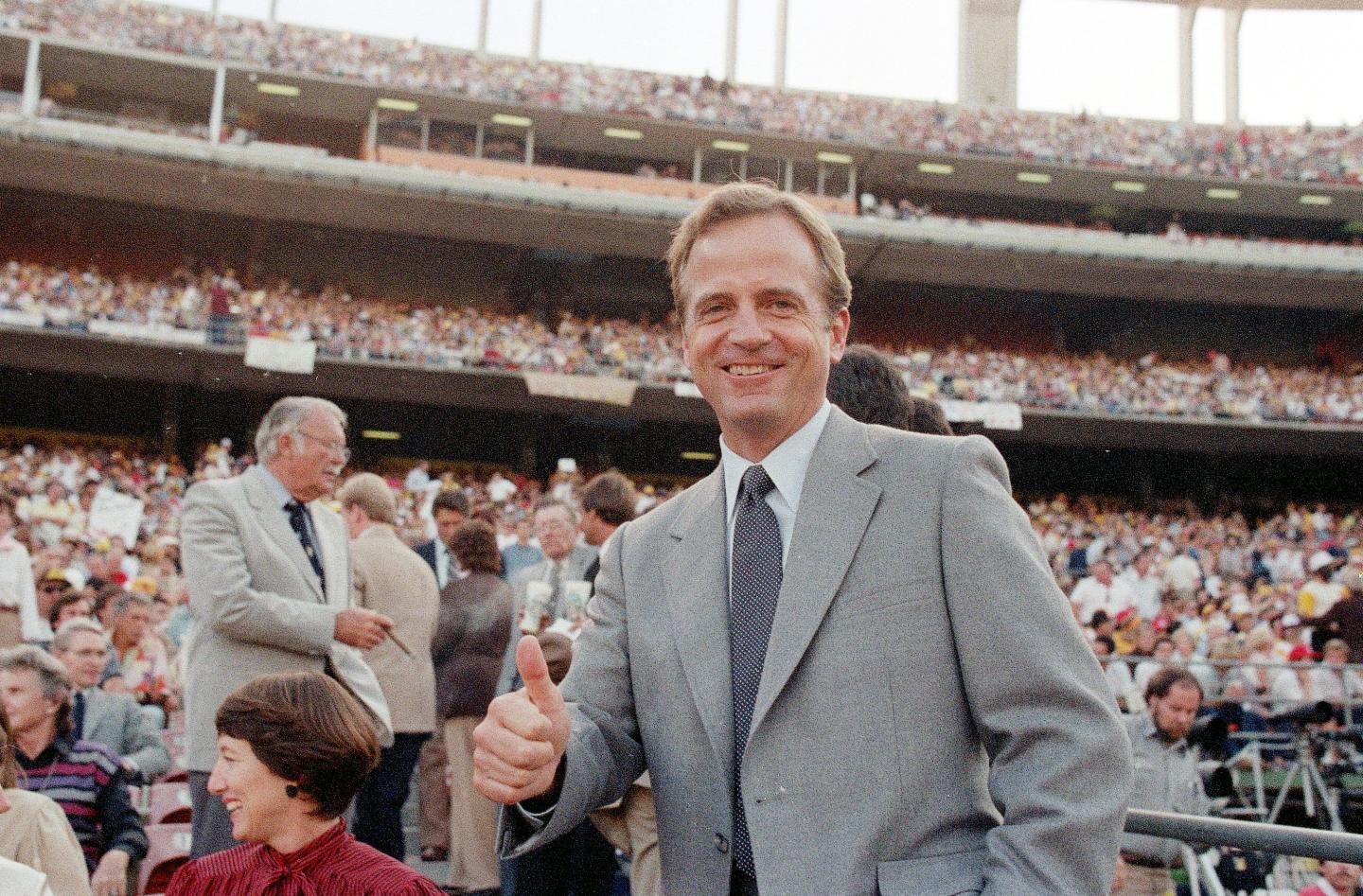
Ueberroth, 47, has shown he can find opportunities in bleak situations. An obscure Southern California entrepreneur who made a small fortune in the travel and hotel business, he turned the usually loss-ridden Olympic Games into a bonanza that earned nearly $250 million in Los Angeles—even without Soviet participation. The 26 pro baseball team owners hired him to replace the innocuous and ineffectual Bowie Kuhn. Ueberroth’s assignment is to re-create his Olympics miracle for baseball.
A game plan is taking shape. The hard part—Ueberroth’s job—will be getting baseball’s contending powers to agree to it. The owners are a wealthy, opinionated lot with major league egos—“We can’t even negotiate with ourselves,” says John McMullen, owner of the Houston Astros. The players, whose king-size salaries are part of the problem, don’t acknowledge that anything’s wrong. The cities on which some teams depend for stadiums and financial breaks have financial troubles of their own. Cool and charismatic, the commissioner will have to draw on negotiating skills he used effectively in L.A. to bring all sides together.
A big question, given Bowie Kuhn’s servile relationship to owners in the past, is how tough Ueberroth will be with recalcitrant owners. What they own are companies—the teams—that cooperate and call themselves Major League Baseball. The ambiguous position of commissioner is their creation. Under the Major League Agreement, the commissioner has authority to take such actions as he deems appropriate in the best interests of the game—a vague, broad definition of powers. But while nominally the owners’ disciplinarian, he is also their employee; they vote him in and out of office. While Kuhn was wary of offending any owner, Ueberroth seems more likely to be his own man.
The owners’, and Ueberroth’s, strategy is to convince the players how serious baseball’s situation really is, that they are partners with as much interest as the owners in stabilizing the game’s finances. Once players and owners start to look at their joint maladies together, Ueberroth may be in a position to prescribe, or impose if necessary, the bitter medicine that’s called for.
Major League Baseball—all 26 teams combined—earned just $4,586 in 1978 and has lost money at a breathtaking pace ever since. In 1983, the last year for which complete figures are available, 18 of 26 teams lost money—seven between $1 million and $3 million, and ten over $3 million each. The overall operating loss for the year was $66.6 million, an average of $2.6 million per team. In a sense, this overstates the loss. Teams can depreciate player contracts—a big-league tax benefit. But even discounting for that, the industry operating loss in 1983 was still $45 million, or $1.7 million per club. Baseball has never been a big moneymaker and needn’t be. Most owners are happy to break even or take small losses, which can offset profits from other sources. But deficits at recent levels are no fun.
The future looks even worse. New national television contracts that took effect last year will pay the Major Leagues’ Central Fund $1.2 billion over six years, or roughly four times what the teams were splitting up before. But nine of 11 clubs that have reported results so far for 1984 still showed an operating loss—three between $1 million and $3 million and four over $4 million. The Seattle Mariners, one of baseball’s biggest money losers, dropped over $6 million. Ernst & Whinney, the major leagues’ auditor, projects that combined losses will mount to $155 million by 1988, or $6 million per team. And that assumes owners will not have to contribute more to the players’ pension plan, a key issue in new contract negotiations with the players’ union. The last contract expired December 31.
The debt many teams have incurred to finance losses quintupled after 1976 to over $20 million in 1983. The Texas Rangers—formerly the Washington Senators—haven’t shown a profit since they came into being in 1972 and now pay 10% to 12% of their budget to service debt. “The leagues’ constitutions require teams to maintain a 60-40 ratio of assets to liabilities,” says Mike Stone, president of the Rangers. “I know we are not yet in compliance on an operating basis and I wonder how many other teams are.”
Liabilities other than debt, mostly deferred compensation under player contracts, are mounting so fast that they could one day shut the game down. “If a team were to have $50 million in liabilities it couldn’t cover and if for some reason it had to file for bankruptcy,” Ueberroth speculates, “the players would probably seek recovery from Major League Baseball or other owners. It could start a domino effect.”
For years the prices paid for franchises were rocketing, but they may have topped out when the Detroit Tigers changed hands 18 months ago for a reported $50 million. Today as many as eight teams are looking for buyers. People have offered to buy and move teams to other cities, but owners, out of civic concern or fear of community outrage, have turned them down. The new commissioner is dead set against teams moving. “It’s demoralizing to fans,” he says, “and I just don’t think it’s right.”
Baseball’s money troubles began in the Seventies, when players won court rulings that liberated them from league-wide controls that had prevented them from moving freely between teams. Players became free agents in free markets, and owners, desperate to turn their teams into winners, seemed willing to pay almost any price for top talent. The average player’s salary jumped from $51,000 in 1976 to $329,000 last year, a nearly sevenfold increase that threw the equilibrium of baseball budgets out of whack. Thirty-seven players will make over $1 million this year, two of whom have cracked $2 million: Phillies third baseman Mike Schmidt and Red Sox outfielder Jim Rice.
During the same period revenues tripled to an estimated $621 million. Attendance increased 43% to 44.7 million. The average price people paid to see a ball game rose from $3.45 in 1976 to $6.21 in 1984. No ticket sells for more than $10, and some go for as little as $1.50.
The owners were counting on TV revenues to bail them out. That hasn’t happened. Ballpark attendance still generates 62% of the major leagues’ revenues, compared with just over 70% a decade ago. Broadcasting brings in most of the rest. A glut in TV sports programming has diluted ratings and advertising revenues, and means that when baseball negotiates a new TV contract for 1990, it may get less than it earns now. Nielsen ratings last year for the All-Star Game and the World Series—baseball’s crown jewels—declined slightly from 1983.
Pay TV, which seemed ideally suited for baseball’s large inventory of games, has been a big disappointment. Viewers have been reluctant to pay extra monthly charges for certain games when they can see other games on local TV or, in the last few years, on superstations—local stations that beam their programs via satellite to cable systems around the country.
Far from being baseball’s salvation, television revenues are destabilizing the game by making franchises in big television markets wealthier than those in small markets. Unlike the National Football League, which controls all television rights, sometimes blacks out local television for home games, and divvies up revenue equally among the teams, Major League Baseball controls only national TV rights. Each club pockets the money from local TV.
Consequently, teams in New York, Chicago, Philadelphia, and Los Angeles—the four biggest TV markets—make considerably more from local broadcasting than do teams in smaller cities like Seattle or Milwaukee. The Milwaukee Brewers, for instance, recently sold the local television rights to 16 games for about $240,000—roughly the same as the Chicago Cubs get for just one weekend game.
The disparity between the big- and small-market clubs creates a vicious circle. The teams in big TV markets can afford to buy the best players, which in turn gives them a better chance of putting together a winning season—the one proven way to fill seats at the ballpark and make more money. The small-market teams have to drop out of the bidding for the good players, their teams become weaker, fewer people want to watch their games, and they lose more money. “The gap between what small-market teams and big-market teams can pay for player salaries is getting increasingly severe,” says Ueberroth. “This is a very new problem, and we won’t see the full impact for five years.”
Most owners agree that the plan to save baseball depends on player cooperation. “The relationship between labor and management is the main problem,” says Eddie Einhorn, a co-owner of the Chicago White Sox. “In the old days management called all the shots. Now it’s all labor. It went from one extreme to the other, and we never found a middle ground.”
Claiming that survival of the enterprise is at stake is an approach the automakers and other highly unionized manufacturers have used successfully to gain concessions from labor. But the players have heard owners cry poor before and suspect that baseball profits are being sheltered or hidden in the owners’ other businesses. “People seem to be willing to commit more and more money to buying franchises and players, so you can’t just assume there is an economic problem,” says Don Fehr, the acting director of the Players Association, the players’ union. “The objective facts don’t jib with the assertion that they’re all going broke.”
While no owner has mentioned anything about rolling back salaries, they are all looking for a scheme to stop the precipitous rise. The most appealing idea to many is a salary cap for each team, much like what the National Basketball Association put into effect last year. Based on historical relationships of salaries to revenues among its teams, the NBA determined that 53% of the league’s gross operating revenues was the appropriate amount that should go to players’ salaries. The NBA divided that amount by its 23 teams and made some adjustments to arrive at an overall salary cap per team. Each team then allocates its money among players according to their relative value. During a transition phase, team salaries that were above the cap were frozen until the rest of the league caught up.
In the future, team salaries will rise in direct proportion to overall league revenues. “Eventually, if every team has the same amount of money to spend on salaries, the teams should achieve parity,” says Michael Megna, vice president of Milwaukee-based American Appraisal Associates, a firm that has appraised the value of many professional sports franchises. “The cap should prevent rich teams from buying talent from poorer teams and allow poorer teams to build up their talent supply.”
Since baseball is already losing money with salaries at 50% of revenues, owners would like to see the split at a lower level. An industry expert says it must fall between 25% and 33% to make the game viable. One reason it must be lower than the NBA’s 53% is that baseball teams maintain expensive minor-league farm systems for player development—a cost pro football and basketball don’t bear because they recruit most of their players directly out of college. The cost of running the minor leagues was $56.7 million in 1983, or $2.2 million per team. Eddie Einhorn of the White Sox has proposed getting rid of the minors, but the other owners rejected the idea because it went against baseball tradition. “I brought it up because the minors don’t make economic sense,” says Einhorn. But without them, the majors would have to rely for new players on colleges and high schools. Because baseball is a summer sport, few schools have well-funded baseball programs.
The players aren’t likely to buy salary caps. By definition, they put a lid on how much owners can spend for individual players. The final decision in the current negotiations on what percentage of revenues ought to go to the players’ benefit plan—a central issue—could set a precedent for any future discussion on what percentage of revenues might make an appropriate salary cap.
More revenue sharing might be a less restrictive way to achieve the same effect as a salary cap. To the extent that potential new revenues are shared, owners have less incentive to bid up players’ salaries. Of the extra revenue brought in by an expensive star, the team that paid his salary would get no more than a team that didn’t.
The small-market teams and owners without broadcast interests would like to see some sharing of local TV and radio revenues. But the big-market owners, who often own local TV and radio stations that broadcast the team’s games, are loath to give up any of these revenues to competitors. The higher prices they paid for their teams reflected high anticipated broadcast revenues—and some of them are losing money anyway. New York Yankees owner George Steinbrenner has reportedly attacked the idea as “creeping socialism.” Others, including some free-market economists, argue it would dull owners’ competitive instincts—and ultimately competition on the field.
The players oppose revenue sharing for the same reason they’re against a salary cap. Says Don Fehr, “Players fought for a hundred years to get a free-market salary. They can’t imagine giving it up now.”
So far Peter Ueberroth is keeping a safe distance from the contract negotiations between owners and players, being careful not to take sides. He also studiously avoids comment on inflammatory issues such as players’ salaries, salary caps, or revenue sharing. “My job is to improve the climate of collective bargaining,” he says tersely.
Some owners think he’s playing it too safe. “Ueberroth hasn’t banged any heads yet,” says one. “The greatest uncontrolled increase in salaries has occurred on his watch.” But the commissioner has shown some mettle. In February he overruled a decision by American League owners that would have blocked a broadcasting company from buying into the Texas Rangers. He has told reporters he believes he has the power to order owners to open their books and would use it if owners and players thought it would help their negotiations. In a public-relations coup that delighted fans and players, he reinstated Willie Mays and Mickey Mantle to baseball. Bowie Kuhn had banned them from working in major league baseball after they went to work for Atlantic City casinos. The commissioner helped persuade Milwaukee to block construction of a prison next to the Brewers’ stadium. He helped convince Cincinnati to drop its lawsuit against the Reds to recover stadium revenues lost during the 1981 players’ strike. Next he’s going after Seattle, which refuses to improve its stadium lease with the Mariners.
He has launched a virtual crusade against superstations, which he charges are stealing audiences from other teams’ markets. “Superstations must pay to take baseball into other markets,” he says. Ueberroth pushed Ted Turner to sign a contract giving a percentage of his superstation revenues to the Major League Central Fund to compensate other teams he may be hurting. Three of four other superstations have followed suit. “The money does not amount to much now, maybe $15 million to $20 million to divide among the teams in the first year,” says Ueberroth. “But once we’ve established the principle that they must pay, the next time we negotiate it’s only a matter of how much.”
Owners claim they have pretty well exhausted promotional gimmicks to get people to come out to ballparks. But Ueberroth thinks more can be done to generate new revenues and cut costs. His ideas include:
- A market survey of baseball fans. Preliminary research indicates only nine million people go to baseball games, although some 40 million or more read box scores in the newspaper every day. Ueberroth hopes the survey will confirm these figures and help owners figure out how to get more of these fans into ballparks. He thinks attendance can be boosted to two-thirds of the parks’ capacity. Raising prices might just discourage attendance without adding much revenue; at current low prices the major leagues sold only 42% of their seats last year. In any case, Ueberroth says making the national pastime more expensive “wouldn’t be moral.”
- Improving the family atmosphere at ballparks. The Detroit Tigers announced they will sell only low-alcohol beer at their park. Medical facilities will be standardized at all parks this year. Restrooms will now be monitored and security bolstered throughout the parks and in parking lots. Pittsburgh plans to rope off a section for families only.
- Corporate sponsorships, which paid off at the Olympics. Companies that bought large blocks of tickets would take over special sections of the ballpark that they could design and administer themselves.
- Consolidating some costs on a league basis for travel, scouting, and the minor leagues. This year, for instance, will be the first that all teams will participate in the Scouting Bureau, which provides information about promising high school and college players.
Such promotional ideas and more are badly needed, but so is a consensus to preserve baseball. What gives the game extra life is its mythology, its role as America’s sport. As Marge Schott, the effervescent new owner of the Cincinnati Reds, puts it, “If you don’t have faith in baseball, then you don’t have faith in America.” Ueberroth says he does not want to be cast as baseball’s savior, but that is what the owners and the fans expect him to be. His job, as at the Olympics, is to make mystique pay off.
The Seattle Mariners’ Losing Formula
“I had already done a lot of things for profit,” recalls George Argyros, 48, the majority owner of the Seattle Mariners, “so I was looking for something that had more than just economic rewards.”
Whatever the rewards of getting into baseball, they certainly weren’t economic: Argyros, who made his money in real estate, hasn’t been burdened with one penny of profits since he bought a piece of the young franchise in 1981. Since then the Mariners have amassed a deficit of $21,073,646.
Many of the Seattle team’s problems are like those strapping other clubs—only worse. “In 1981 our total players’ salary cost was $2.2 million,” Argyros says. “Now it’s $6 million—and we have one of the lowest average salaries in the game.” The Mariners netted a piddling $1.1 million from local broadcasters; teams in the largest markets pull in $10 million or more. The Mariners’ $1.4 million for marketing was twice what teams in more baseball-conscious areas have to spend. As in most businesses, trouble begets trouble. Of the $1.6 million the Mariners paid in interest last year, $1.3 million was on money borrowed to cover losses, more of which are certain this season.
Seattle Mariners, 1984 (thousands)
| Revenues | Amount |
|---|---|
| Home-game tickets (net) | $3,427 |
| Away-game tickets | $1,777 |
| Local radio and TV (net) | $1,013 |
| National TV | $5,323 |
| Concessions, programs, stadium advertising | $751 |
| Miscellaneous | $423 |
| Total revenues | $12,714 |
| Expenses | Amount |
|---|---|
| Players’ salaries | $5,196 |
| Players’ pension-plan contribution | $596 |
| Player development | $3,117 |
| Other team expenses (travel, coaches, staff, etc.) | $3,993 |
| Stadium | $162 |
| Team’s share of commissioner’s and league’s expenses | $343 |
| Selling, general, and administrative expenses | $2,449 |
| Interest | $1,634 |
| Total expenses | $18,820 |
| Net loss | $6,106 |