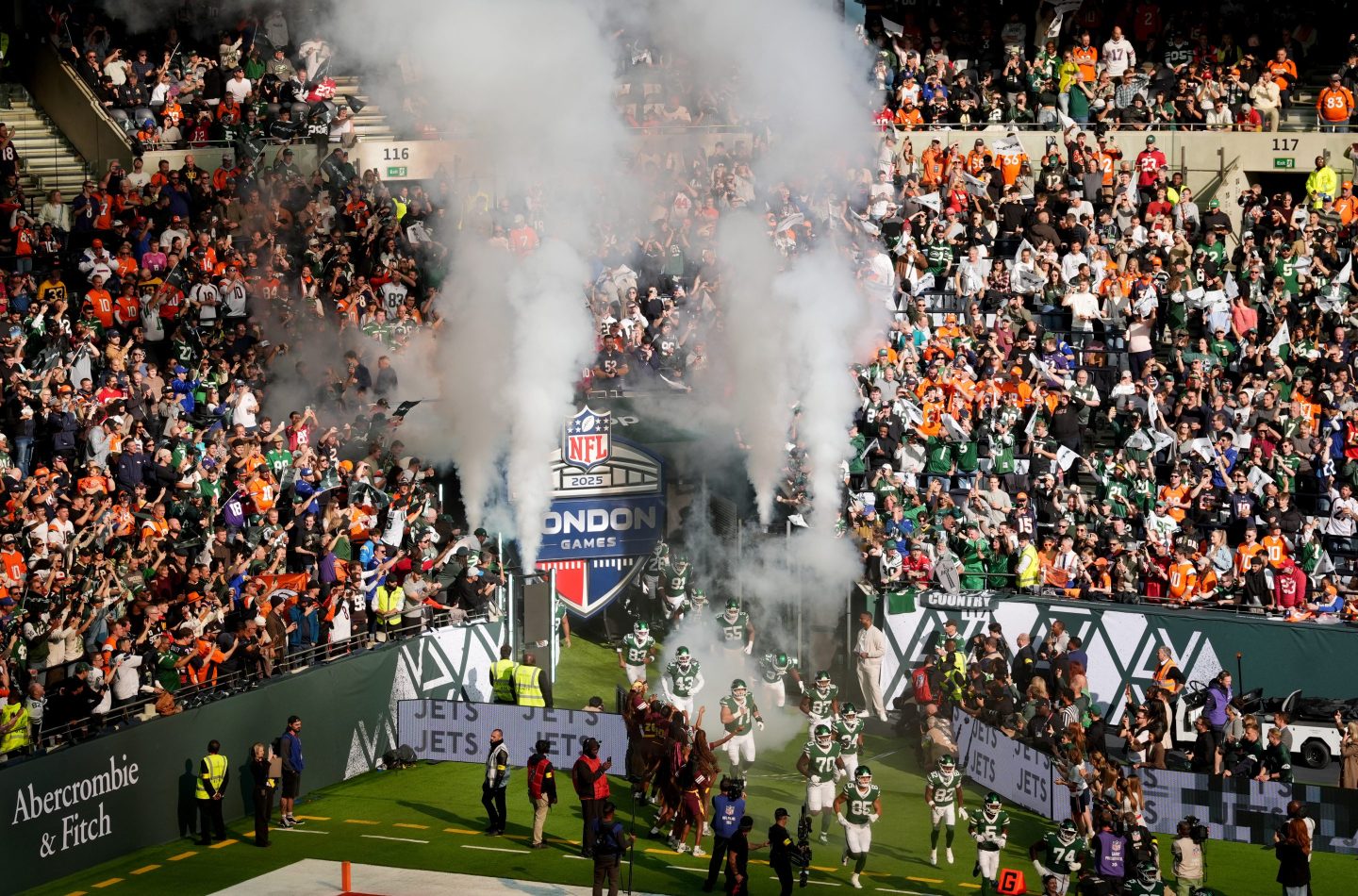
When the Pittsburgh Steelers and the New Orleans Saints walk onto the turf of the Stade de France on Oct. 25, the National Football League (NFL) will stage its first competitive game on French soil. It’s part of a record nine-game international run this season, spanning four continents and seven countries, including London, Madrid, Melbourne, and Rio de Janeiro.
The series is part of the NFL’s strategy to deepen its foothold in Europe. “We’re using the game as a catalyst,” Tim Ellis, the league’s chief marketing officer, tells Fortune. “To get people interested, to get them talking, to get the media to pay attention.” For Ellis, the 80,000 tickets available for the Stade de France game matter far less than the millions of fans the league hopes to convert in the weeks and months after the final whistle.
There are signs the league is generating real demand overseas. London will have hosted 45 games by the end of this season and remains the league’s most mature overseas market. Melbourne and Paris, where Ellis says the league’s fan base has grown past 14 million, are also expected to draw big crowds. Ticket interest for the NFL’s Melbourne match has surpassed the Melbourne Cricket Ground’s 100,000-seat capacity, with more than 151,000 fans registering interest. Meanwhile, more than 600,000 people joined the virtual queue for last year’s Steelers game at Croke Park in Dublin. Ticket and hospitality revenue, Ellis says, pales in comparison to what the NFL hopes to build in media rights, sponsorship, and merchandise deals, once European audiences are converted into fans who watch 50-plus games a year rather than one.
The NFL isn’t the only organization running this experiment. Earlier this summer, FIFA was in the process of successfully exporting soccer to the U.S. as it joined Mexico and Canada in cohosting the World Cup. Despite its global popularity, soccer has struggled to find the same fandom in the U.S. as it boasts across Europe. Roughly a quarter (27%) of U.S. sports fans show an interest in soccer, compared with a global average of 40%, according to Sports Innovation Lab and JvM Sports. However, this World Cup has been a turning point. More than 6.25 million people attended matches through to the conclusion of the last round of 16, according to FIFA, and 18 million tuned in for the U.S. Men’s National Team opener against Paraguay across Fox’s platforms. The NFL is taking notes. “I’ve long admired FIFA for their global reach,” Ellis says, pointing to the power of “border-crossing stars” such as Lionel Messi. “Another lesson is storytelling,” he adds. “People want to know the backstories of the athletes. That stuff is inspirational.”
This is not the first time the NFL has sought to break into Europe. The first attempt, a 1974 plan for an Intercontinental Football League, with teams penciled in for Istanbul, Rome, Munich, West Berlin, Vienna, and Barcelona, folded before playing a single down. The NFL World League, established in 1989, enjoyed slightly more success.
The transatlantic tournament featured 10 teams: six from the U.S., one from Canada, and three from Europe. The league kicked off in 1991 at the Waldstadion in Germany, as the Frankfurt Galaxy took on the London Monarchs. However, the league suspended operations after its second season. Rebuilt as an all-European circuit in 1995 and rebranded NFL Europa, it limped on with squads in England, Germany, the Netherlands, Scotland, and Spain until the league finally pulled the plug in 2007.
NFL Europa never landed a TV contract in its own markets, starving it of revenue that might have kept it afloat. The venture ran up roughly $400 million in losses over 16 years, according to analysis by Chang Wan Woo, published in the Journal of Communications Studies. The constant rebranding, franchise relocations, and lack of experienced players limited the competition’s popularity, with fans showing little appetite for a developmental league playing what was considered a watered-down version of the sport.

Earlier expansion efforts struggled in part because the league assumed the product would sell itself, Ellis says: “It understood almost nothing about how outsiders actually saw the game.” To the uninitiated European viewer, American football can seem “chaotic,” he says. “[They view it] as a spectacle more than a sport: big men in gladiatorial armor colliding, stopping, colliding again, then cutting to commercials.” By contrast, 41% of Americans say football is their favorite sport, a Gallup survey found. “Most Americans absorbed the rules by cultural osmosis long before they could articulate them,” says Ellis. “Strip away that lifetime of exposure, and you’re left with, quite frankly, a baffling and barbaric game.”
Increasing the NFL’s popularity abroad has been “an incredible challenge,” Ellis says, but he believes his experience of working in the U.S. and across Europe makes him uniquely well suited to finally bridge the divide. Earlier in his career, Ellis traveled to Paris to study French. He then spent five years working his way around the world: driving tractors on a kibbutz in Israel; building platforms for North Sea oil rigs in Norway; bartending on a luxury cruise line; and briefly modeling in Tokyo. He spent 12 years in Sweden, much of it running international accounts at the advertising agency Forsman & Bodenfors, before moving client-side at Volvo. After a stint at Volkswagen, Ellis spent seven years working in Santa Monica for the video game company Activision. “After living and working all over the world, I’ve learned that markets don’t reject the product, they reject the translation,” Ellis says.
“Strip away that lifetime of exposure, and you’re left with a baffling and barbaric game.”
Tim Ellis, EVP and CMO, NFL
When Ellis joined the NFL in 2018, he commissioned research across the league’s priority markets to get a better understanding of the awareness and perception of the sport internationally. “Many international viewers simply hadn’t registered that these enormous men are also elite athletes, world-class sprinters, some of them Olympic medalists,” Ellis says. “They’re like ballet dancers, but they’re 280 pounds of muscle.” His team ran a parallel study: What does someone need to know to enjoy the game? The research found that the two factors most likely to put a newcomer off—the sport’s complexity and its violence—are precisely what hooks them once they develop a deeper understanding of the sport.
This information has informed the NFL’s European marketing strategy as it aims to turn casual viewers into committed ones. “The idea is not to dumb the game down,” Ellis says, “but to escort newcomers across the threshold from confusion to fascination.” The strategy is gaining traction. In 2019, the Tottenham Hotspur Stadium in London became the first arena outside North America specifically built to accommodate an American football game. Two NFL games are scheduled to be played there in October, with another being hosted at Wembley, and a fourth in Madrid.
One of the core elements of the strategy has been to give people an established U.S. club to root for and players to love, Ellis explains. All 32 NFL teams now hold designated international marketing territories, which has allowed the sport to tap into some of the tribal fandom that soccer teams enjoy across Europe. Additionally, the league is developing digital content centered on athletes’ families and backstories. This “helmets-off” strategy is designed to help international audiences get to know players and turn the sport’s stars into recognizable personalities in Europe.
The NFL has also had to rethink how to market itself to a continent that “doesn’t do swagger,” as Ellis puts it. “U.S. sports marketing runs on swagger,” he says. But the league’s own research found that what reads as charisma in Dallas can land as arrogance in Düsseldorf. “Something that we would see as confident, they would see as bro-y or too macho,” he adds. As the NFL expands overseas, it is also having to contend with anti-American sentiment in some markets. Because American football is closely woven into U.S. culture, the sport is often associated with overt displays of patriotism, such as flag ceremonies and military flyovers. Abroad, Ellis says, the league has to tread carefully, because that same patriotism can be read as “political in nature” by international audiences if it isn’t handled correctly.
Another element of the strategy involves increasing participation in the sport abroad. The NFL Academy, an elite development initiative for student athletes, is based in Loughborough, England, and has partnerships with Loughborough College and Loughborough University. The program combines academic study with daily training, giving aspiring young athletes in the U.K. an opportunity to make it professionally. “College football rosters used to be almost entirely American,” Ellis says. However, this year he expects over 30 international players to join NCAA Division I programs—the highest level of college football in the U.S. The International Player Pathway, a separate initiative established in 2017, is tasked with identifying elite global talent and developing them into NFL-ready players.
A noncontact version of the game, called flag football, has also become a fast-growing entry point for girls in the U.S. and abroad. The NFL lobbied for flag football to become an Olympic sport, and it is set to debut at the Los Angeles Games in 2028. Ellis says the NFL is already pushing to keep the noncontact variant on the program for Brisbane 2032. “We’re trying to get more Europeans to play football, not just watch it,” he says. “A child who plays the game is dramatically more likely to become a lifelong fan.”
The financial stakes explain why Europe matters so much to the league. NFL revenue topped $23 billion in the past fiscal year, according to S&P Global Market Intelligence, and the league is targeting $25 billion by 2027. Media rights are the largest contributor: The NFL’s current broadcast deal, worth nearly $110 billion over 11 years, accounts for almost half of total annual earnings. Replicating this model in Europe would represent a major financial boon. The lesson from prior endeavors is that new markets aren’t won by adapting a product to suit local tastes. They’re won, as Ellis says, “by exporting the real thing, unchanged, and building the story, stars, and trust.”
This article appears in the August/September 2026: Europe issue of Fortune with the headline “Can the NFL finally conquer Europe?”