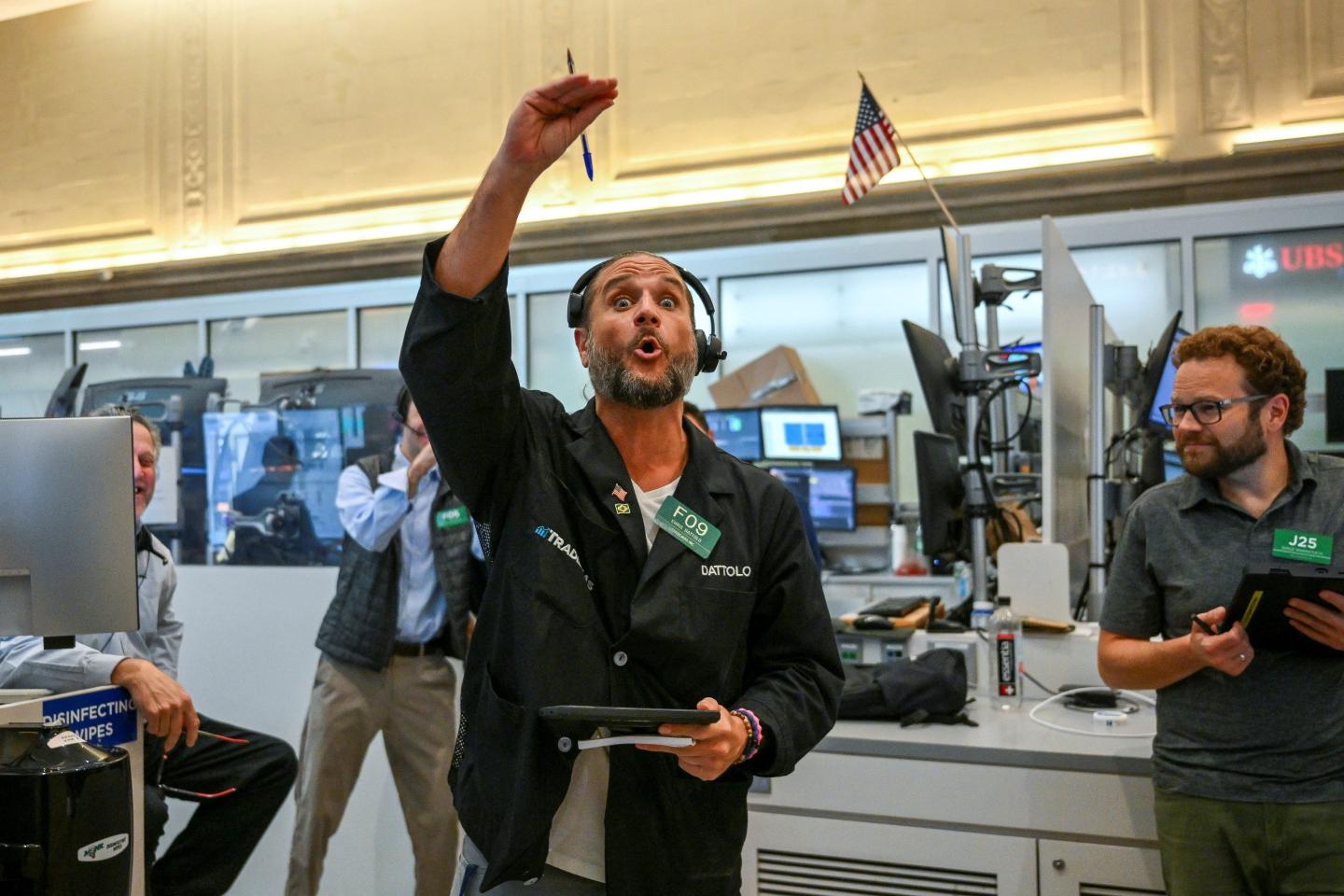
South Korea’s Kospi closed down nearly 11% on Tuesday, its eighth circuit breaker of 2026 and one of the worst days of the year. South Korea’s famously volatile retail market is now infecting Western markets: The American semiconductor index SOX fell as much as 6% Tuesday, a fourth straight losing session and its longest streak this year, dragging the Nasdaq-100 down 9.7% from its record high—just short of a correction.
Yet the panic doesn’t square with what’s happening on the ground. Memory prices just keep going up, not down. Third-quarter contracts for DRAM are settling 20% to 30% higher this month. Google and Meta have signed contracts locking in prices and volumes for five years, and analysts generally don’t expect meaningful new supply until 2028.
“Right now there’s a lot of panic around the AI investment,” Gil Luria, a technology analyst at D.A. Davidson, told Fortune, “and the panic appears to be indiscriminate.”
What gives? Well, three explanations are circulating. First, the Chinese memory maker CXMT made its debut Monday, surging 466% in Shanghai after raising $8.6 billion. Second, the Information reported that a Chinese-state-based company has begun mass-producing immersion deep ultraviolet (DUV) lithography machines, which is a fancy way of saying that it’s doing something that ASML has only been able to do for about a decade. And third, fears about hyperscalers overspending on the heavy industry of AI have grown into the “panic” Luria describes.
Semiconductors have never been better
Analysts who track memory supply chains say the first two worries don’t hold up. China has actually had access to DUV lithography for years, Matt Bryson, who covers semiconductors at Wedbush, told Fortune. Making the machines domestically doesn’t change what Chinese firms can produce. The actual binding constraint is EUV—a more advanced technology that China still lacks.
Essentially, lithography is how the bespoke patterns of a chip get printed onto silicon, and the wavelength of light determines how small those patterns can be. Deep ultraviolet works down to a point, but below it, manufacturers need extreme ultraviolet (EUV), a much shorter wavelength that prints finer features. ASML is the only company in the world that makes EUV machines, and export controls keep them out of China. Chipmakers can still build advanced memory with DUV, but it takes more passes, which makes it more expensive. So that gap is what separates American chipmaker Micron, as well as South Korea’sSamsung and SK Hynix from CXMT.
And even if CXMT had the technology, it’s not clear it would be able to distribute widely outside China, Bryson said. It would probably face some protectionism: questions about how independent its intellectual property is, and possible infringement suits from Western memory makers. For now, though, its chips are going mostly into Chinese PCs and handsets.
The actual truth on the ground right now is that there is not enough memory in the world. Intel has said it can’t meet demand; Apple has been forced to raise prices on consumer devices owing to the semis squeeze. “None of those things make sense in a world where spending is about to slow,” Bryson said.
He also argued the market would know quickly if it were wrong. If hyperscalers cut, spot memory prices would move immediately; “the industry is small enough,” he said, that everyone would find out.
Sell the hyperscalers, buy the semis?
The third worry is a bit more difficult to dismiss. Alphabet reported the largest quarterly profit in corporate history last week, with cloud revenue up 82%, and its stock fell anyway. What investors fixated on was all that capital expenditure, which the company raised to as much as $205 billion for this year, from $91 billion in 2025, with a warning that 2027 would be higher still. Moody’s expects the six largest hyperscalers to spend roughly $785 billion this year and close to $1 trillion in 2027, and wrote last week that the ultimate return on all of it “is unclear.”
Alphabet had its worst day of the year after that announcement, and now Nvidia is getting similar treatment after reports of its deal. Yet some analysts argue that the Nvidia guarantee is being misread. Rather than an obligation that Nvidia expects to fund, Luria described the backstop as a financial instrument to lower its customers’ cost of capital; making it easier for them to get funding.
It’s a strange turn because, for the past few months, the going trade has been that semiconductors are eating the hyperscalers’ lunch, making it more expensive for the boom to fund. It’s been “buy the semis and sell the hyperscalers”: The correlation between the two fell to –31% this month, an all-time low, according to Wells Fargo’s Ohsung Kwon, while semis started trading in line with capital goods instead.
Kwon thinks that trade’s about to be over. The question now, he wrote in a Tuesday note, is hyperscaler return on investment and whether capex eventually gets cut if the returns don’t show up. If that’s what the market is really trading, he argues, semis and hyperscalers should be moving together, not opposite.
He agrees that traders are overreacting. Semiconductors track earnings more closely than any other industry group, he notes, and after the drop they’re pricing forward earnings growth of 28% against current growth near 70%. At nearly 19 times forward earnings, that implies 18% growth six months out.
With Microsoft and Meta reporting Wednesday, Apple and Amazon Thursday, and the Fed’s rate decision wedged in between, it’s a “make or break” week for equities, Kwon notes.