

When Robinhood and Coinbase went public back in the first half of 2021, the companies occupied very different lanes. Today, the two founder-led firms are clashing on multiple fronts as Robinhood seeks to co-opt large portions of Coinbase’s crypto empire, while the latter has rebranded itself as an “everything exchange” for stocks and more. Both firms reported second-quarter earnings this week, and their results are likely to reveal which has the upper hand.
While the market has soured on both stocks, there are strong indications that one firm—Robinhood—is in a position to turn the corner, thanks to its early momentum in new and emerging sectors like prediction markets and tokenized finance. Coinbase, meanwhile, is struggling to find its footing after betting heavily on a strategy involving its in-house blockchain that has yet to pay off.
Q2 earnings preview for COIN and HOOD
(Update: Robinhood’s Q2 earnings saw the company beat analyst expectations on both revenue and profit, while Coinbase significantly missed estimates for both targets.)
Even as the two rivals were predicted to bring in approximately the same amount of overall revenue, analysts are decidedly more bullish on Robinhood with Mizuho’s Dan Dolev predicting the company could become the “first ‘hyperscaler’ in the brokerage industry.” The outlook for Coinbase is more mixed, with analysts expressing concern about the company’s exposure to weakness in the crypto markets, and several downgrading its stock to “hold” or “sell.”
Perhaps most telling, though, is that Robinhood’s current market cap of around $85 billion is double that of its rival, which indicates investors believe it has far more growth potential, even though Coinbase brought in considerably more revenue in the past year.
When it comes to this week’s earnings, investors will be looking for answers to a familiar question: How successfully are the companies diversifying their revenue streams? This topic weighs especially heavy on Coinbase, which has made major strides in building up its “services and subscriptions” sector but still relies primarily on crypto trading revenue.
And in a worrying sign, Coinbase’s revenue coming from non-trading activity actually dropped last quarter. Also concerning is that the golden goose within that category remains the USDC stablecoin—from which Coinbase derived well over half of its $585.5 million in services revenue—and that this goose is now threatened by a consortium of banks and credit card firms planning to launch a stablecoin of their own.
One bright spot for Coinbase is prediction markets, which the company described last quarter as one of its fastest-growing categories ever, and that is on track to deliver $100 million in annualized revenue. This development helps support Coinbase’s case that it is no longer just a crypto platform but an “everything exchange”—a case that will be stronger if it can show on Thursday that there is significant appetite for its new stock offerings.
For Robinhood, the picture is very different. While the company is also subject to the ups-and-downs of trading volumes, only 12% of its revenue comes from crypto, while the stocks that remain its bread and butter are less prone to the extreme slumps of crypto. At the same time, Robinhood has made significant headway in categories like credit cards and banking as it makes a push into the broader financial sector.
And while prediction markets are a bright light for Coinbase, they are shaping up to be something of a supernova for Robinhood as the category brought in more than $100 million in the first quarter alone. That figure is likely to soar as Robinhood uses its massive distribution network to forge new partnerships—a development that has led the CEO of the biggest player in the sector, Kalshi, to identify the company as its foremost competitor.
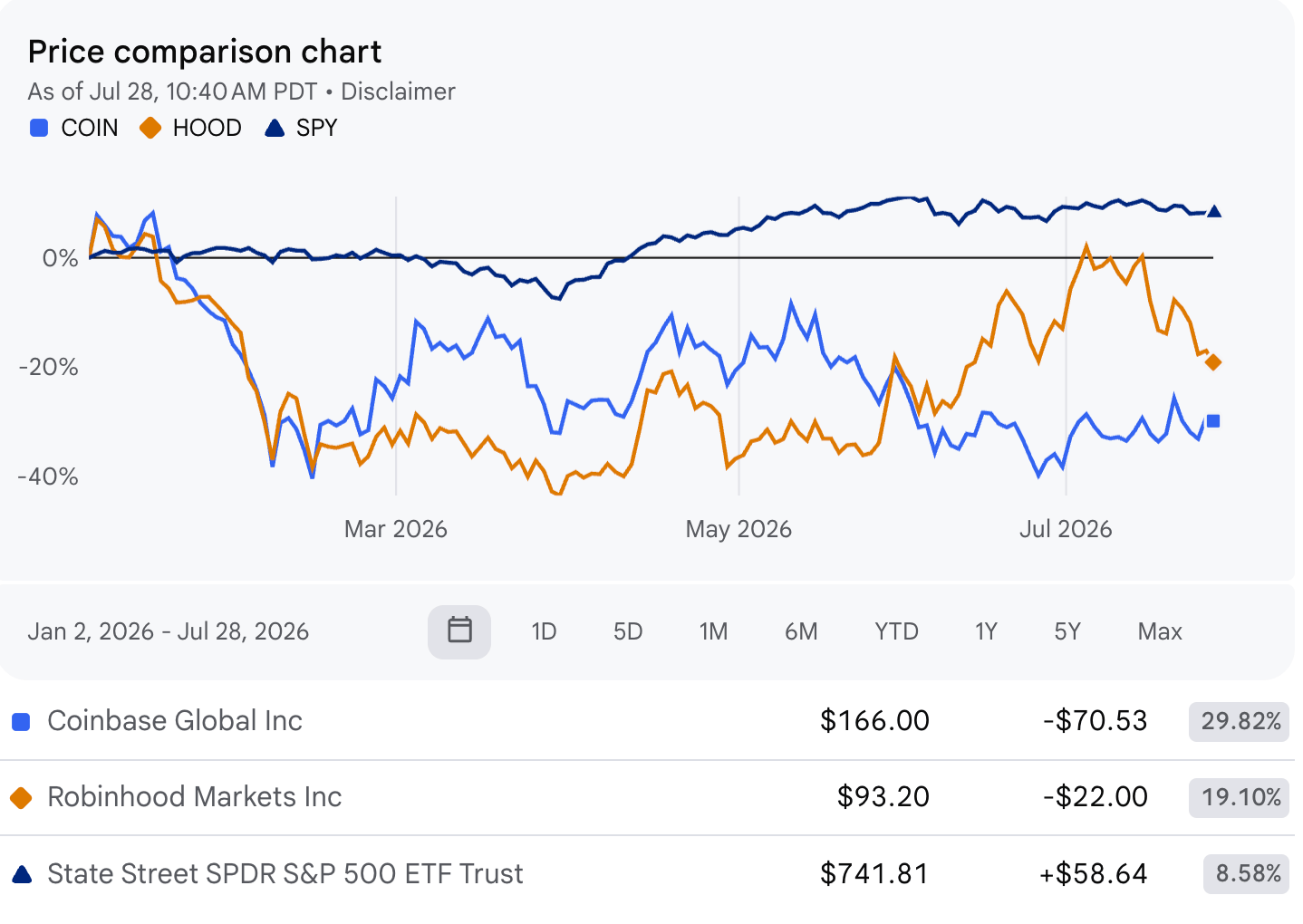
While Robinhood appears to be better positioned in the near term than Coinbase, both firms will have to do a lot more to win back investors who, as the chart below shows, have soured on their stock even as the broader market is up this year. The good news for both companies is that the next five years will see a wave of blockchain-driven financial innovation that they are in a strong position to lead.
Battle for the next wave of blockchains
President Donald Trump’s election victory in late 2024 drove the price of Bitcoin and other cryptocurrencies to new heights, but since then the market has languished in a prolonged downturn, and there are signs that retail investors have turned away from crypto for good. While this has hurt the share price of both Coinbase and Robinhood, new developments in the world of blockchain may soon more than offset the loss of retail traders.
Those developments relate to the field of tokenized stocks and AI-driven commerce, both of which are closely tied to blockchain—creating a big opportunity for the chains that both Coinbase and Robinhood have built in-house.
When it comes to tokenized stocks, the most common model has involved creating a so-called wrapper in the form of a token that trades on the blockchain and is backed by a share of stock held in custody. Robinhood has been a first mover in the field, and CEO Vlad Tenev has talked up a “tokenization supercycle” as financial firms discover that blockchain-based stock trading allows for instant settlement and 24/7 trading.
While Tenev’s characterization has the whiff of hype, there are ample signs the tokenization cycle he describes is for real, as legacy financial institutions ranging from JPMorgan to the New York Stock Exchange have taken steps to embrace the model.
While the emergence of tokenized stocks would seem to play to Coinbase’s natural strengths, the company has been slow off the mark. This stems from a 2024 decision to use the firm’s in-house blockchain, known as Base, in order to build a social network where users were encouraged to create cryptocurrency assets related to their activity. This effort proved niche, even by crypto standards, and Coinbase CEO Brian Armstrong recently acknowledged it was a mistake, leaving the company to play catch-up in the realm of finance.
Despite its slow start, Coinbase’s recent move into stock trading positions it well for the long term in the emerging field of tokenized assets. The company may struggle to execute, however, as it confronts a wave of executive churn and capital constraints that stem from a decline in the crypto market, and from paying out lavish stock awards to current and former executives.
There is also the question of whether blockchain activity can translate to meaningful revenue. Chains like Base make money from so-called sequencer fees (which relate to relaying and ordering transactions), but so far the revenue has been negligible.
This could change as the nascent field of agentic commerce, or using agents to make online purchases, expands. Coinbase has scored an early win in the field by promulgating a new open-source protocol, known as X402, that has emerged as the clear early favorite as a way for agents to engage in shopping. This new industry is also a passion project for Armstrong, and could deliver meaningful revenue for Coinbase—though it could take years for that revenue to arrive.
Robinhood has leaned into agentic commerce as well, though Tenev has stated that the company is happy to pursue a strategy that involves relying on the networks of Visa and Mastercard. This could soon change, however, given the surprise popularity of its new Robinhood Chain, which launched earlier this month and is already rivaling Base when it comes to transaction volume.
All of this, though, will take years to shake out, and investors weighing the two companies are likely to focus on a key strategic question: whether Robinhood can become a full-fledged crypto company faster than Coinbase can add a full layer of traditional finance offerings. For now, at least, Robinhood is winning that race.
This post was updated on July 31 to reflect the two companies’ earning results.