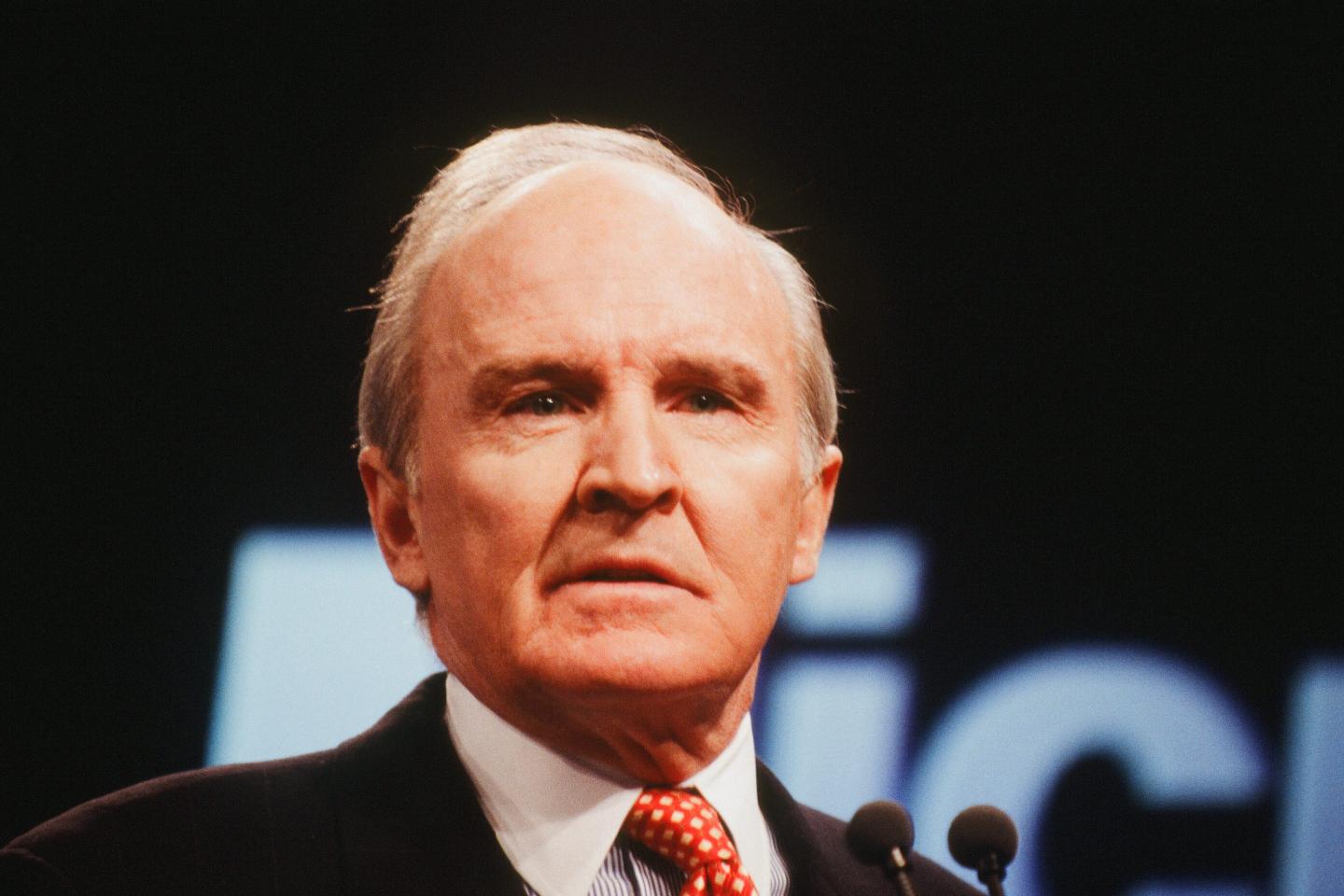
In September 1994, the unraveling of the investment firm Kidder, Peabody & Co., GE’s subsidiary, was a scandal that had jumped from niche financial publications to newspaper front pages: The collision of Wall Street intrigue, a $350-million-plus fraud, and the larger-than-life figure of Jack Welch, then arguably the most celebrated CEO in America, was irresistible.
In a cover story for Fortune, Terence Paré dug into the saga: Bond trader Joseph Jett was accused of manufacturing some $350 million in phantom profits over 28 months. Welch was never charged with any crime or accused of direct complicity, but Paré’s reporting showed a startling lack of oversight from GE and Jett’s supervisors—including Michael Carpenter, the loyalist Welch installed to run Kidder in 1989, who appeared to have lacked the proper SEC licensing for his first four years on the job.
“Jack Welch’s Nightmare on Wall Street,” as the article’s headline put it, went far beyond one rogue trader. It sprung from a deeper well, Paré argued: “the business creed…whose prophet is the charismatic Welch.” A sidebar titled “A Litany of Sins” tallied five separate GE fraud settlements in the prior decade alone. “When you put the Kidder scandal together with other transgressions that have sullied GE’s reputation over the past decade,” Paré wrote, “you begin to get a sense that somewhere in the highly successful and celebrated GE culture something is not right.”
Part of the problem, Paré suggested, was Welch’s uncompromising demand for outsize results across GE’s businesses—and the leadership at Kidder’s attempts to “turn out high-performance numbers the way other GE businesses turn out appliances.”
It’s perhaps the kind of “success theater” that Larry Culp would describe encountering when he became CEO of GE decades later. That phrase comes from Shawn Tully’s must-read magazine story on Culp’s turnaround of GE, in the next issue of Fortune.
Culp took over a company in 2018 that was much diminished from the glory days of Jack Welch. “On Culp’s first day as CEO, GE’s market cap measured just $96 billion, down over 80% from its peak in September 2000,” Tully wrote. He quoted the GE board member and veteran activist investor Nelson Peltz: “I was sure GE was going to file for Chapter 11. Then Larry arrived and performed the most amazing rescue I’ve ever read about or borne witness to.”
Culp’s approach was explicitly a departure from many of Welch’s. Where Welch had centralized and synergized—which arguably masked the problems at Kidder as it leaned upon GE’s balance sheet and brand—Culp did the opposite, breaking the sprawling conglomerate into discrete, accountable P&Ls and ultimately three independent companies. “Focus beats synergies every time,” Culp explained.
It worked: Those three companies—GE Aerospace, GE Vernova, and GE HealthCare—now have a combined valuation of $689 billion, with annualized shareholder returns of roughly 30%, double those of the S&P 500.
Three decades later, Paré’s blistering analysis of what went wrong at Kidder reads like an early crack in the Welch mythology—the “Neutron Jack” persona built on ruthless efficiency that business schools and the business press (including Fortune itself) have canonized.
Culp’s “cultural reboot” was aimed directly at trying to avoid the kind of “success theater” that was the norm in the Welch era. “In the old GE, messengers got shot,” Culp told Tully. “I wanted to create a market for problems.”