
• Home
  • Latest
  • Fortune 500
  • Finance
  • Tech
  • Leadership
  • Lifestyle
  • Rankings
  • Multimedia

Trendingnow

1

Egg companies made $1.22 billion in profit off a $6 carton — now they’re buying their way out of a price-fixing case with 53 million donated eggs

2

Meet the Zillennials: The luckiest micro-generation in the workforce, born between 1993 and 1998

3

Economists have found an answer to slowing cognitive decline: Avoid retiring early, study finds

1

Egg companies made $1.22 billion in profit off a $6 carton — now they’re buying their way out of a price-fixing case with 53 million donated eggs

2

Meet the Zillennials: The luckiest micro-generation in the workforce, born between 1993 and 1998

3

Economists have found an answer to slowing cognitive decline: Avoid retiring early, study finds
North Americahistory

Before independence, America tried — and failed — to conquer Canada

By
Sarah M.S. Pearsall
Sarah M.S. Pearsall
and
The Conversation
The Conversation
Down Arrow Button Icon
By
Sarah M.S. Pearsall
Sarah M.S. Pearsall
and
The Conversation
The Conversation
Down Arrow Button Icon
July 4, 2026, 8:44 AM ET
usa
A truck drives into the United States at the Canada-US border in Saint-Bernard-de-Lacolle, Quebec, Canada, on Tuesday, June 30, 2026. US trips by Canadian residents are down about 30% from before Trump's return to office, according to Statistics Canada data. Andrej Ivanov/Bloomberg via Getty Images
Add Fortune on Google for similar content.

Strange as it is to say, the U.S. Declaration of Independence has deep roots in Canada.

Recommended Video

That assertion may come as a surprise to people in the United States ahead of its 250th anniversary. The common narrative is fixated upon 1776, the 13 rebelling Colonies and the bold military actions of Founding Fathers such as George Washington.

But as I document in my new book, “Freedom Around the Globe,” there is a much wider and often forgotten geographical context. Indeed, it is impossible to understand fully the trajectory of the U.S. in 1776 without comprehending a wider imperial world and what happened in 1775. In fact, the American Revolution ran through Canada.

A broader British North America

In 1775, the first year of the American Revolutionary War, Britain possessed double the famous 13 colonies in North America alone, with many in Canada and the Greater Caribbean – including East and West Florida.

At least some of these colonies had become nominally British in the 1760s, thanks to military triumph late in the Seven Years’ War, 1756-1763. In late 1759, the British had vanquished the French at the battle of the Plains of Abraham near Quebec City, thus ensuring that the British gained this province and a string of French forts in the interior.

In 1763, with the Treaty of Paris, Quebec officially became part of the British Empire. It took British bureaucrats and politicians some years and not a little wrangling to figure out how to integrate French and Indigenous Catholics, with their own laws, into the British Empire.

A major milestone in this process was the Quebec Act of 1774, allowing the practice of Catholicism and modified French law in Canada. Colonists down south, especially fierce New England Protestants who took a dim view of Catholicism, viewed this act – and their new fellow imperial subjects – with dismay and considerable suspicion.
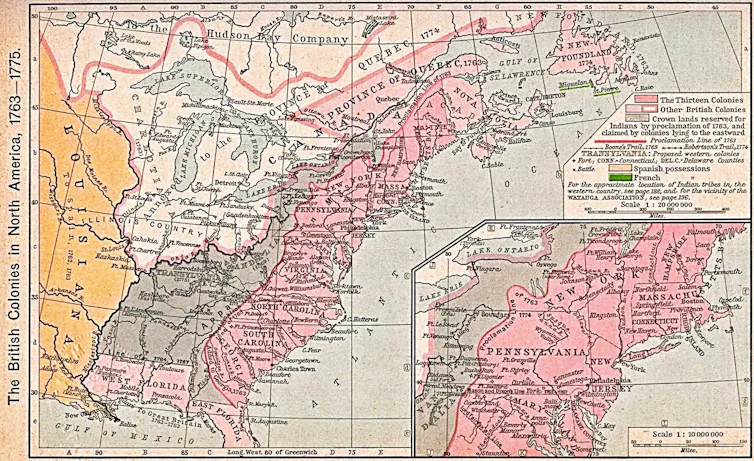
A colonial era map.
Map of the British colonies in North America from 1763 to 1775. Universal History Archive/Universal Images Group via Getty Images

Pushing for a 14th colony

Still, by 1775, those in the 13 Colonies who called themselves “Friends of Liberty” hoped that Canada would “complete the union of 14 provinces,” as one man put it. Accordingly, the First Continental Congress wrote to Quebec’s habitants – residents of French origin – to invite them to join their new nationalist project. The letter explained in patronizing terms how the English government worked.

The Congress acknowledged that there were religious differences with French Catholics but expressed confidence that the “transcendent nature of liberty” could overcome such distinctions. They commissioned its translation into French and ordered a thousand copies for Canadian distribution. By early 1775, Quebec’s governor complained that this letter was stirring up the population by planting dangerous doubts about British imperial authority.

On May 1, 1775, the day the Quebec Act took effect, the life-size marble statue of George III in Montréal – erected in gratitude for his assistance following a fire – was vandalized, indicating disquiet there about this new order.

The Second Continental Congress, which followed the first after its dissolution, continued efforts to win over French Canadians. They sent another letter, again translated and widely distributed. “We yet entertain hopes of your uniting with us in the defence of our common liberty,” they pleaded. The Continental Congress urged Canadians to reject “the fetters of slavery, however artfully polished.” Signed by “Jean Hancock, le “Président du Congrès,” this missive prompted discussions among people in Canada.

The invasion of Canada

As 1775 wore on, force came to join careful letters.

One Boston newspaper proclaimed: “From the friendly disposition of the Canadians … joined to the intrepidity of the Continental army, there is a fair prospect of the speedy reduction of the metropolis of Canada to … obedience.”

It was a cheering if jumbled message: Canada a metropolis? Friendly French Catholic enemies? Allies reduced to obedience? Nothing in it quite made sense, but few in those “United Colonies” – not yet states – wanted to think too hard about these claims or their implications.

Quebec was “easy Prey,” pronounced George Washington in September 1775. He put the well-regarded, Irish-born Gen. Richard Montgomery in charge of the conquest of Canada. Montgomery and his troops managed to take Montréal at the end of November. The British monarchy looked to be toppling in Canada. That marble sculpture of George III, vandalized in 1775, was now beheaded altogether, to the cheers of soldiers. The next step was to join forces at Québec to take that city and thus the province.

December was not a good time to launch a Canadian siege. However, the terms of thousands of soldiers expired on Dec. 31. So Continental Army leadership forged ahead on the last, short, dark day of 1775. A blizzard made conditions horrific. Even Montgomery fretted that his forces were “half-starved and half-naked.” Still, rank-and-file soldiers did what they could. Pinned to their random assortment of hats were scrawled, handmade signs proclaiming liberty or death. They mostly got the latter.

Montgomery was killed within the first few hours on Dec. 31, 1775. His men were left to fight for themselves, as one private, Jeremiah Greenman, wrote in consternation as he found himself – like one-third of his fellow Continental soldiers – a prisoner of war.
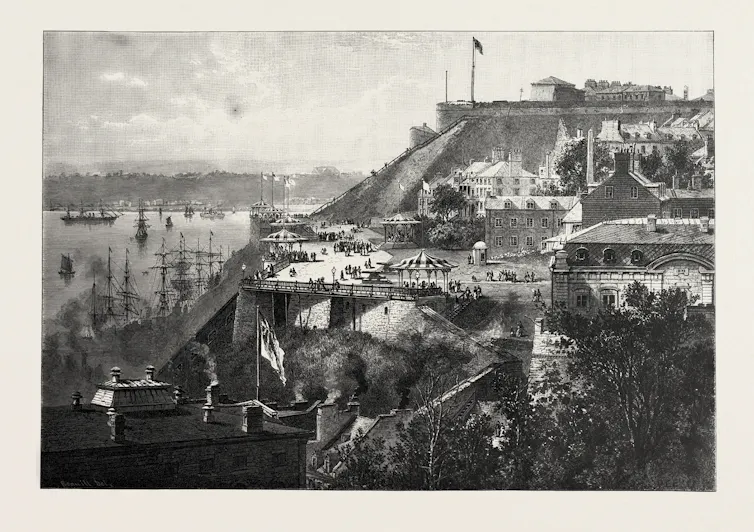
An old black and white engraving.
An artist’s engraving of Quebec in the early 1800s. Universal History Archive/Universal Images Group via Getty Images

The move to independence

The attack on Quebec was a disaster. The icy cold was fatal. Supplies were insufficient. Smallpox raged among malnourished troops. The Canadian catastrophe highlighted the inadequacies of the current system of supply and the lack of American credit. Soldiers, starving and frustrated, did not behave especially well, thus turning Canadians against the cause.

Perhaps unsurprisingly, subsequent attempts at diplomacy, led by the ailing diplomat and intellectual Benjamin Franklin, also proved ineffective. As one Continental officer later declared, “We have bro’t about ourselves by Mismanagement” what the British could not: the near-complete loss of Canadian support.

In January 1776, news of the defeat shocked colonists. Montgomery’s death provoked an outpouring of heartfelt support. Marylanders showed their adoration by naming Montgomery County for him.

That same month, in Philadelphia, an English-born printer published a treatise, dedicating partial profits “for mittens for the troops that were going to Quebec.” That would have been a lot of mittens, because the publication was the bestselling pamphlet of 18th-century North America: Thomas Paine’s “Common Sense.”

The death of an Irishman in Canada propelled many Americans to agree with this Englishman Paine that independence was the right course. As one put it, “Poor Brave Montgomery! But it is not a time to cry but to revenge.” Paine capitalized on the momentum by publishing a dialogue between Montgomery’s ghost and an American in February, debating independence. In the glum mood of early 1776, Paine’s arguments landed.

Grave loss in Canada precipitated the Declaration of Independence, created with an eye to France and Spain as allies. To obtain the help it needed, the newly named United States of America had to become an independent nation. Few countries would intervene in a colonial rebellion, but they might join a war against the hated British. As Montgomery’s brother-in-law observed, France was a good prospect for “foreign aid” to the fledgling nation.

Indeed, assistance – in terms of finances, arms and, eventually, soldiers – from France and Spain would make all the difference, allowing Washington and others to move from defeat to victory. The momentum that resulted in the Declaration of Independence came in part from Canada.

Sarah M.S. Pearsall, Professor of History, Johns Hopkins University

This article is republished from The Conversation under a Creative Commons license. Read the original article.

The Conversation
The Fortune 500 Innovation Forum will convene Fortune 500 executives, U.S. policy officials, top founders, and thought leaders to help define what’s next for the American economy, Nov. 16-17 in Detroit. Apply here.
About the Authors
By Sarah M.S. Pearsall
See full bioRight Arrow Button Icon
By The Conversation
See full bioRight Arrow Button Icon
Add Fortune on Google for similar content.

Latest in North America

Finance
Lorem ipsum dolor sit amet, consectetur adipiscing elit, sed do eiusmod tempor incididunt ut labore et dolore magna aliqua. Ut enim ad minim veniam
By Fortune Editors
October 20, 2025
Finance
Lorem ipsum dolor sit amet, consectetur adipiscing elit, sed do eiusmod tempor incididunt ut labore et dolore magna aliqua. Ut enim ad minim veniam
By Fortune Editors
October 20, 2025
Finance
Lorem ipsum dolor sit amet, consectetur adipiscing elit, sed do eiusmod tempor incididunt ut labore et dolore magna aliqua. Ut enim ad minim veniam
By Fortune Editors
October 20, 2025
Finance
Lorem ipsum dolor sit amet, consectetur adipiscing elit, sed do eiusmod tempor incididunt ut labore et dolore magna aliqua. Ut enim ad minim veniam
By Fortune Editors
October 20, 2025
Finance
Lorem ipsum dolor sit amet, consectetur adipiscing elit, sed do eiusmod tempor incididunt ut labore et dolore magna aliqua. Ut enim ad minim veniam
By Fortune Editors
October 20, 2025
Finance
Lorem ipsum dolor sit amet, consectetur adipiscing elit, sed do eiusmod tempor incididunt ut labore et dolore magna aliqua. Ut enim ad minim veniam
By Fortune Editors
October 20, 2025

Most Popular

Finance
Lorem ipsum dolor sit amet, consectetur adipiscing elit, sed do eiusmod tempor incididunt ut labore et dolore magna aliqua. Ut enim ad minim veniam
By Fortune Editors
October 20, 2025
Finance
Lorem ipsum dolor sit amet, consectetur adipiscing elit, sed do eiusmod tempor incididunt ut labore et dolore magna aliqua. Ut enim ad minim veniam
By Fortune Editors
October 20, 2025
Finance
Lorem ipsum dolor sit amet, consectetur adipiscing elit, sed do eiusmod tempor incididunt ut labore et dolore magna aliqua. Ut enim ad minim veniam
By Fortune Editors
October 20, 2025
Finance
Lorem ipsum dolor sit amet, consectetur adipiscing elit, sed do eiusmod tempor incididunt ut labore et dolore magna aliqua. Ut enim ad minim veniam
By Fortune Editors
October 20, 2025
Finance
Lorem ipsum dolor sit amet, consectetur adipiscing elit, sed do eiusmod tempor incididunt ut labore et dolore magna aliqua. Ut enim ad minim veniam
By Fortune Editors
October 20, 2025
Finance
Lorem ipsum dolor sit amet, consectetur adipiscing elit, sed do eiusmod tempor incididunt ut labore et dolore magna aliqua. Ut enim ad minim veniam
By Fortune Editors
October 20, 2025
Fortune Secondary Logo
Rankings
  • 100 Best Companies
  • Fortune 500
  • Global 500
  • Fortune 500 Europe
  • Most Powerful Women
  • World's Most Admired Companies
  • See All Rankings
  • Lists Calendar
Sections
  • Finance
  • Fortune Crypto
  • Features
  • Leadership
  • Health
  • Commentary
  • Success
  • Retail
  • Mpw
  • Tech
  • Lifestyle
  • CEO Initiative
  • Asia
  • Politics
  • Conferences
  • Europe
  • Newsletters
  • Personal Finance
  • Environment
  • Magazine
  • Education
Customer Support
  • Frequently Asked Questions
  • Customer Service Portal
  • Privacy Policy
  • Terms Of Use
  • Single Issues For Purchase
  • International Print
Commercial Services
  • Advertising
  • Fortune Brand Studio
  • Fortune Analytics
  • Fortune Conferences
  • Business Development
  • Group Subscriptions
About Us
  • About Us
  • Press Center
  • Work At Fortune
  • Terms And Conditions
  • Site Map
  • About Us
  • Press Center
  • Work At Fortune
  • Terms And Conditions
  • Site Map
  • Facebook icon
  • Twitter icon
  • LinkedIn icon
  • Instagram icon
  • Pinterest icon

Latest in North America

Before independence, America tried — and failed — to conquer Canada
North Americahistory
Before independence, America tried — and failed — to conquer Canada
By Sarah M.S. Pearsall and The ConversationJuly 4, 2026
1 hour ago
The 1964 box set that predicted Dylan going electric — and still explains American music today
Arts & EntertainmentMusic
The 1964 box set that predicted Dylan going electric — and still explains American music today
By Ted Olson and The ConversationJuly 4, 2026
1 hour ago
p
Politicshistory
69% of Americans think the founders would be disappointed in democracy today. A French philosopher predicted why
By Robert A. Ballingall and The ConversationJuly 4, 2026
2 hours ago
w
Travel & LeisureWorld Cup
‘I can understand the, um, obesity here’: The World discovers American cuisine at the World Cup
By Dee-Ann Durbin and The Associated PressJuly 4, 2026
2 hours ago
dec
North Americamuseums
A retired insurance executive found a lost Declaration of Independence in Britain’s National Archives
By Danica Kirka and The Associated PressJuly 4, 2026
2 hours ago
ring
PoliticsTariffs
Belgium got its tariffs cut. Then it sent Trump a diamond Superman ring
By Sam McNeil and The Associated PressJuly 4, 2026
2 hours ago

Most Popular

Egg companies made $1.22 billion in profit off a $6 carton — now they’re buying their way out of a price-fixing case with 53 million donated eggs
Law
Egg companies made $1.22 billion in profit off a $6 carton — now they’re buying their way out of a price-fixing case with 53 million donated eggs
By Wyatte Grantham-Philips and The Associated PressJuly 2, 2026
2 days ago
Meet the Zillennials: The luckiest micro-generation in the workforce, born between 1993 and 1998
AI
Meet the Zillennials: The luckiest micro-generation in the workforce, born between 1993 and 1998
By Nick LichtenbergJuly 3, 2026
1 day ago
Economists have found an answer to slowing cognitive decline: Avoid retiring early, study finds
Economy
Economists have found an answer to slowing cognitive decline: Avoid retiring early, study finds
By Sasha RogelbergJuly 2, 2026
2 days ago
On Wall Street, analysts increasingly don’t believe the U.S. government’s 'misleading' job numbers
Economy
On Wall Street, analysts increasingly don’t believe the U.S. government’s 'misleading' job numbers
By Jim EdwardsJuly 3, 2026
1 day ago
Even as Elon Musk calls philanthropy ‘very hard,’ every day Americans gave a record $617 billion—despite feeling the squeeze over the cost of living
Success
Even as Elon Musk calls philanthropy ‘very hard,’ every day Americans gave a record $617 billion—despite feeling the squeeze over the cost of living
By Preston ForeJuly 4, 2026
7 hours ago
$25 billion CEO says one-hour interviews are a waste of time—he puts candidates through six hours of tests and wants them to order wine at lunch
Success
$25 billion CEO says one-hour interviews are a waste of time—he puts candidates through six hours of tests and wants them to order wine at lunch
By Orianna Rosa RoyleJuly 3, 2026
1 day ago

© 2026 Fortune Media IP Limited. All Rights Reserved. Use of this site constitutes acceptance of our Terms of Use and Privacy Policy | CA Notice at Collection and Privacy Notice | Do Not Sell/Share My Personal Information
FORTUNE is a trademark of Fortune Media IP Limited, registered in the U.S. and other countries. FORTUNE may receive compensation for some links to products and services on this website. Offers may be subject to change without notice.