
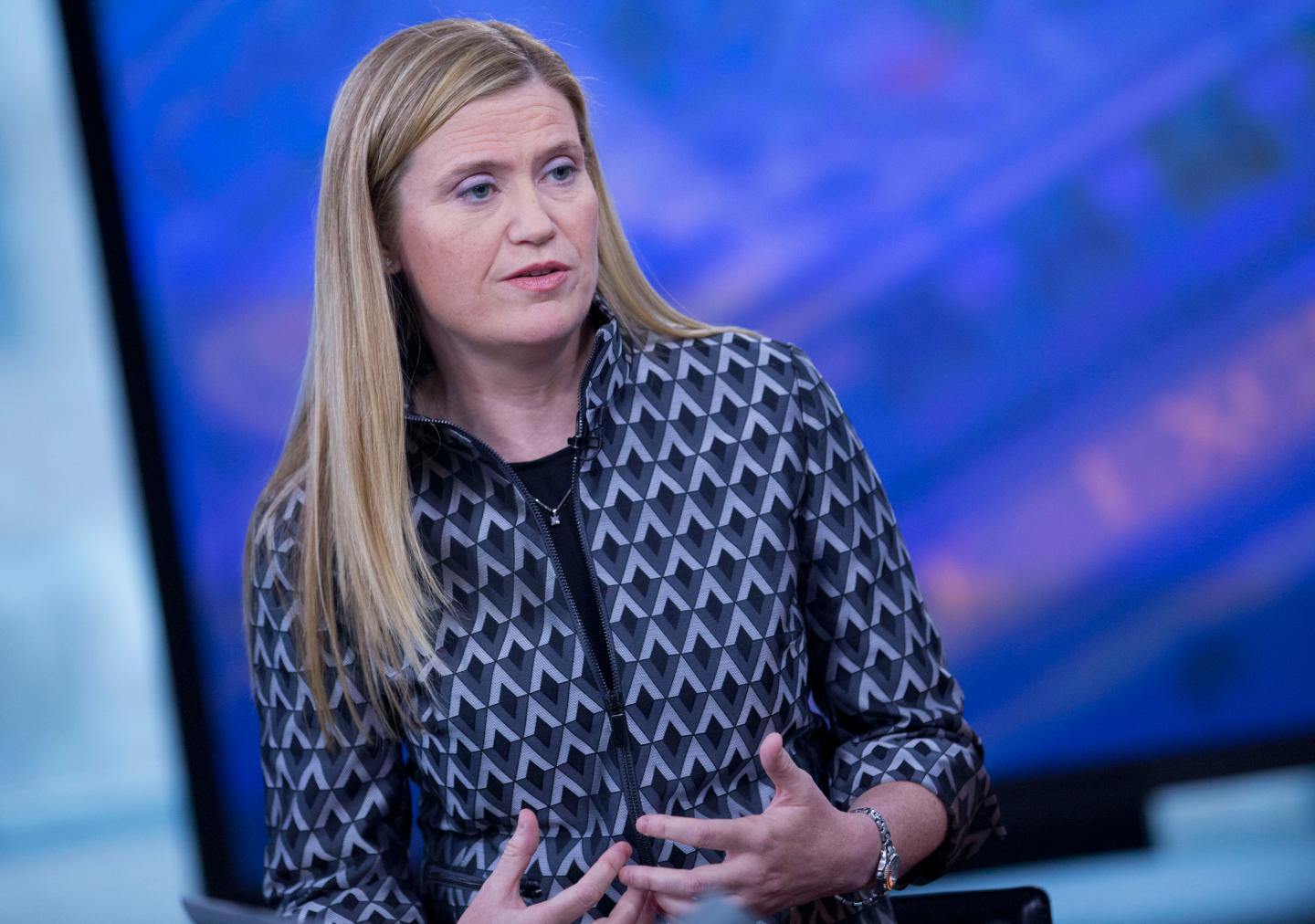
Last week, a stream of employees gathered inside JPMorgan’s office in midtown Manhattan. They were there, according to the Wall Street Journal, to share their well wishes and admiration with Marianne Lake, the bank’s CEO of consumer and community banking. Earlier that morning, the bank had announced the elevation of two other executives to co-presidents—and Lake’s retirement after 25 years.
The announcement held more weight than a simple executive shuffle. JPMorgan has for years been searching, in a process that sometimes spills over into public view, for a successor to CEO Jamie Dimon. Lake had been a leading contender to take over from Dimon, and her elevation to CEO would have made her the first woman to run JPMorgan and the second to run a major Wall Street bank, after Citi’s promotion of Jane Fraser to CEO cracked that glass ceiling in 2021.
Dimon praised her as “an outstanding partner and friend,” noting her “unquestioned integrity” and decades of leadership. Yet with Lake’s departure, called “abrupt” by Bloomberg, JPMorgan has closed the door on what had been, for years, one of the most credible opportunities to put a woman at the helm of one of the most powerful financial institutions in the world.
“It’s really a chess board,” Korn Ferry global vice chair Jane Edison Stevenson tells Fortune of succession planning. “It’s when the current CEO leaves, it’s how long people are willing to wait, it’s when they’re ready. They all have to come together.”
The making of a contender
For much of the past decade, Marianne Lake seemed like the future of JPMorgan.
A British-born executive who joined the bank in 1999, she built her career across divisions, with an emphasis on financial rigor and operational command. She rose through finance roles, became chief financial officer, then CEO of consumer lending, and then co-CEO and eventually sole CEO of consumer and community banking, one of the firm’s most important divisions with $76 billion in revenue last year and more than 86 million consumers.
Along the way, she climbed the Fortune Most Powerful Women list year after year (she ranked No. 23 in 2026), becoming not just a senior executive but a sign of what was possible inside a firm often held up as the gold standard of Wall Street management.
When JPMorgan more explicitly shaped its succession narrative, Lake was central to it. What grabbed attention was not just that JPMorgan had one strong female candidate in the mix to take over from Dimon—but that there were two.
The same year Fraser took over Citi, in 2021, Lake became co-CEO of CCB alongside Jennifer Piepszak. The pair had previously swapped jobs, taking turns as CFO and CEO of the consumer bank. Now they were explicitly tied together, sharing a role poised to prepare them for the biggest job of all; they were even the first-ever tie on Fortune’s Most Powerful Women list that year. Their parallel rise suggested not just individual success, but a pipeline.
But in early 2025, Piepszak exited the JPMorgan CEO race. She “does not want to be considered for the CEO position at this time,” JPMorgan spokesperson Joe Evangelisti said at the time. “Her clear preference is for a senior operating role working closely with Jamie [Dimon] and in support of top leadership going forward.” She became the bank’s COO, a role she still holds today—but left Lake as the lone serious female contender in the race to the top. What seemed at first like a strong pipeline for women became less of a sure thing.
When Piepszak made her decision, Dimon weighed in on the CEO race: “We have several exceptional people. You guys know most of them. It’ll be one of those people,” Dimon said in early 2025.
Other candidates over the years included Daniel Pinto, long viewed as Dimon’s emergency “hit-by-a-bus” successor, but he announced plans to retire by the end of 2026. Meanwhile, Doug Petno and Troy Rohrbaugh continued to rise, going from co-CEOs of the commercial and investment bank (CIB) to co-presidents of the bank last week—the last two men standing. Dimon wrote in a memo to employees, shared with Fortune, that the decision to elevate the pair “reflects the board’s confidence in their extraordinary leadership capabilities, business performance, relationships, experience and commitment to always doing the right thing.” “These changes also mark an important step in our board’s thoughtful process around succession planning and development of our top leaders,” he added.
Lake wrote in a memo to JPMorgan employees, also shared with Fortune, “Moments like these are always bittersweet, but I just want to say how truly proud I am of all that we achieved together—and how honored I have been to work alongside you. This is truly the best team on the planet. Together, we have built the best consumer banking franchise in America … I have no doubt it will only get better from here. … While I will miss you all, I’ve never been more confident about the future of CCB and all of JPMorganChase—and I’ll be cheering you on.”
The rise to the top
The fact that, at any point, there were two female candidates in the mix to become CEO of JPMorgan is in itself remarkable. Dimon’s approach to talent played a big role in making that possible. He has long favored what he told Fortune in 2025 are “test jobs”—roles designed to stretch executives across different parts of the business. The approach is applied regardless of gender but has, at times, helped elevate women within the firm; women are less likely to raise their hands without feeling 100% qualified for something. Of her own path within JPMorgan from CMO to CEO of JPMorgan Wealth Management, another exec, Kristin Lemkau, told Fortune in 2025, “I have not asked for any of these jobs. They’ve asked me to do them. Maybe that’s not how it typically works,” she says. “I’ve been scared of every job I’ve gone into—but that’s great too.”
In addition to Lake, Piepszak, and Lemkau, the firm boasts Mary Erdoes, its CEO of asset and wealth management. Last week, the bank revealed $20 million bonuses for both Piepszak and Erdoes, a signal of their value to the firm. (Petno and Rohrbaugh each got $30 million.) Piepszak, Erdoes, Petno, and Rohrbaugh all report to Dimon directly.
But allowing execs to gain—and prove—capability is only the first step in succession planning. Dimon’s retirement plans have shifted over the years. Often, his answer was “five years away.” In 2024, he said it was “not five years anymore.” Every year extended has an impact—the obvious candidate in 2021 might not be the right choice in 2030.
Dimon himself has emphasized how quickly succession plans can change. “Of course, at the last minute, people get sick, they change their mind, they have family circumstances,” he said in January 2025. “Even if you thought you knew today, you couldn’t be completely sure,” he added.
A shifting playing field
By mid-2026, the signals around Lake had begun to shift. According to the Wall Street Journal, Lake decided to leave after it became clear she was no longer in the running to become CEO. She is expected to eventually take on another top executive role elsewhere. (She is still only in her 50s.) Her career, by any measure, remains among the most accomplished in banking.
But her departure from JPMorgan carries a weight beyond her. About 55 women run Fortune 500 companies, an all-time record that is still far from parity at 11%.
Before Lake’s exit from JPMorgan, two other succession races that seemed likely to elevate a woman to one of the top CEO jobs in the world had gone the other way. At Walmart, Kath McLay left her role as CEO of Walmart International after John Furner was named chief executive. At Disney, Dana Walden emerged from the succession process with an expanded role as president and chief creative officer—but not the CEO title, which went to Josh D’Amaro. These were three jobs that were not just Fortune 500 CEO roles—but the most elite of the elite, jobs with huge societal, economic, and cultural impact beyond the businesses themselves.
“It’s not different than what happens to men every day, but it has a much higher cost because there aren’t as many women in situations to be the counterpoint,” Stevenson says.
How to crack the glass ceiling
If a bank with as much female talent as JPMorgan still couldn’t get one of its women to the finish line in the CEO race, what chance is there elsewhere?
Companies must put more women in “positions of preparation to increase the odds they are selected at the moment of transition,” Stevenson advises. That process can take as long as 15 years. Companies’ pullback from initiatives that explicitly supported diverse employees throughout 2025 could affect whether that happens or not. (Dimon himself has defended some of JPMorgan’s DEI efforts, and called other programs “stupid shit.”) At the board level, data is already showing an impact. In the first quarter of 2026, white men got a higher share of new board seats than they had in a decade, while women’s share of new directorships declined.
One bright side, Stevenson argues, is that Lake (and even Piepszak, should she ever choose to leave) could become CEOs elsewhere in finance. “It could mean there’s an extra female CEO in financial services,” she argues. Indeed, JPMorgan alumni have gone on to significant jobs; Thasunda Brown Duckett spent 17 years at JPMorgan, including a stint as CEO of the consumer bank, before she became the president and CEO of retirement solutions firm TIAA. Charlie Scharf was a protegé of Dimon’s before he became the CEO of Wells Fargo.
“It’s disappointing,” Stevenson says, “but I don’t think it’s over.”