

• Home
  • Latest
  • Fortune 500
  • Finance
  • Tech
  • Leadership
  • Lifestyle
  • Rankings
  • Multimedia

Trendingnow

1

'I literally was crying last night because I’m nervous about what I’m going to find out': a record 51% of Americans aren't 'cost secure' on health

2

Jeff Bezos pledged $10 billion for climate change. With the 2030 clock ticking, his wife, Lauren Sánchez Bezos, is leading the charge to spend it

3

The Great Recession’s missing children are finally bringing college’s financial crisis into sight. Welcome to the ‘enrollment volatility’ era

1

'I literally was crying last night because I’m nervous about what I’m going to find out': a record 51% of Americans aren't 'cost secure' on health

2

Jeff Bezos pledged $10 billion for climate change. With the 2030 clock ticking, his wife, Lauren Sánchez Bezos, is leading the charge to spend it

3

The Great Recession’s missing children are finally bringing college’s financial crisis into sight. Welcome to the ‘enrollment volatility’ era
AIEconomics

Nobel Laureate Daron Acemoglu on the ‘brainless’ AI discourse, the myth of capitalism and the Gen Z revolution risk

Nick Lichtenberg
By
Nick Lichtenberg
Nick Lichtenberg
Business Editor
Down Arrow Button Icon
Nick Lichtenberg
By
Nick Lichtenberg
Nick Lichtenberg
Business Editor
Down Arrow Button Icon
June 21, 2026, 5:00 AM ET
ace
Daron Acemoglu, the Nobel laureate.Bryce Vickmark
Add Fortune on Google for similar content.

Daron Acemoglu has a number for everything. The MIT economist — who won the Nobel Memorial Prize in Economic Sciences in 2024 for his work on institutions and prosperity — estimates that roughly 0.55% in total factor productivity gains is what AI will actually deliver over the next decade, a fraction of Wall Street’s euphoric projections. He estimates only about 5% of tasks will be profitably automated in the near term, equivalent to a 1% or 1.5% increase in GDP.

Recommended Video

And when asked how much of the current AI discourse he finds intellectually serious, he doesn’t hesitate: about 20%.

“I find all of this discussion of capitalism so brainless,” Acemoglu told Fortune, insisting that we should be focused on the “enormous increase” in corporate power and monopoly instead. “That’s what we should be talking about. What we should be talking about is the displacement and unequalizing roles of AI.” When asked how much of the discourse he finds, in his words “brainless,” he barely paused. “About 80%,” he said. He clarified that the thinking is rather speculative or close to fictional, not stupid per se.

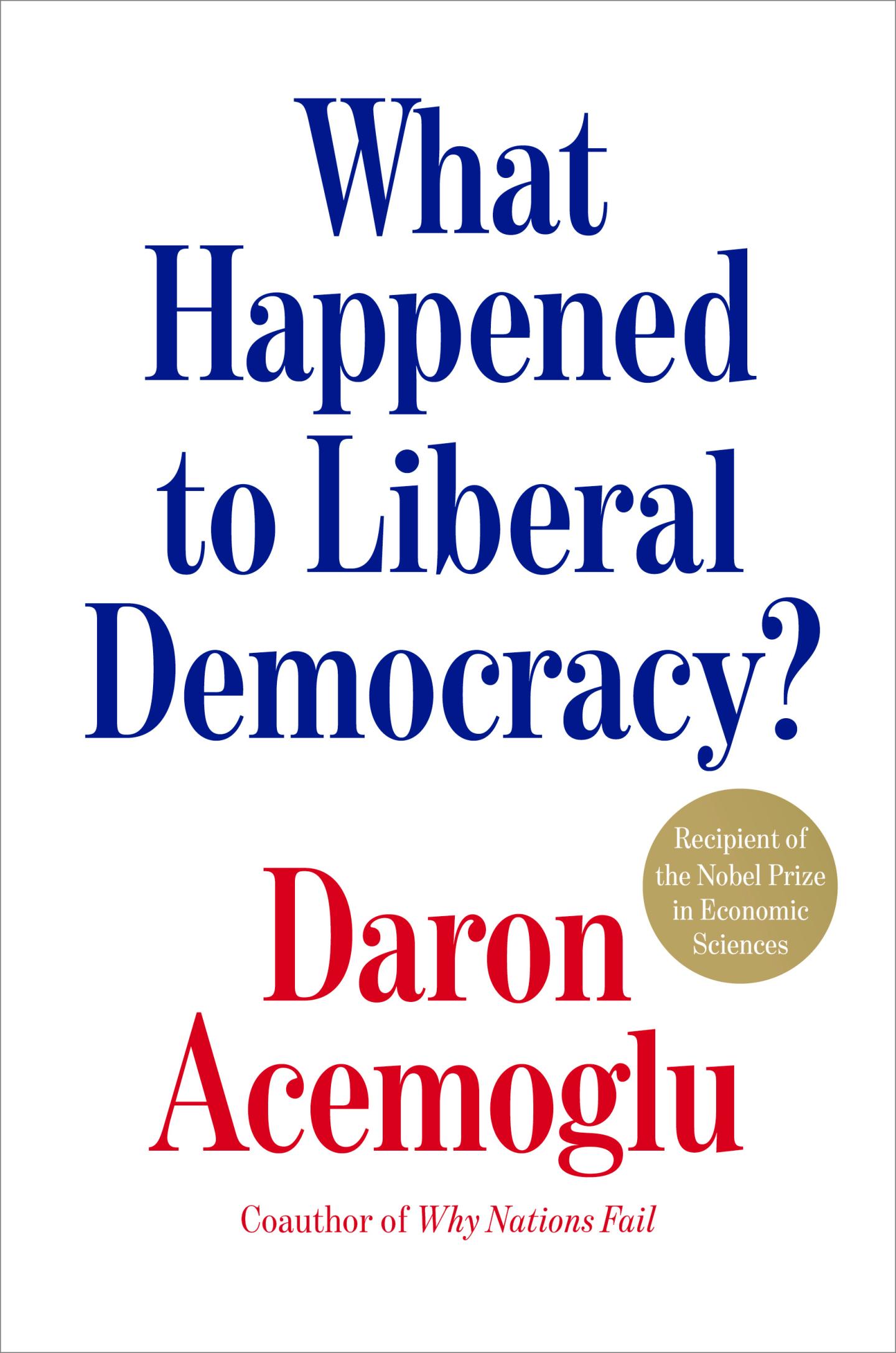
“Unfortunately, a lot of the left is a big contributor to that,” he added, stressing that it’s a central point of his forthcoming book What Happened to Liberal Democracy? “The success of liberal democracy was rooted in social democratic, center-left ideas, and governments playing a leading role. And that space cannot be filled by stupid ideas and by being completely unaware of, you know, what AI is doing, what are its capabilities, what are its implications, nor could it be filled by, Frankfurt School-influenced quasi-Marxist oppressed/oppressor dynamics applied to everything.”

He added acidly that he’s grown sick of the phrase “colonizing AI” as an example of unhelpful Marxist rhetoric, detached from a center-left lens that would actually be practical and helpful. It’s vintage Acemoglu, extending his decades-long argument that the health of economies and the health of democratic institutions are inseparable — and that AI is now stress-testing both simultaneously.
‘Capitalism is a completely useless word’

Ask Acemoglu where he stands on capitalism and he’ll redirect the question entirely.

“I don’t like the term capitalism,” he said. “It makes it sound like there is a uniform model that includes Sweden, Egypt, Argentina, Honduras, the United States, South Korea, Japan. There’s no overlap between these economies, how they are organized.” The only overlap he sees is that they have markets, “but so did the Soviet Union.”

His preferred frame, developed across Why Nations Fail and The Narrow Corridor with co-author James Robinson, is inclusive versus extractive institutions. The question isn’t whether a country has markets, but whether its economic and political rules broaden participation and reward innovation — or whether they concentrate power at the top and extract value from everyone else.

Seen through that lens, AI is not troublesome in its own right, but rather whether it is positioned as inclusive or extractive. Today’s AI hyperscalers, he argues, fit the extractive mold almost perfectly: concentrated ownership, regulatory capture, and a business model that extracts data and attention at scale.

Instead of reckoning with that, he said, we get all kinds of other talk about whether capitalism is mutating into technofeudalism, or whether AI will automate away every job in existence. “People are saying such stupid things. I can’t believe it.”

The productivity illusion

Acemoglu’s skepticism about AI’s economic upside isn’t contrarianism — it’s grounded in a framework he’s applied to every major wave of automation for decades.

Productivity gains from automation, he explained, only materialize if machines can do tasks significantly cheaper or better than humans. If the improvement is marginal, or if integration costs eat into gains, the math doesn’t add up — even if the automation is widespread. “It’s not that you cannot get big productivity gains from automation,” he said. “It is that it’s not as easy as sometimes it’s presumed.”

What would actually move the needle? True “human complementarity,” Acemoglu insisted, would be AI that enables workers to do things they simply couldn’t do before, expanding the range of tasks and services on offer, rather than just accelerating existing ones. He turned media critic briefly: “Podcasts massively expanded the demand for news,” he noted. If AI can do what he calls “new tasks” — versions that were not previously available — “that is the real pathway to true human complementarity, not just enabling you to do what you were doing before in a better way, or in a faster way.”

Acemoglu nodded when Fortune mentioned his finding that most research on AI productivity is overblown because it overwhelmingly focuses on easy, well-defined tasks where context is clear. These are not representative of the economy, which simply isn’t set up with so many of those, and AI is just not great for hard tasks yet. “You need new tools, sort of a tool that reliably understands and distills the best research, and is not swayed by the worst research in a particular field, and provides that to you in a context relevant and an accurate manner, and allows you to interrogate it.”

The sharpest version of his argument cuts even deeper: the productivity gains that AI bulls are penciling in don’t just require better models — they effectively require artificial general intelligence. For genuinely huge productivity gains from automation, “then we really, really need something close to AGI for that,” Acemoglu said, referring to the concept of artificial general intelligence. “So that’s why AGI is not just a theoretical issue — it’s really relevant for these productivity projections.” He’s skeptical we’re close. Current models, he argues, perform badly across too many dimensions of real-world work — they can’t read a room, they can’t connect non-obvious dots across domains, and they fail precisely where human judgment is most valuable. The gap between what LLMs do well in demos and what they do reliably in complex, high-stakes professional environments remains, in his view, far wider than the industry’s marketing suggests.

The revolution risk

Acemoglu added that the Fortune 500 should hope that he’s right, paradoxically, that AI won’t be that useful.

“If it were the case that 30%, 40% of new university graduates can’t find jobs,” he said, “what would that do to democracy and social peace? Wherever that has happened in the past, you’ve had revolutions.”

Revolutions, he added quickly, are inherently unpredictable, shaped by the interplay of repression, redistribution, and the ambient attitudes of a generation. Social media adds a new variable that history offers no reliable guide to. “In the past, youth did not have Instagram, TikTok, and Twitter,” he said. “Perhaps that changes things. I have no idea.”

But the direction of concern is clear. A generation of workers who trained and credentialed for an economy that AI has since restructured — and who feel economically stranded — is a constituency that has historically not stayed quiet. The grumbling at this spring’s commencement ceremonies, he suggested, may be an early signal.

What would fix it

Acemoglu’s critique comes with a prescription, though he’s frank about how far the current moment is from acting on it.

The U.S. needs to have a genuine conversation about what is socially desirable from AI — not just what is technically possible or financially profitable for a handful of hyperscalers. That conversation, he argues, has to center on wages, jobs, shared prosperity, and “meaningful, dignified lives for workers.” It also has to include serious global governance — including cooperation with China, which he says is ahead of the U.S. in integrating AI into manufacturing, robotics, and commerce, even as it lags on large language models.

“I think that [U.S.-China collaboration] would be so beneficial,” he said. “We need global governance for AI. We also need the ‘AI race’ not to get out of control. And we need the two sides to share best practices on things that are useful for humanity,” he said, mentioning disease control, productivity, shared best practices and global safety regulations. The current geopolitical climate, he acknowledged, makes that nearly impossible. “The only bipartisan issue in the United States right now is China bashing,” he said, adding that it was that way during the Biden era.

The intellectual failure, in his view, runs deeper than policy. It’s a failure of imagination — an inability to articulate what a genuinely human-centered AI future would look like, and the political will to demand it.

“We’re all so blindly taken in by what OpenAI, Anthropic, and a few other hyperscalers are offering,” he said, “because we haven’t articulated a reasonable alternative.” Squint and you hear the old phrase from the Paul Newman classic Cool Hand Luke: what we have here, gentleman, is a failure of imagination.

Subscribe to Fortune Gulf Brief. Every Tuesday, this new newsletter delivers clear-eyed, authoritative intelligence on the deals, decisions, policies, and power shifts shaping one of the world’s most consequential regions, written for the people who need to act on it. Sign up here.
About the Author
Nick Lichtenberg
By Nick LichtenbergBusiness Editor
LinkedIn icon

Nick Lichtenberg is business editor and was formerly Fortune's executive editor of global news.

See full bioRight Arrow Button Icon
Add Fortune on Google for similar content.

Latest in AI

Finance
Lorem ipsum dolor sit amet, consectetur adipiscing elit, sed do eiusmod tempor incididunt ut labore et dolore magna aliqua. Ut enim ad minim veniam
By Fortune Editors
October 20, 2025
Finance
Lorem ipsum dolor sit amet, consectetur adipiscing elit, sed do eiusmod tempor incididunt ut labore et dolore magna aliqua. Ut enim ad minim veniam
By Fortune Editors
October 20, 2025
Finance
Lorem ipsum dolor sit amet, consectetur adipiscing elit, sed do eiusmod tempor incididunt ut labore et dolore magna aliqua. Ut enim ad minim veniam
By Fortune Editors
October 20, 2025
Finance
Lorem ipsum dolor sit amet, consectetur adipiscing elit, sed do eiusmod tempor incididunt ut labore et dolore magna aliqua. Ut enim ad minim veniam
By Fortune Editors
October 20, 2025
Finance
Lorem ipsum dolor sit amet, consectetur adipiscing elit, sed do eiusmod tempor incididunt ut labore et dolore magna aliqua. Ut enim ad minim veniam
By Fortune Editors
October 20, 2025
Finance
Lorem ipsum dolor sit amet, consectetur adipiscing elit, sed do eiusmod tempor incididunt ut labore et dolore magna aliqua. Ut enim ad minim veniam
By Fortune Editors
October 20, 2025

Most Popular

Finance
Lorem ipsum dolor sit amet, consectetur adipiscing elit, sed do eiusmod tempor incididunt ut labore et dolore magna aliqua. Ut enim ad minim veniam
By Fortune Editors
October 20, 2025
Finance
Lorem ipsum dolor sit amet, consectetur adipiscing elit, sed do eiusmod tempor incididunt ut labore et dolore magna aliqua. Ut enim ad minim veniam
By Fortune Editors
October 20, 2025
Finance
Lorem ipsum dolor sit amet, consectetur adipiscing elit, sed do eiusmod tempor incididunt ut labore et dolore magna aliqua. Ut enim ad minim veniam
By Fortune Editors
October 20, 2025
Finance
Lorem ipsum dolor sit amet, consectetur adipiscing elit, sed do eiusmod tempor incididunt ut labore et dolore magna aliqua. Ut enim ad minim veniam
By Fortune Editors
October 20, 2025
Finance
Lorem ipsum dolor sit amet, consectetur adipiscing elit, sed do eiusmod tempor incididunt ut labore et dolore magna aliqua. Ut enim ad minim veniam
By Fortune Editors
October 20, 2025
Finance
Lorem ipsum dolor sit amet, consectetur adipiscing elit, sed do eiusmod tempor incididunt ut labore et dolore magna aliqua. Ut enim ad minim veniam
By Fortune Editors
October 20, 2025
Fortune Secondary Logo
Rankings
  • 100 Best Companies
  • Fortune 500
  • Global 500
  • Fortune 500 Europe
  • Most Powerful Women
  • World's Most Admired Companies
  • See All Rankings
  • Lists Calendar
Sections
  • Finance
  • Fortune Crypto
  • Features
  • Leadership
  • Health
  • Commentary
  • Success
  • Retail
  • Mpw
  • Tech
  • Lifestyle
  • CEO Initiative
  • Asia
  • Politics
  • Conferences
  • Europe
  • Newsletters
  • Personal Finance
  • Environment
  • Magazine
  • Education
Customer Support
  • Frequently Asked Questions
  • Customer Service Portal
  • Privacy Policy
  • Terms Of Use
  • Single Issues For Purchase
  • International Print
Commercial Services
  • Advertising
  • Fortune Brand Studio
  • Fortune Analytics
  • Fortune Conferences
  • Business Development
  • Group Subscriptions
About Us
  • About Us
  • Press Center
  • Work At Fortune
  • Terms And Conditions
  • Site Map
  • About Us
  • Press Center
  • Work At Fortune
  • Terms And Conditions
  • Site Map
  • Facebook icon
  • Twitter icon
  • LinkedIn icon
  • Instagram icon
  • Pinterest icon

Latest in AI

Sam Altman thinks AI will surpass human intelligence by 2030.  His rival AI billionaires say it’ll be even sooner
AISam Altman
Sam Altman thinks AI will surpass human intelligence by 2030. His rival AI billionaires say it’ll be even sooner
By Marco Quiroz-GutierrezJune 21, 2026
41 minutes ago
ace
AIEconomics
Nobel Laureate Daron Acemoglu on the ‘brainless’ AI discourse, the myth of capitalism and the Gen Z revolution risk
By Nick LichtenbergJune 21, 2026
2 hours ago
Patricia Camden is EY Studio+ Customer Experience and Loyalty Leader
CommentaryConsulting
EY: we found your biggest AI blind spot. It’s called the ‘tempo gap’
By Patricia Camden and John DuboisJune 20, 2026
23 hours ago
SpaceX executives celebrate the IPO with confetti
C-SuiteSpaceX
Meet the SpaceX insiders Elon Musk trusts to run his $2.4 trillion dollar empire
By Lily Mae LazarusJune 20, 2026
1 day ago
Both U.S. and Chinese AI firms are setting up shop in Singapore. Can the country become Asia’s neutral AI hub?
AsiaSingapore
Both U.S. and Chinese AI firms are setting up shop in Singapore. Can the country become Asia’s neutral AI hub?
By Angelica AngJune 19, 2026
2 days ago
Sam Altman looks down and to the side, frowning.
AIOpenAI
Sam Altman was ‘0%’ excited to be a CEO of a public company—but OpenAI is taking steps to compete in the AI IPO blitz anyway
By Sasha RogelbergJune 19, 2026
2 days ago

Most Popular

'I literally was crying last night because I’m nervous about what I’m going to find out': a record 51% of Americans aren't 'cost secure' on health
Health
'I literally was crying last night because I’m nervous about what I’m going to find out': a record 51% of Americans aren't 'cost secure' on health
By Ali Swenson, Amelia Thomson-Deveaux and The Associated PressJune 20, 2026
18 hours ago
Jeff Bezos pledged $10 billion for climate change. With the 2030 clock ticking, his wife, Lauren Sánchez Bezos, is leading the charge to spend it
Environment
Jeff Bezos pledged $10 billion for climate change. With the 2030 clock ticking, his wife, Lauren Sánchez Bezos, is leading the charge to spend it
By Sydney LakeJune 19, 2026
2 days ago
The Great Recession’s missing children are finally bringing college’s financial crisis into sight. Welcome to the ‘enrollment volatility’ era
Economy
The Great Recession’s missing children are finally bringing college’s financial crisis into sight. Welcome to the ‘enrollment volatility’ era
By Tristan BoveJune 20, 2026
1 day ago
Nvidia CEO Jensen Huang says electricians and plumbers will be needed by the hundreds of thousands in the new working world
Success
Nvidia CEO Jensen Huang says electricians and plumbers will be needed by the hundreds of thousands in the new working world
By Preston ForeJune 20, 2026
23 hours ago
A new trade war may be brewing. This time, Europe is taking a page from Trump's playbook — 'We no longer live in a world of pink ponies and rainbows'
Economy
A new trade war may be brewing. This time, Europe is taking a page from Trump's playbook — 'We no longer live in a world of pink ponies and rainbows'
By Jason MaJune 20, 2026
13 hours ago
Microsoft boss Steve Ballmer publicly dismissed Chrome as a 'rounding error'—but Google’s CEO says he used the jab as fuel to win the browser-wars
Success
Microsoft boss Steve Ballmer publicly dismissed Chrome as a 'rounding error'—but Google’s CEO says he used the jab as fuel to win the browser-wars
By Preston ForeJune 17, 2026
4 days ago

© 2026 Fortune Media IP Limited. All Rights Reserved. Use of this site constitutes acceptance of our Terms of Use and Privacy Policy | CA Notice at Collection and Privacy Notice | Do Not Sell/Share My Personal Information
FORTUNE is a trademark of Fortune Media IP Limited, registered in the U.S. and other countries. FORTUNE may receive compensation for some links to products and services on this website. Offers may be subject to change without notice.